Showing posts with label Descartes. Show all posts

Monday, 22 February 2021

Common Sense and the Common Good

I recently spent more time than is probably healthy watching the second impeachment of the former US president Donald Trump. Many of the prosecutors spoke powerfully, but one deeply. This was the lead prosecutor Rep Jamie Raskin. His closing remarks hit me in both the head and the heart, they stirred my soul. I was already aware of the personal tragedy that he and his family had recently struggled with. On the 5th of January he had buried his son Thomas who had sadly taken his own life following a struggle with deep depression. Raskin persuaded several members of his family to attend the capitol building, to be together on January 6th, they day of the attack that led to Trumps impeachment. Raskin seems to be a man of deep integrity with sense of duty and purpose. Quite remarkable really in this day and age, to stand up and do your duty, even though you and your loved ones were suffering the deepest kind of grief. Raskin though clearly has a sense of a higher purpose than just himself. Of course his grief was not only for the loss of his son, but also for what had happened to his country.

Throughout the trial Raskin invoked Thomas Paine, who his son Tommy was named in honour of. Paine authored the pamphlet “Common Sense”, in which he famously advocated for American independence in 1776. Raskin stated "Senators, America we need to exercise our common sense about what happened," He continued,  "Let's not get caught up in a lot of outlandish lawyers theories here. Exercise your common sense about what just took place in our country." Later he paraphrased Paine again, from another pamphlet called "The Crisis". "Tyranny, like hell, is not easily conquered, but we have this consolation: The more difficult the struggle, the more glorious in the end will be our victory." During the trial he said “I’m not going to lose my son at the end of 2020 and lose my country and my republic in 2021. It’s not going to happen.” He closed the prosecution case by updating some of Paine’s language, to be more gender inclusive stating  “These are the times that try men and women’s souls.” Raskin appealed to common sense throughout his addresses, urging the 100 hundred senators who were the jury to use theirs “Common Sense is also the sense we all have in common as a community…Exercise your common sense about what just took place in our country” when deciding whether to impeach former President Donald Trump.


Thomas Paine offered a common sense approach to religion, rejecting authority and creeds of any kind. That each is compelled to seek their own truth and that what mattered is how we live our lives as he stated  “I believe that religious duties consist in doing justice, loving mercy, and endeavouring to make our fellow-creatures happy.”

Jamie Raskin and Thomas Paine got me thinking about “common sense” in general and how vital that is not only at this time, but all times. To repeat Raskin “Common Sense is also the sense we all have in common as a community.” Common sense is about seeing things as they actually are and doing what ought to be done, for the common good.

Generally speaking when we talk of “Common Sense” we speak of something innate within us that does not require specialised training. This is true, but it can go too far. We ought to not reject expert views on matters, just because we believe our guts tell us something else or because someone on the internet told us otherwise. This brings to mind an old word shared by Susie Dent from Countdown this week, “ultracrepidarian” a nineteenth century word meaning “a presumptuous critic; one who loves to give opinions on matters they know very little about.

We must trust all our human senses of course we should, including the sixth, what Carl Jung called our “Collective Unconscious”, that said we must never suspend our reason, our capacity to think and have the humility to listen to those who perhaps know more than we do. If recent times have proved anything it is that just because you have a YouTube channel it does not make you an expert. Neither does some ones passion mean they are correct. It brings to mind a cartoon I saw this week that said, “Let me interrupt your expertise with my confidence.”

There is nothing new in this appeal to “Common Sense”. Aristotle described it as the ability in animals, including humans, to process sense-perceptions, memories and imagination to reach judgements. He claimed only humans have true reasoned thinking which takes them beyond common sense. So he seemed to suggest that in and of itself common sense was not enough, we still need to reason.

Our modern understanding of “Common Sense” dates back to the enlightenment era. In French the saying is “Bon Sense” which means “Good Sense”. I suspect that Descartes thought that common sense was pretty uncommon, suggesting that all have access to it, but that it is rarely used well, he suggested that we ought to be skeptical of it. Needless to say common sense did seem to develop during this time, and it was Paine’s “Common Sense” that became the most influential document of its time, influencing the revolutions of both France and America.

“Common Sense” seems vital right now. There has been an urgent appeal to it these last 12 months as we have struggled to live through this pandemic. In an age when trust in “experts” has eroded people have struggled to know who they should trust. Sadly we are living in the age of the “ultracrepidarian”.

“Common Sense” is vital as we continue to roll out the vaccine. Many people are skeptical of the vaccine, they have their fears. I watched a interesting program on Panorama on this only this week. Vaccines: The Disinformation War It focused on a recent video that has been spread throughout the internet primarily targeting folk who have genuine concerns about the vaccines. It is quite effective. There are many forces who are spreading disinformation about the vaccine and it is feeding into people’s fear. Vulnerable people are being targeted and this is dangerous. It is key to listen to those who know what they are talking about and then use our common sense, a sense that is shared by all and yet at times can appear so uncommon. To quote Jamie Raskin again  “Common Sense is also the sense we all have in common as a community.” Remember that we are in this together folks.

I was very grateful last week that both myself and Sue were able to get our first dose of the Astra Zeneca vaccine, due to our work. I do hope that we will all be in this position soon and that we can begin to return to live the lives we would like, to return to a full common community.

The season of Lent has just begun. I trust that you enjoyed your pancakes on Tuesday, on what I like to call “Flat Yorkshire Pudding Day”. How do you eat yours? Do you prefer savoury or sweet? Being a good Yorkshire man I prefer mine with a thick onion gravy. I know that others think that this is utterly disgusting and makes no sense at all. Makes perfect sense to me, after all that a pancake is a flat “Yorkshire Pudding”.

People often give things up for Lent. I personally though prefer to think of what I can give towards the common good, it makes sense to me, rather than give things up. I suspect that we have all had to give up enough these last few months. So let us instead focus on what we can give to the common good, seems like common sense to me.

Matthew’s Gospel, Chapter 4 describes Jesus facing temptation from “The Devil”, now my common sense cannot believe in a literal being that embodies all that is wrong in the world. That said my commonsense has no problem believing that there are voices both within and without that can knock me from my path. It is so easy to be distracted and tempted down so many pathways in life. Which of the voices both within and without do we trust? How do we rely on our senses, so as to make the right decisions in life? It is not always easy or that simple. We live in an age where there is so much distrust. I have a questioning mind and I ask questions of everything. Sometimes I have to ask the common questions that apply to all, I can’t always do as David Whyte suggests ask my own questions and give up on other peoples question, there are at times that common questions matter to us all. There is a common good and there truly is common sense.  To quote Representative Raskin once again “Common Sense is also the sense we all have in common as a community.”

There is a great deal of power in fear and in anger it influences our reason and our decision making. Who and what do we trust? Some say that we should trust our gut. Should we whilst also ignoring our reasoning faculties? What if what our guts are saying is coming from fear? Sometimes your intuitive feeling is the correct thing, but not alone, sometimes it might be completely wrong. I have noticed an example of this in recent weeks. Actually, it has come to light during the weekly quiz. Sometimes the first thought, the instinctive thought, that seemingly comes from nowhere is correct. Answers that come from some strange hidden place, that you didn’t even know you knew. I am unaware of so much until I find myself in conversation with someone and then suddenly this knowledge is there that I was not even conscious of, the human mind is an incredible thing, a complete mystery to me. That said sometimes that intuitive thought has proved to be completely wrong.

Sue and myself have proved to be a good team at these weekly quizzes, but we could have done better if we had not only relied on our gut feelings but also our reason. We have talked ourselves out of the correct answer on several occasions. One example was last week. We were asked where Mozart was born, which city? Now I knew he was Austrian and so we said to ourselves Vienna, the obvious answer. I then began to doubt this initial feeling and kept on saying, "I don’t think that is right, for some reason I think he was born in Saltzburg." We did not trust this reasoning and stuck with our initial answer Vienna. Mozart of course was born in Saltzburg. It didn’t matter as we won the quiz that week. That said it was still frustrating.

So how do we find the common sense, which seems so un-common at times; how do we trust that sense that we all have in common? Maybe Jamie Raskin can be the example to follow. He stayed true to his moral compass, he followed the greater common good, despite living with intense personal grief. He is certainly an example to me in this time when such people are portrayed as folk who should not be trusted. We have lived through a difficult year, there is light at the end of the tunnel. There is a fresh hope, there is "Respair", if we remain sensible if we live with common sense, a sense that we all have in common a sense that considers the common good, the good of all. It is up to us, it is up to all of us.

Monday, 25 January 2021

Living the Quiz of Life: What is Your Question

For a while we have been hosting a joint congregation quiz on Zoom. It has been a lot of fun and thankfully each week it seems someone different wins. Zoom quizzes have become very popular ever since the first lockdown, helping folk beat the loneliness of our time. Now the popularity of quizzes ought not to surprise us, as they have become a staple diet of modern popular light entertainment on television.

One frustration many of us experience during quizzes, whether on tv or at home, is the inability to quite get to the answer, even if you know you know it, something I have suffered from many times on a Friday afternoon. Well, it seems there is a word for this. “Lethologica” (pronounced LETH-og-LODG-ik-a), which is the inability to remember a word or put your finger on the right word. It is the reason that words like “whatchamacallit” and “thingymabob” exist. Helpful, but just try and remember the word “lethologica”, especially when the answer to the question just won’t come. It is amazing what is buried deep there in the recesses of memory.

Now can you guess what all this got me thinking about? Well, it got me thinking about about the word “Quiz” and where it came from. Does it mean what it always did? I had my suspicion that it probably doesn’t. I also wondered if there may be lessons in how we may live our lives spiritually alive from this popular human pastime. Can we ask the right questions about life? Can we live in the quiz of life?

First things first though. What is the answer to the question, where does the word “quiz” come from?

Well there is a story told, which is likely acrophyll, of a prominent Dublin theatre manager named Richard Daley in the late 18th century who placed a “wager” (now there’s another word of interesting origin) that he could make up a word of no meaning and that it would become common talk in the city within “twenty-four hours. Now in the course of a day the letters “Q.U.I.Z” were chalked or pasted on the walls of Dublin, and it is said that by the end of the day everyone was talking about it and thus he won the wager.

The story has been disputed, although there was a theatre manager named Richard Daley in the Dublin of the day, it is just suggested that the word was in use before his time. Whatever the word “Quiz’s” origin it has certainly changed in meaning over time. The word originally meant an eccentric person or object. Later it meant “to make fun of” or “one who mocks”. It appears in Charlotte Bronte's “The Professor” 1857 “He was not odd – no quiz – yet he resembled no one else I had ever seen before.” As well as Jane Austen’s Northanger Abbey “Where did you get that quiz of a hat? It makes you look like an old witch.” It soon became applied to a person who makes fun or mocks another, or a practical joke. As in Charles Dickens “Martin Chuzzlewit "For goodness sake, Mrs. Todgers," interposed the lively Merry, "don't call him a gentleman. My dear Cherry, Pinch a gentleman! The idea!" "What a wicked girl you are!" cried Mrs. Todgers, embracing her with great affection. "You're quite a quiz I do declare!" By the late nineteenth century it began to morph into our current understanding, referring to test or questions, obviously influenced by words such as “question” and “inquisitive”.

So that is where “quiz” comes from and yes it has certainly changed in meaning over time. Can we learn lessons from this on how we may live our lives spiritually alive from this popular human pastime? Can we ask the right questions about life? Can we live in the quiz of life?

The idea of quizzing or being quizzed is I believe vital to living spiritually alive, to living a life of virtue. To do so requires us to ask questions of life and ourselves, to become inquisitive, to make a quiz out of living, to become skeptics in the truest sense of the word. A sceptic is someone who inquires, who questions, who doubts a truth given unless they explore it themselves. Note the title of the Unitarian publication, that I contribute a monthly column to “The Inquirer”. It seems to me that to Inquire is to quiz, to be a skeptic about “truth”.

The first skeptics were found in ancient Greece. Socrates is the father of Scepticism. For him it was impossible for humans to truly know the absolute truth about anything, that the human mind isn’t designed to do so. As he said “I am the most ignorant man in Athens”. He knew more than anyone else it seems and he truly knew how little knowledge about life he truly had. It is this humility that leads to openness and was also a guard against the hubris of some of the great and the good of the day. Humility with respect to the search for knowledge is the key to skepticism, I wonder if this is still the case today.

Now over time sceptical thinking developed from the idea that it was impossible to truly know anything, to being humbled by how many competing wonderful ideas about life existed and the conclusion that as wonderful as they are, they can’t all be right, thus developing into a study of probabilities. Therefore to doubt and question is not to be against an idea it is about asking the ultimate questions of existence. This to me is the essence of living spiritually alive of religious living. A true skeptic is not against things, they are open to the possibility of things. Rene Descartes, considered the father of modern enlightenment thinking, is a wonderful example of this. He decided that in order to arrive at absolute truth, he must discard any belief that could be doubted. He did so until he arrived at a single remaining certainty within himself, the fact that he existed. He could no longer doubt this doubt and from there he was able to build something.

Sadly, I think that doubt and scepticism has at times got stuck in Descartes starting point. We live in a time where we have eroded all truth and truth claims, in this post-postmodern era. Meanwhile paradoxically there is a growth in belief in all kinds of conspiracy theories for which there is little or no true evidence, thus it seems that true skepticism is being eroded. How often do we hear the line “I’ve done my own research” which often usually means the rejection of most knowledge and the acceptance of something seen on YouTube or some of the dark places on the internet. There has been a rejection of Socrates and Descartes humility and an acceptance of some unverifiable source without really question. It blows my mind that so many people throughout this world have accepted with question the cult of Q-Anon and similar “conspiracy theories”, despite the fact that their predictions never come true. Sadly, the followers have reached the point where to question this truth would destroy everything that they stand for. This is not scepticism, it is the antipathy of it. This is not asking questions of life. This is not being life’s quiz master or mistress.

In the modern age we have things like “Alternative Facts” from former President Donald Trump’s special advisor Kellyanne Conway, which is essentially another way of saying a lie, but making it more palatable. It is interesting that since Trump’s ban from social media, following the horror witnessed in Washington on January 6th that there is now 75% less disinformation being spread on these platforms. Hopefully, this will lead to folk discerning the truth from the dangerous disinformation. It will not be easy though, as skepticism seems so far removed from much of the world today. We need to learn how to become skeptics again. Former President Trump has proved to be one of the biggest spreaders of disinformation our there. According to the Washington Post's "Fact Checker he made a total of 30,573 false or misleading statements during the four years of his presidency. By the way this was a question asked in this weeks quiz. No one got near the total, everyone underestimate the amount by wide margins.

The key to true scepticism is humility with regards to the search for truth, it is the ability to see you are wrong, to actually doubt your doubts. This is what Rousseau did. He could not deny his own existence, “I think therefore I am”. Like Socrates the key is humility which leads to an openness to truth. Sadly it seems that some folk can never admit to being wrong about anything, due to the fear that it might lead to them to seeing that what they believe is untrue. The truth is though, to echo good old Socrates, none of us ever gains access to the whole truth.

Humility, is always the key in the search for truth. This is wonderfully illustrated in the following piece of wisdom from Anthony DeMello’s “One Minute Wisdom”

"To a visitor who described himself as a seeker after Truth, the teacher said: “If what you seek is Truth, there is one thing you must have above all else.” “I know,” answered the student, “an overwhelming passion for it.” “No,” said the teacher, “an unremitting readiness to admit you may be wrong.”

To seek the truth one needs humility and openness and enough self-esteem to see that we are wrong sometimes and of course the capacity to admit to this. If we cannot, we will not be able to see the truth, even when it is right in front of us. It is so easy to become blinded by what we think we know. We need the openness that comes with true humility, it’s a truth that will set us free.

In John’s Gospel Jesus said “Ye shall know the truth and the truth shall set you free.” Words that are echoed in DeMello’s wisdom shared above. I have discovered that this can only be the case if we are truly quizzical about the truth we think we know,  and the truth that is offered to us. Not by accepting the truth we are given but by seeking truth, by asking open questions by being quizzical, by becoming true quiz masters and asking open and humble questions about life. If you want to be a seeker of truth then above everything else what you need is an unremitting readiness to admit that you may be wrong. The truth is of course. Once you can see you are wrong about something, admit you are wrong about something, do whatever you can to put right what was once wrong, then you are no longer wrong, you are right.

The key, as Socrates taught, is humility and acceptance that you will never see the whole truth about everything, a humitly that will open us up to deeper and greater truths about, life, ourselves and our world.

It is said that when Isidor Rabi, the 1944 Nobel Prize winner in physics, was interviewed about his achievements, he said he owed it all to his mother. "When we got out of school, all the mothers would ask their children what they had learned that day. My mother would inquire instead, 'What did you ask today in class?'"

So let us all become life’s quiz masters. Let us be humble and open enough to not merely answer the questions that others ask of us, but to learn to ask life’s most important questions. What did you ask today?

Sunday, 9 July 2017

The Aliveness of Things

Last Friday I had the joy of conducting the wedding of two young women who have been attending worship with us for a while. It was a truly beautiful occasion, full of joy and full of love. At the end of the service many of those present thanked me for the service and told me how much they loved it. Some of the comments will live with me for a long time. One in particular I believe will keep me going for quite some time. I had a long and continuing conversation with one of the guests, but it was the first thing that he said that struck powerfully. He said something like “I gave up on religion 50 years ago, but something happened today. This service has awoken something in me. Thank you.” He thanked me, when in reality the thanks are all mine. It is for moments like this that I do this work. It’s why I’m here I believe. It’s why we are all here, to discover the truth that life is more than mere material processes.  We are called, I believe, to help awaken one another to the aliveness of being, to raise one another’s consciousness.

I love the aliveness of things. I feel that the last few years of my life has been all about awakening to this aliveness of things. This kind of universal consciousness at the core of all life, what the western religions might call God. I witness it in all life, I see it in human creativity too, particularly art. I love the aliveness in words, in art, in music or whatever is creative. We experience the works in the moment, whether individually or collectively and yet, especially the great works, are somehow timeless. They possess a consciousness of their own, as their aliveness is not only in the moment they were written or recorded or created, but continuing on and on into eternity. If life has revealed anything to me it has awoken me to the fact that things are much more than merely the sum of their parts, they have a power beyond the mere limits of the material they are formed from and that they grow in power and meaning beyond the limits of the creators imaginations. That aliveness of course was there before the creation grew in the creators imagination; it is vital to remember, of course. all that has occurred before those moments of creation; all the incredible aliveness that allowed them to be created. I love the aliveness of things; I love the aliveness of my mere thoughts and feelings, knowing that they come from something far more than the mere chemical reactions in my brain or even my singular consciousness; I love the aliveness of things they are so much more than the sum of their parts.

It’s not just in great works of human creation that I witness this same aliveness, I see it in the ordinary in the loving interaction, in the small gesture of loving kindness and I see it manifest in the natural world. I see powerfully a simple loving universal consciousness at work in life, it enlivens and empowers me. It gives my life meaning and makes my life worth living, hey even dying, for.

Now there are many who would dispute this truth, I would have done at one time or another and who knows I may do so again in the future. Many suggest that there is no such thing as consciousness, that it is merely a creation of the brain, a stage of the evolutionary process. What do you think? What do you think about consciousness? Is it merely a creation of the functions of the brain?

In philosophical circles consciousness is considered the “Hard Problem” as it seems impossible to solve adequately. The great minds don’t seem to have come up with a satisfactory answer to what exactly it is and or why it exists. In fact many of the great minds seem to fall out about it all the time. I’m sure that many would scoff at my unscientific conclusion about life and yet it doesn’t sound as crazy as some of the great theories of the so called great minds, who have equated we humans with “lumbering robots” and or asked why we are not just zombies or to quote that wonderful short story of science fiction, simply thinking meat. We are more than merely this though, surely we are. Reductionist world views seem to miss what is so clearly in front of its eyes.

The truth is of course that maybe, just maybe we won’t ever come up with a satisfactory answer, to what we call “consciousness”. Maybe one day we will not know the answer to everything. It is possible, I suppose, that one day we will, and it shouldn’t stop us striving for the answers. Our human consciousness after is the very thing that drives us, compels us to do so. Let’s just never forget to do what Mary Oliver suggested, let’s remember to pay attention to beauty of the daisy and all life for that matter. For I believe that same consciousness is at the heart of it all, connecting it all, bringing the aliveness to life.

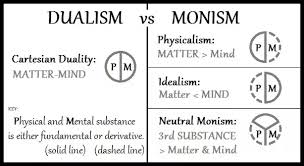
Now please excuse me if this next bit is hard to follow but I am going to briefly attempt to summarise three schools of thought about consciousness that have emerged in the modern era. The three being “dualism”, “physicalism” and “pansychism”.

“ Cartesian Dualism” dates back to seventeenth century when Rene Descartes identified the problem that has tied the great minds in knots ever since. He realised, that on the one hand, that there was nothing more undeniably obvious than the fact that we are conscious beings, everything else could be an illusion but not this, as he said “I think therefore I am”. That said he suggested that this consciousness seemingly does not obey the usual rules of science of the physical realm, as it can only be observed from within and can’t really be described except from the one who is conscious of it. From this he concluded that the mind therefore must be made from some special kind of none material stuff that are not ruled by the laws of nature and thus bequeathed by God upon humanity, thus raising us above nature in some special way.

“Dualism” began to be questioned particularly by the secular scientific community that took “physicalism” – the idea that only physical things exist – as its primary principle. The problem was though that although it rejected dualism, for many years, it could not come up a convincing alternative to it. Such views concluded that the mind and consciousness are a result of processes of the brain, but no concrete answers beyond that could be unearthed. As a result the topic became virtually taboo and was referred to as “The Hard Question”. This led in 1989 to Stuart Sutherland writing in the “International Dictionary of Psychology” that with regard to consciousness “it is impossible to specify what it is, what it does, or why it evolved. Nothing worth reading has been written on it.”

There have been developments since, most notably by Francis Crick and others who have suggested that certain neurons firing at particular frequencies are the cause of inner awareness. And there seems little doubt that there is a physical aspect to it, as awareness of who or what we are is affected by the workings of the brain. Brain injury and degenerative disease such as forms of dementia seem to prove this and certainly impact on our perception of consciousness. That said just merely putting consciousness of ourselves and life itself down to impulses within the brain seems wholly inadequate an answer to me. I’m with Sutherland on this one. There is also the problem of free will and the potential to change. It seems that “physicalism” on the whole denies this possibility, claiming we are merely subject to our biological impulses.

In more recent times another theory has developed, which is linked to some more ancient knowledge. The theory has become known as “panpsychism”, which suggest that everything in the universe might be conscious, or at least potentially conscious, or conscious when put into certain configurations. It suggest that consciousness is not merely limited to humans thus rejecting dualism and humanities privileged position.

“Pansychism” does not require a belief in some special mind substance that resides in the brain, nor does it require the suspension in the belief of the laws of physics. Meanwhile nor does it require us deny the reality of our own experiences and the strange acceptance that consciousness doesn’t exist, when it’s so obvious that it does. On the contrary, “panpsychism” suggests that consciousness is everywhere, life it is throbbing with it. It suggests in fact that consciousness is the energy of life.

“Pansychism suggest that there is a connectiveness to everything and that everything affects everything else. It also suggests that consciousness does not actually require a brain at all, that it exists beyond the brain. I would suggest from this that actually the function of the brain is not to create consciousness but to make sense of it and interpret and perhaps communicate this consciousness. Isn’t this what we are doing when we are sharing our own personal experiences of life? Isn’t this what words are for? Isn’t this what creative expression is for? And when we do so do we not somehow increase the experience for ourselves and others and bring about change?

Now you may well ask what is this guy on? And what has this got to do with his work? What’s this got to do with what happened at the wedding? What has it got to with the power of great works of art and loving action etc? Well I believe everything. As I often say I believe everything matters, every thought, every word, every deed, every interaction is interconnected and impacts on everything else. It seems to me that consciousness is everywhere and that life is throbbing with it. The purpose of religion and spirituality is to awaken us to this. If we do we may just begin to live by the “Golden Rule of Compassion” and do unto others as we would have them do to us. How could we not as we are all connected by the same consciousness, we have the same blood flowing through us and we have the same spirit animating us. We are all a part of the aliveness of life. So as we awaken to this consciousness we begin to act on it and incarnate this aliveness in our lives.