Showing posts with label consciousness. Show all posts

Monday, 20 July 2026

There must be another way — a way to unself just enough to remember each other


It is said that soon after his enlightenment that the Buddha passed a man on the road who was struck by the Buddha's extraordinary radiance and peaceful presence. The man stopped and asked, "My friend, what are you? Are you a celestial being or a god?"

"No," said the Buddha.

"Well, then, are you some kind of magician or wizard?"

Again the Buddha answered, "No."

"Are you a man?" "No."

"Well, my friend, then what are you?"

The Buddha replied, "I am awake"

The Buddha was awake, he was fully conscious to all that is and all that will ever be. He was fully integrated, he did not see himself as separate, well he did not see himself at all.

Now this is not a claim I would or could make about myself. I can be self conscious at times, aware of my short comings and frustrations. I more liberate from this than when I was younger. Some days I feel free and others I can get caught up in my shortcomings.

As a child I was very self conscious about the way I moved. This became excruciating as a teenager. I was born some of the nerve endings at the base of my spine underdeveloped. It was something akin to a less severe form of spina bifida. As a child I had to frequently go for physiotherapy and there was a period when I was not allowed to engage in any sport. I hated the feeling it engendered in me as I looked at the other kids running around in the playground, knowing I wasn’t allowed to join in.

It was a few years later when the pain really hit me though, in my mid to later teens when I was painfully aware of the way I walked. I waddled when I moved, I still do now. I remember walking down the street of the town I grew up in and whenever I saw someone walking towards me, especially teenage girls, I would stand up straight and attempt to push my feet inwards in the vain hope that they wouldn’t think that there was something wrong with me. I must have looked a right sight.

I was just so terribly self-consciousness, locked in on what I believed was wrong with me. As I look back now’ I’m not wholly convinced that the problem was my perceived physical imperfections. I suspect that if I’d been born without this physical difficulty the problem would have manifested in other areas of my life. The problem was the self-consciousness, I was locked in myself and therefore not fully conscious, I was separate and felt alone.

One thing I’ve learnt over the years is that I am not alone in this. So many suffer from self-consciousness, feel lost, lonely and cut off because they are locked in what they believe is wrong with them. Sometimes it is harder to see what is right, than what is wrong. This is a deeply lonely, isolated, way to be.

Socrates said that “The unexamined life is not worth living”. Now while not wishing to argue with the great philosopher I do wonder if the “over examined life” can prove just as worthless. It is so easy to get lost in oneself, wrapped up in our own underwear to such an extent that we do not live at all. We can become so self-conscious that we fail to become conscious of all that is and all that as ever been. It is so easy to become wrapped up in our own perceived needs that we fail to live in the world with others and then complain about feeling lonely. Yes it is important to examine ourselves, to understand who we are and what makes us tick, but that should not be an end in itself, a destination. It is a staging post in the spiritual adventure, but not an end in itself.

I have had several conversations with people recently who have been struggling with severe self-consciously, manifesting as pride. Bruce Lee observed "the core of pride is self-rejection" and Agnes Martin knew when she cautioned that pride destroys freedom, joy and creativity. The ancient Greeks had a word for the ultimate self-consciousness “hubris”; the most destructive form of pride; a pride that puts yourself at the centre of the universe. This strange and terrible kind of total self-consciousness invariably ends in self-annihilation. Think of Narcissus who was so locked into his own reflection that he drowned. The great writers of tradgedy have always understood this, from Sophocles to Shakespeare. We witness it in the monsters of history and some world leaders of our age.

One antidote to such destructiveness is to live creatively. Madeleine L’Engle wrote on this:

“Creativity is an act of discovering. The very small child, the baby, is still unself-conscious enough to take joy in discovering himself: he discovers his fingers; he gives them his complete, unself-conscious concentration.”

Continuing…

“The kind of unself-consciousness I’m thinking about becomes clearer to me when I turn to a different discipline: for instance, that of playing a Bach fugue at the piano, precisely because I will never be a good enough pianist to play a Bach fugue as it should be played. But when I am actually sitting at the piano, all there is for me is the music. I am wholly in it, unless I fumble so badly that I perforce become self-conscious. Mostly, no matter how inadequate my playing, the music is all that matters: I am outside time, outside self, in play, in joy. When we can play with the unself-conscious concentration of a child, this is: art: prayer: love.”

I think we all have activities that make us feel free. Free to be ourselves and be part of something more than our mere selves and part of something larger. I know I am when I sing freely. When I feel confident and comfortable enough with a piece of music. I can express myself freely, but freely as a part of something more than myself.

When I feel free in song I embody those words of Maria Popova:

“There must be another way — a way to unself just enough to remember each other, to grow a little more awake to this world that shimmers with wonder, of which any one self is only a fleck.”

When singing I unself just enough to feel fully part of the “Musica Universalis”, I feel a little more awake in the world that shimmers, I am one self in an incredible interconnected universe.

Negative self absorption keeps us separate, locked into all that is wrong with ourselves or all that is wrong with the world. When you look at your own reflection in the mirror, what do you see? Do you see someone that you love? Do you see who you really are? While we may see ourselves warts and all, how many of us see the beauty spots too? The self-absorption that most people I come into contact with suffer from, tends to be a deeply ingrained negative type. The preoccupation is often with what is wrong with them, with their shame, rather than how wonderful they are. Also the pride is in worrying what people think of them, that someone might just see their flaws and reject them.

This kind of self-consciousness can become so consuming that it takes over our human interactions. I wonder how many of us suffer from this kind of commentary when we meet up with people. “What will they think of me?” “How do I look?” “If I say something, will they think I’m an idiot?” and then as it continues, “He gave me a funny look, he must have thought me a fool. Why on earth did I have to make that stupid remark? Gosh I’m such a freak, they all seem to be staring at me.”

This kind of inner dialogue can be so crippling. It can haunt us from the moment we wake and continue throughout our day, eating away at our every decision. Oh and of course because we doubt ourselves and every decision we make, we assume that everyone else must be doing exactly the same thing. This kind of self-consciousness can be so crippling and it blocks us off almost entirely from the world around us. We can be consumed by this kind of self-consciousness we see the world from our own point of view and it aint a pretty one.

So what can we do about it? How do we wake up to a greater consciousness? How do we break free from this crippling self-consciousness?

In the Gospel’s Jesus taught his followers that they must lose themselves in order to be found. That by emptying ourselves of our self-absorption we begin to be filled with the spirit of neighbourliness. So that when we look deeply into the still waters we are not drawn in by narcissistic self-consciousness and loathing at our own reflection, but rather into a deeper contemplation of our shared lives. We become conscious of all that is, all that has been and all that will ever be. By opening ourselves to and for others we begin to shed that debilitating skin of self-consciousness that is so easy to become imprisoned in.

Gandhi said “The best way to find yourself is to lose yourself in service of others”

The Buddha talked of Nirvana, of being freed from the suffering that was the blight of humanity. He showed that we all suffered and that it was in seeing our suffering as individual that led to this sense of separation. He suggested that we needed to break through our suffering not only to serve others but to reach a higher state of being, true consciousness, to be awake.

Now please don’t get me wrong I am not suggesting that we do not need to know ourselves to understand how we tick. All I am saying is that we must not get stuck there, we must not get lost there and we must not see this as a destination, more a staging post on the journey. The adolescent stage I suspect. Sadly, for many folk, me included, this adolescent stage often goes well into adulthood.

I remember another antidote that probably fuels creativity suggested in Forrest Church’s “Lifecraft”, a book suggesting ways to make life an act of creation, a way to move from self-consciousness to consciousness. He offered three simple suggestions, which he called the three “E’s”, “empathy”, “ecstasy” and “enthusiasm”. The key he claimed could be found in the literal understanding of these words. “Empathy”, to suffer or feel with another; “Ecstasy”, to stand outside ourselves; “Enthusiasm”, to manifest the god (theos) within us.

Empathy is a deep felt compassion. When we open our hearts empathically to another we are courageously refusing to allow self-consciousness to stand in the way of a higher consciousness that comes into being as we feel what another is going through. In so doing we serve both ourselves and the other person, as well as that higher consciousness beyond our singular selves.

Now ecstasy has often been misunderstood as some kind of hedonistic state and therefore self- indulgent, it is far from this. In its truest sense what it actually does is takes us out of ourselves and lifts us beyond the confines of ourselves. In so doing we transcend our self-consciousness and enter a realm in which purpose begins to emerge and meaning is found.

Enthusiasm means to be filled with spirit, with holy energy. Enthusiasm allows us to be fully involved and engaged in whatever it is we are doing. It allows us to see beyond the confines we have created. Forrest himself states that “Here, once again, consciousness displaces self-consciousness. We escape from our mirrored room. Its mirrors turn into windows. Or the pond grows so still that we can see beyond our own reflection to the trees and clouds and birds and sun. There is, by the way, no higher form of spiritual practice. When we step out of our own shadow, consciousness replaces self-consciousness.”

In so doing we are set free to walk with others in our own faltering ways. Instead of being lost in what we believe is wrong with us we are set free to do what we can in this our shared world and in so doing we encourage others to do the same, as perfectly imperfect children of God.

For me the purpose of the spiritual life is to develop a deepening sense of connection. We all have our troubles and our worries either within ourselves, those around us or wider world. We need to see them for what they are, we need to acknowledge the truth, but we must not get stuck there, for that will paralyse us and stop us doing what we can. We cannot change the way the world is but that need not prevent us from doing what we can do and in doing so we will grow spiritually as we become integrated into all that has been, all that exists and all that will ever be.

As a kind of conclusion I’d like to leave you with one final thought. I think that so much of modern spiritually gets it wrong because it is seeking the wrong thing. There is so much talk of finding ourselves, when in actual fact what we ought to be doing is losing ourselves. What we ought to be striving for, I believe, is integration and remove those aspects within ourselves that block this. We all ask the question “Who am I?” when really we ought to asking is “How am I doing? And if we are still feeling utterly dis-connected we need to ask why? And how can I integrate once again? You see if we can begin to integrate with all that is, all that has been and all that has ever been we begin to truly cohere. In doing so we transcend our self-consciousness and become conscious. We become spiritually mature. We become like the Buddha, awake.

So how conscious are you today? Are you truly awake?

If not. I have found a way to unself just enough so that we remember each other, to remember we are part of something wonderful and greater than our little selves. To feel a little more awake in this world that shimmers. To know that our single selves are just a fleck, but a vital part of the “Musica Universalis”

“There must be another way — a way to unself just enough to remember each other”

Please find below a devotion based on the material in this "Blogspot"


Monday, 4 March 2024

The Three E’s Empathy, Ecstasy and Enthusiasm: Turning Self Consciousness into Consciousness

I was in the park with Molly on Monday morning. I was feeling tired and somewhat run down. I had woken up with a bad throat. Sunday had been a long day, three services and several other activities. There weren’t many dogs around for Molly to play with so she made her own fun. She is such a happy little dog, full of life and character, at ease with herself and life itself. After a while a woman appeared with her tiny dark cavalier spaniel. I have passed the woman in the street many times over the time I have had Molly. Her little dog was somewhat unfriendly towards Molly as a puppy, the woman said her dog didn’t like puppies, or men for that matter. Even as Molly became an adult the woman never stopped for them to get to know each other. It was different this time though. The woman came talking to me, she seemed upset. She told me her dog was unwell, in fact she had heart failure, she was only eight years old. It was her fifth Cavalier and two of her previous ones had died the same way. I told her I had seen her dog with a walker a few days before and I pointed out to the walker that there something wrong with her. The walker had informed the woman and she had taken the dog to the vet. The woman told me that she was trying to get her dog to go to the toilet, but didn’t want to walk. Then Molly brought her to life and she ran around and played for a little while, before they went off to the coffee shop. The poor woman has some big decisions to make over the next few days, as she doesn’t want her little dog to suffer. I felt for her.

As I walked away I was thinking about the three keys of the spiritual life that Forrest Church had identified, “Empathy”, “Ecstasy” and “Enthusiasm”. They are essential antitdotes to the blight of self-consciousness and lead to connection and consciousness. I was awake, I was conscious that day, despite feeling somewhat low and tired in mood. I had been a few days earlier when I noticed the little spaniel struggling. Molly had too, her empathy and enthusiasm had brought a few moments of ecstasy to that sweet little dog. We were at ease with ourselves, we knew ourselves and thus we were not slaves to ourselves, we were instead awake to the life around us.

Socrates said that “The unexamined life is not worth living”. Now while not wishing to argue with the great philosopher I do wonder if the “over examined life” can prove just as worthless. It is so easy to get lost in ourselves, wrapped up in our own underwear, to such an extent that we do not live at all. We can become so self-conscious that we fail to become conscious of all that is and all that has ever been. It is so easy to become wrapped up in our own perceived needs that we fail to live in the world with others and then complain about feeling lonely. Yes it is important to examine ourselves, to understand who we are and what makes us tick, but that should not be an end in itself, a destination. It is a staging post in the spiritual adventure, but not an end in itself.

I remember at last year’s “Ministry in the Making” I was asked to speak on the purpose of ministry, which literally means to serve. The college principal was somewhat concerned that while the students had a great deal of self understanding this in itself was not all that the spiritual life is about. That it is not just about knowing and understand ourselves. Self awareness and spirituality is something that comes to life in the real world, that its purpose is to fit us to be of maximum usefulness in this life. I thought about my time in the park with Molly, I probably do as much ministry there as anywhere else in life. Monday morning proved that once again.

The spiritual life is about love. Yes love for ourselves, but also one another and life itself and of course whatever it is we believe is at the core of all, what I call God. Sadly sometimes spirituality can tend to be too inner focused and a turning away from life. Such approaches can make us even more self focused and instead of setting us free, enchains us even more.

So yes I agree with Socrates, that “the unexamined life is not worth living”. That said the “over examined life” can prove just as worthless. It can easily become inhibiting and can lead to a kind of self-consciousness that can become so consuming that it takes over our human interactions. I wonder how many of us suffer from this kind of commentary when we meet up with people. “What will they think of me?” “How do I look?” “If I say something, will they think I’m an idiot?” and then as it continues, “He gave me a funny look, he must have thought me a fool. Why on earth did I have to make that stupid remark? Gosh I’m such a freak, they all seem to be staring at me.”

I was talking with a friend on Tuesday morning who described some such interaction at a work event the other day. She found herself becoming consumed by such an inner dialogue. Thankfully she was able to step out of herself and begin to make contact with others, this helped them do the same thing.

This though is not always the case. This kind of self conscious inner dialogue can be so crippling. It can haunt us from the moment we wake and continue throughout our day, eating away at our every decision. Oh and of course because we doubt ourselves and every decision we make, we assume that everyone else must be doing exactly the same thing. This kind of self-consciousness can be so crippling and it blocks us off almost entirely from the world around us. We can become so consumed by this kind of self-consciousness that we see the world entirely from our own point of view, excluding all others.

One of my great frustrations with a lot of modern “so called spirituality” is that it does not seem to be about relationships at all. It seems to be all about the self, almost about protecting the self, from the so called “messiness” of living. It seems to have become almost narcissistic in its nature. Maybe that’s why it can seem so appealing. The truth is of course that all we ever achieve in blocking ourselves off from the messiness, from circling our spiritual wagons, is increase the loneliness and the emptiness.

The spiritual life is about relationship. We need to be in what I have often heard called right relationship, with ourselves, with others and with whatever it is we connects all of life, what is often called the Divine, to live spiritually alive.

I can usually get a good measure as to where I am at spiritually by simply checking where I am at relationally with myself, with others and with God, they are all interconnected and inter related.

So what can we do about it? How do we wake up to a greater consciousness? How do we break free from this crippling self-consciousness? How do we become better inter-related.

According to the Gospel’s Jesus taught his followers that they must lose themselves in order to be found. That by emptying ourselves of our self-absorption we begin to be filled with the spirit of neighbourliness. So that when we look deeply into the still waters we are not drawn in by narcissistic self-consciousness and loathing at our own reflection, but rather into a deeper contemplation of our shared lives. We become conscious of all that is, all that has been and all that will ever be. By opening ourselves to and for others we begin to shed that debilitating skin of self-consciousness that is so easy to become imprisoned in.

Gandhi said “The best way to find yourself is to lose yourself in service of others”

The Buddha talked of Nirvana, of being freed from the suffering that was the blight of humanity. He showed that we all suffered and that it was in seeing our suffering as individual that led to this sense of separation. He suggested that we needed to break through our suffering not only to serve others but to reach a higher state of being, true consciousness, to be awake to the life in which we live.

Now please don’t get me wrong this morning I am not suggesting that we do not need to know ourselves to understand how we tick, “The unexamined life is not worth living”. All I am saying is that we must not get stuck there, we must not get lost there and we must not see this as a destination, more a staging post on the journey. The adolescent stage I suspect. Sadly for many folk, me included, this adolescent stage often goes well into adulthood.

So how do we move from self-consciouness to consciousness. Well as I mentioned earlier Forrest Church in his wonderful book “Lifecraft” offered three simple suggestions, which he called the three “E’s”, “empathy”, “ecstasy” and “enthusiasm”. The key he claimed could be found in the literal understanding of these words. “Empathy”, to suffer or feel with another; “Ecstasy”, to stand outside ourselves; “Enthusiasm”, to manifest the god (theos) within us.

“Empathy” is a deep felt compassion. When we open our hearts empathically to another we are courageously refusing to allow self-consciousness to stand in the way of a higher consciousness that comes into being as we feel what another is going through. In so doing we serve both ourselves and the other person, as well as that higher consciousness beyond our singular selves.

Now “Ecstasy” has often been misunderstood as some kind of hedonistic state and therefore self- indulgent, it is far from this. In its truest sense what it actually does is takes us out of ourselves and lifts us beyond the confines of ourselves. In so doing we transcend our self-consciousness and enter a realm in which purpose begins to emerge and meaning is found.

“Enthusiasm” means to be filled with spirit, with holy energy. Enthusiasm allows us to be fully involved and engaged in whatever it is we are doing. It allows us to see beyond the confines we have created. Forrest himself states that “Here, once again, consciousness displaces self-consciousness. We escape from our mirrored room. Its mirrors turn into windows. Or the pond grows so still that we can see beyond our own reflection to the trees and clouds and birds and sun. There is, by the way, no higher form of spiritual practice. When we step out of our own shadow, consciousness replaces self-consciousness.”

In so doing we are set free to walk with others in our own faltering ways. Instead of being lost in what we believe is wrong with us we are set free to do what we can in this our shared world and in so doing we encourage others to do the same, as perfectly imperfect children of God.

For me the purpose of the spiritual life is to develop a deepening sense of connection. We all have our troubles and our worries either within ourselves, those around us or wider world. We need to see them for what they are, we need to acknowledge the truth, but we must not get stuck there, for that will paralyse us and stop us doing what we can. We cannot change the way the world is but that need not prevent us from doing what we can do and in doing so we will grow spiritually as we become integrated into all that has been, all that exists and all that will ever.

So much of modern spiritually gets it wrong because it is seeking the wrong thing. There is so much talk of finding ourselves, when in actual fact what we ought to be doing is losing ourselves. What we ought to be striving for, I believe, is integration and remove those aspects within ourselves that block this. We all ask the question “Who am I?” when really we ought to asking is “How am I doing? And if we are still feeling utterly dis-connected we need to ask why? And how can I integrate once again? You see if we can begin to integrate with all that is, all that has been and all that has ever been we begin to truly cohere. In doing so we transcend our self-consciousness and become conscious. We become spiritually mature. We wake up to the world in which live and breathe and share our being and we will know the joy of living, in all its mystery.

Below is a video devotion based on the material in this "blogspot"


Monday, 27 February 2023

Are You Awake? Consciousness and Self-Consciousness

Sunday’s have been extra busy these last few months. After leading worship Molly and myself have been going to puppy school. Before Christmas she passed puppy class and these last few weeks we have been working towards the Bronze Award of “The Kennel Club Good Citizen Dog Scheme”. When working with her at home she has been doing great. The problem is when she is with other dogs; when Molly is with other dogs she just wants to play. All the commands have been going well, except recall. In the park this one seems the most difficult.

Last Sunday was the examination, for the Bronze award. Things did not begin well. For some reason she chose this Sunday to turn her nose up at the training treats I had. Thankfully one of the other owners leant we some cheesy ones which she loved.

The assessment began. I found myself feeling anxious about it. It actually felt worse than my driving test, but I kept centering myself and saying “The fear prayer” over and over, under my breath. “God please remove my fear and direct my attention to what you would have me be. Molly was her usual calm self. Just playing in-between the different tests. Things went well. There was a moment during the stay command, when the dogs are to stay still for a whole minute. A motorbike went past and misfired loudly, this caused a couple of dogs to move, but Molly just looked up, and stayed still. The only test that proved difficult was recall, I knew that this would be the case. She did, just not with the rushed enthusiasm of the other dogs. She came, but slowly at her own pace.

We passed the exam and will now move onto the silver award in a few weeks time. An observer of the test had been the woman who had instructed us during the first puppy classes. She said some lovely things to me about Molly and our relationship and how far she had come, saying that we must have been working hard on our relationship. I cannot tell you how much this meant to me.

One thing I have noticed since Molly came into my life has been an increase in old feelings of self-consciousness. Not so much about myself but how others perceive me, through Molly. People do offer comments all the time about her and I have taken on board the odd critical one. On the whole though she is a lovely dog, very calm, friendly and sociable, pretty fearless too. She is smart and knows her own mind. She is not at all self conscious, she is fully conscious of herself and the world in which she lives and breathes and enjoys her being. She is teaching me so much. Molly is a treasure and fully awake.

As I was reflecting about Sunday this week I was reminded of a story attributed to the Buddha.

It is said that soon after his enlightenment that the Buddha passed a man on the road who was struck by the Buddha's extraordinary radiance and peaceful presence. The man stopped and asked, "My friend, what are you? Are you a celestial being or a god?"

"No," said the Buddha.

"Well, then, are you some kind of magician or wizard?"

Again the Buddha answered, "No."

"Are you a man?" "No."

"Well, my friend, then what are you?"

The Buddha replied, "I am awake"

The Buddha was awake, he was fully conscious to all that is and all that will ever be. He was fully integrated, he did not see himself as separate, well he did not see himself at all.

Now this is not a claim I would or could make about myself. I believe I am more awake these days than I have ever been in the past, but I am very aware of a sense of separation from time to time. That said I am more conscious than I ever was before. There is a simple reason for this, I am less self-conscious than I once was. Of course, I am not yet the perfectly self-actualised enlightened being. It is highly unlikely that I ever will be, but I am not crippled by self consciousness these days, it does not paralyse me. I feel more connected, at one, with all that is, than at any other time in my life. I feel conscious, I feel awake, but I used to be terribly self-consciousness and I suspect that it was this that was the very root cause of so much of that aching loneliness that used to eat away at me. I felt, separate, cut off, alone. How many of us feel like this, it is so much the plague of the modern age.

It has been interesting to notice how I have been revisited by some of these feelings recently. I was terribly self conscious as a child, there are many reasons for this, or should I say I found many reasons for it. One being a birth defect. I was born with some of the nerve endings at the base of my spine being underdeveloped. It was something akin to a less severe form of spina bifida. As a child I had to frequently go for physiotherapy and there was a period when I was not allowed to engage in any sport. I hated the feeling it engendered in me as I looked at the other kids running around in the playground, knowing I wasn’t allowed to join in.

It was a few years later when the pain really hit me though, in my mid to later teens when I was painfully aware of the way I walked. I remember walking down the street of the town I grew up in and whenever I saw someone walking towards me I would stand up straight and attempt to push my feet inwards in the vain hope that they wouldn’t think that there was something wrong with me. I must have looked a right sight.

I was just so terribly self-consciousness; I was just so locked in on what I believed was wrong with me. Today I have come to understand that the problem was not my perceived physical imperfections. I suspect that if I’d been born without this physical difficulty the problem would have manifested in other areas of my life. The problem was the self-consciousness, I was locked in myself and therefore not fully conscious, I was separate and felt alone.

One thing I’ve learnt over the years is that I am not alone in this. So many of us suffer from forms of self-consciouness. We feel lost, lonely and cut off because we are locked in what we believe is wrong with us. Sometimes it is harder to see what is right, than what is wrong. This is a deeply lonely, isolated, way to be.

Socrates said that “The unexamined life is not worth living”. Now while not wishing to argue with the great philosopher I do wonder if the “over examined life” can prove just as worthless. It is so easy to get lost in oneself, wrapped up in our own underwear to such an extent that we do not live at all. We can become so self-conscious that we fail to become conscious of all that is and all that has ever been. It is so easy to become wrapped up in our own perceived needs that we fail to live in the world with others and then complain about feeling lonely. Yes it is important to examine ourselves, to understand who we are and what makes us tick, but that should not be an end in itself, a destination. It is a staging post in the spiritual adventure, but not an end in itself.

Now this form of self-absorption has been labelled Narcissism. You remember the ancient Greek story of the boy who fell so in love with his own reflection that he fell into the water and drowned. I’m not sure that it is entirely correct to label this form of self-consciousness this way. There seems very little love there at all. Quite the opposite in fact the pre-occupation is with what is wrong. When you look at your own reflection in the mirror, what do you see? Do you see someone that you love? Do you see who you really are? While we may see ourselves warts and all, how many of us see the beauty spots too? The self-absorption that most people I come into contact with suffer from tends to be a deeply ingrained negative type. The preoccupation is often with what is wrong with them, with their shame, rather than how wonderful they are.

This kind of self-consciousness can become so consuming that it takes over our human interactions. I wonder how many of us suffer from this kind of commentary when we meet up with people. “What will they think of me?” “How do I look?” “If I say something, will they think I’m an idiot?” and then as it continues, “He gave me a funny look, he must have thought me a fool. Why on earth did I have to make that stupid remark? Gosh I’m such a freak, they all seem to be staring at me.”

This kind of inner dialogue can be so crippling. It can haunt us from the moment we wake and continue throughout our day, eating away at our every decision. Oh and of course because we doubt ourselves and every decision we make, we assume that everyone else must be doing exactly the same thing. This kind of self-consciousness can be so crippling and it blocks us off almost entirely from the world around us. When we become consumed by this kind of self-consciousness we see the world from our own point of view and it aint a pretty one.

So what can we do about it? How do we wake up to a greater consciousness? How do we break free from this crippling self-consciousness?

In the Gospel’s Jesus taught his followers that they must lose themselves in order to be found. That by emptying ourselves of our self-absorption we begin to be filled with the spirit of neighbourliness. So that when we look deeply into the still waters we are not drawn in by narcissistic self-consciousness and loathing at our own reflection, but rather into a deeper contemplation of our shared lives. We become conscious of all that is, all that has been and all that will ever be. By opening ourselves to and for others we begin to shed that debilitating skin of self-consciousness that is so easy to become imprisoned in.

Gandhi said “The best way to find yourself is to lose yourself in service of others”

The Buddha talked of Nirvana, of being freed from the suffering that was the blight of humanity. He showed that we all suffered and that it was in seeing our suffering as individual that led to this sense of separation. He suggested that we needed to break through our suffering not only to serve others but to reach a higher state of being, true consciousness, to be awake.

Now please don’t get me wrong I am not suggesting that we do not need to know ourselves to understand how we tick. All I am saying is that we must not get stuck there, we must not get lost there and we must not see this as a destination, more a staging post on the journey. The adolescent stage I suspect. Sadly for many folk, me included, this adolescent stage often goes well into adulthood.

So how do we move from self-consciouness to consciousness. Well Forrest Church in his wonderful book “Lifecraft” offered three simple suggestions, which he called the three “E’s”, “empathy”, “ecstasy” and “enthusiasm”. The key he claimed could be found in the literal understanding of these words. “Empathy”, to suffer or feel with another; “Ecstasy”, to stand outside ourselves; “Enthusiasm”, to manifest the god (theos) within us.

Empathy is a deep felt compassion. When we open our hearts empathically to another we are courageously refusing to allow self-consciousness to stand in the way of a higher consciousness that comes into being as we feel what another is going through. In so doing we serve both ourselves and the other person, as well as that higher consciousness beyond our singular selves.

Now ecstasy has often been misunderstood as some kind of hedonistic state and therefore self- indulgent, it is far from this. In its truest sense what it actually does is takes us out of ourselves and lifts us beyond the confines of ourselves. In so doing we transcend our self-consciousness and enter a realm in which purpose begins to emerge and meaning is found.

Enthusiasm means to be filled with spirit, with holy energy. Enthusiasm allows us to be fully involved and engaged in whatever it is we are doing. It allows us to see beyond the confines we have created. Forrest himself states that “Here, once again, consciousness displaces self-consciousness. We escape from our mirrored room. Its mirrors turn into windows. Or the pond grows so still that we can see beyond our own reflection to the trees and clouds and birds and sun. There is, by the way, no higher form of spiritual practice. When we step out of our own shadow, consciousness replaces self-consciousness.”

In so doing we are set free to walk with others in our own faltering ways. Instead of being lost in what we believe is wrong with us we are set free to do what we can in this our shared world and in so doing we encourage others to do the same, as perfectly imperfect children of God.

For me the purpose of the spiritual life is to develop a deepening sense of connection. We all have our troubles and our worries either within ourselves, those around us or our wider world. We need to see them for what they are, we need to acknowledge the truth, but we must not get stuck there, for that will paralyse us and stop us doing what we can. We cannot change the way the world is but that need not prevent us from doing what we can do and in doing so we will grow spiritually as we become integrated into all that has been, all that exists and all that will ever.

So there you have a solution to self-consciousness, a way to develop consciousness, the three “E’s”, “empathy”, “ecstasy” and “enthusiasm”. “Empathy”, to suffer or feel with another; “Ecstasy”, to stand outside ourselves; “Enthusiasm”, to manifest the god (theos) within us.

As a kind of conclusion I’d like to leave you with one final thought. I think that so much of modern spiritually gets it wrong because it is seeking the wrong thing. There is so much talk of finding ourselves, when in actual fact what we ought to be doing is losing ourselves. What we ought to be striving for, I believe, is integration and remove those aspects within ourselves that block this. We all ask the question “Who am I?” when really we ought to asking is “How am I doing? And if we are still feeling utterly dis-connected we need to ask why? And how can I integrate once again? You see if we can begin to integrate with all that is, all that has been and all that has ever been we begin to truly cohere. In doing so we transcend our self-consciousness and become conscious. We become spiritually mature. We become like the Buddha, awake.

I was thinking this as I watched Molly rolling and dancing and frolicking with several other dogs in the park the other day, what a joy, what a freedom, oh to be so awake.

So how conscious are you today? Are you truly awake?

Below is a video devotion based on the material in this "Blogspot"


Sunday, 9 July 2017

The Aliveness of Things

Last Friday I had the joy of conducting the wedding of two young women who have been attending worship with us for a while. It was a truly beautiful occasion, full of joy and full of love. At the end of the service many of those present thanked me for the service and told me how much they loved it. Some of the comments will live with me for a long time. One in particular I believe will keep me going for quite some time. I had a long and continuing conversation with one of the guests, but it was the first thing that he said that struck powerfully. He said something like “I gave up on religion 50 years ago, but something happened today. This service has awoken something in me. Thank you.” He thanked me, when in reality the thanks are all mine. It is for moments like this that I do this work. It’s why I’m here I believe. It’s why we are all here, to discover the truth that life is more than mere material processes.  We are called, I believe, to help awaken one another to the aliveness of being, to raise one another’s consciousness.

I love the aliveness of things. I feel that the last few years of my life has been all about awakening to this aliveness of things. This kind of universal consciousness at the core of all life, what the western religions might call God. I witness it in all life, I see it in human creativity too, particularly art. I love the aliveness in words, in art, in music or whatever is creative. We experience the works in the moment, whether individually or collectively and yet, especially the great works, are somehow timeless. They possess a consciousness of their own, as their aliveness is not only in the moment they were written or recorded or created, but continuing on and on into eternity. If life has revealed anything to me it has awoken me to the fact that things are much more than merely the sum of their parts, they have a power beyond the mere limits of the material they are formed from and that they grow in power and meaning beyond the limits of the creators imaginations. That aliveness of course was there before the creation grew in the creators imagination; it is vital to remember, of course. all that has occurred before those moments of creation; all the incredible aliveness that allowed them to be created. I love the aliveness of things; I love the aliveness of my mere thoughts and feelings, knowing that they come from something far more than the mere chemical reactions in my brain or even my singular consciousness; I love the aliveness of things they are so much more than the sum of their parts.

It’s not just in great works of human creation that I witness this same aliveness, I see it in the ordinary in the loving interaction, in the small gesture of loving kindness and I see it manifest in the natural world. I see powerfully a simple loving universal consciousness at work in life, it enlivens and empowers me. It gives my life meaning and makes my life worth living, hey even dying, for.

Now there are many who would dispute this truth, I would have done at one time or another and who knows I may do so again in the future. Many suggest that there is no such thing as consciousness, that it is merely a creation of the brain, a stage of the evolutionary process. What do you think? What do you think about consciousness? Is it merely a creation of the functions of the brain?

In philosophical circles consciousness is considered the “Hard Problem” as it seems impossible to solve adequately. The great minds don’t seem to have come up with a satisfactory answer to what exactly it is and or why it exists. In fact many of the great minds seem to fall out about it all the time. I’m sure that many would scoff at my unscientific conclusion about life and yet it doesn’t sound as crazy as some of the great theories of the so called great minds, who have equated we humans with “lumbering robots” and or asked why we are not just zombies or to quote that wonderful short story of science fiction, simply thinking meat. We are more than merely this though, surely we are. Reductionist world views seem to miss what is so clearly in front of its eyes.

The truth is of course that maybe, just maybe we won’t ever come up with a satisfactory answer, to what we call “consciousness”. Maybe one day we will not know the answer to everything. It is possible, I suppose, that one day we will, and it shouldn’t stop us striving for the answers. Our human consciousness after is the very thing that drives us, compels us to do so. Let’s just never forget to do what Mary Oliver suggested, let’s remember to pay attention to beauty of the daisy and all life for that matter. For I believe that same consciousness is at the heart of it all, connecting it all, bringing the aliveness to life.

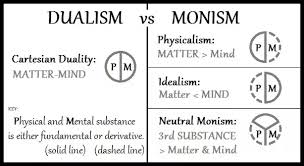
Now please excuse me if this next bit is hard to follow but I am going to briefly attempt to summarise three schools of thought about consciousness that have emerged in the modern era. The three being “dualism”, “physicalism” and “pansychism”.

“ Cartesian Dualism” dates back to seventeenth century when Rene Descartes identified the problem that has tied the great minds in knots ever since. He realised, that on the one hand, that there was nothing more undeniably obvious than the fact that we are conscious beings, everything else could be an illusion but not this, as he said “I think therefore I am”. That said he suggested that this consciousness seemingly does not obey the usual rules of science of the physical realm, as it can only be observed from within and can’t really be described except from the one who is conscious of it. From this he concluded that the mind therefore must be made from some special kind of none material stuff that are not ruled by the laws of nature and thus bequeathed by God upon humanity, thus raising us above nature in some special way.

“Dualism” began to be questioned particularly by the secular scientific community that took “physicalism” – the idea that only physical things exist – as its primary principle. The problem was though that although it rejected dualism, for many years, it could not come up a convincing alternative to it. Such views concluded that the mind and consciousness are a result of processes of the brain, but no concrete answers beyond that could be unearthed. As a result the topic became virtually taboo and was referred to as “The Hard Question”. This led in 1989 to Stuart Sutherland writing in the “International Dictionary of Psychology” that with regard to consciousness “it is impossible to specify what it is, what it does, or why it evolved. Nothing worth reading has been written on it.”

There have been developments since, most notably by Francis Crick and others who have suggested that certain neurons firing at particular frequencies are the cause of inner awareness. And there seems little doubt that there is a physical aspect to it, as awareness of who or what we are is affected by the workings of the brain. Brain injury and degenerative disease such as forms of dementia seem to prove this and certainly impact on our perception of consciousness. That said just merely putting consciousness of ourselves and life itself down to impulses within the brain seems wholly inadequate an answer to me. I’m with Sutherland on this one. There is also the problem of free will and the potential to change. It seems that “physicalism” on the whole denies this possibility, claiming we are merely subject to our biological impulses.

In more recent times another theory has developed, which is linked to some more ancient knowledge. The theory has become known as “panpsychism”, which suggest that everything in the universe might be conscious, or at least potentially conscious, or conscious when put into certain configurations. It suggest that consciousness is not merely limited to humans thus rejecting dualism and humanities privileged position.

“Pansychism” does not require a belief in some special mind substance that resides in the brain, nor does it require the suspension in the belief of the laws of physics. Meanwhile nor does it require us deny the reality of our own experiences and the strange acceptance that consciousness doesn’t exist, when it’s so obvious that it does. On the contrary, “panpsychism” suggests that consciousness is everywhere, life it is throbbing with it. It suggests in fact that consciousness is the energy of life.

“Pansychism suggest that there is a connectiveness to everything and that everything affects everything else. It also suggests that consciousness does not actually require a brain at all, that it exists beyond the brain. I would suggest from this that actually the function of the brain is not to create consciousness but to make sense of it and interpret and perhaps communicate this consciousness. Isn’t this what we are doing when we are sharing our own personal experiences of life? Isn’t this what words are for? Isn’t this what creative expression is for? And when we do so do we not somehow increase the experience for ourselves and others and bring about change?

Now you may well ask what is this guy on? And what has this got to do with his work? What’s this got to do with what happened at the wedding? What has it got to with the power of great works of art and loving action etc? Well I believe everything. As I often say I believe everything matters, every thought, every word, every deed, every interaction is interconnected and impacts on everything else. It seems to me that consciousness is everywhere and that life is throbbing with it. The purpose of religion and spirituality is to awaken us to this. If we do we may just begin to live by the “Golden Rule of Compassion” and do unto others as we would have them do to us. How could we not as we are all connected by the same consciousness, we have the same blood flowing through us and we have the same spirit animating us. We are all a part of the aliveness of life. So as we awaken to this consciousness we begin to act on it and incarnate this aliveness in our lives.

Saturday, 23 August 2014

Are You Awake? Consciousness and Self-Consciousness

It is said that soon after his enlightenment that the Buddha passed a man on the road who was struck by the Buddha's extraordinary radiance and peaceful presence. The man stopped and asked, "My friend, what are you? Are you a celestial being or a god?"

"No," said the Buddha.

"Well, then, are you some kind of magician or wizard?"

Again the Buddha answered, "No."

"Are you a man?" "No."

"Well, my friend, then what are you?"

The Buddha replied, "I am awake"

The Buddha was awake, he was fully conscious to all that is and all that will ever be. He was fully integrated, he did not see himself as separate, well he did not see himself at all.

Now this is not a claim I would or could make about myself. I believe I am more awake these days than I have ever been in the past, but I am very aware of a sense of separation from time to time. That said I am more conscious than I ever was before. There is a simple reason for this I am less self-conscious than I once was. I feel more connected, at one, with all that is, than at any other time in my life. I feel conscious, I feel awake, but I used to be terribly self-consciousness and I suspect that it was this that was the very root cause of so much of that aching loneliness that used to eat away at me. I felt, separate, cut off, alone. How many of us feel like this, it is so much the plague of the modern age.

The other day I was chatting with my mum, it was a wonderful conversation. She was doing most of the talking. This is the case in most of the conversation I have these days. I like it this way. “Now the ears of my ears are awake.”

We got talking about childhood things and what life was like back then. I asked her a question, which I haven’t asked for years about a birth defect I suffered from. She went into detail explaining how when I was born some of the nerve endings at the base of my spine were underdeveloped. It was something akin to spina bifida, but in a less severe form. As a child I had to frequently go for physiotherapy and there was a period when I was not allowed to engage in any sport. I hated the feeling it engendered in me as I looked at the other kids running around in the playground, knowing I wasn’t allowed to join in.

It was a few years later when the pain really hit me though, in my mid to later teens when I was painfully aware of the way I walked. I waddled when I moved, I still do now. When it was my time to be teased at school I would be called "Penguin, cripple, crip, criptic acid and spina bifida." I remember walking down the street of the town I grew up in and whenever I saw someone walking towards me I would stand up straight and attempt to push my feet inwards in the vain hope that they wouldn’t think that there was something wrong with me. I must have looked a right sight.

I was just so terribly self-consciousness. I was just so locked in on what I believed was wrong with me. I’ve been thinking about this over the last few days and do you know what I’m not wholly convinced that the problem was my perceived physical imperfections. I suspect that if I’d been born without this physical difficulty the problem would have manifested in other areas of my life. The problem was the self-consciousness, I was locked in myself and therefore not fully conscious, I was separate and felt alone.

One thing I’ve learnt over the years is that I am not alone in this. So many of us suffer from this from of self-consciouness. We feel lost, lonely and cut off because we are locked in what we believe is wrong with us. Sometimes it is harder to see what is right, than what is wrong. This is a deeply lonely, isolated, way to be.

Socrates said that “The unexamined life is not worth living”. Now while not wishing to argue with the great philosopher I do wonder if the “over examined life” can prove just as worthless. It is so easy to get lost in oneself, wrapped up in our own underwear to such an extent that we do not live at all. We can become so self-conscious that we fail to become conscious of all that is and all that as ever been. It is so easy to become wrapped up in our own perceived needs that we fail to live in the world with others and then complain about feeling lonely. Yes it is important to examine ourselves, to understand who we are and what makes us tick, but that should not be an end in itself, a destination. It is a staging post in the spiritual adventure, but not the final destination.

Some label extreme self-absorption as Narcissism. A word taken from name of a boy of ancient Greek mythology named Narcissus who fell so in love with his own reflection that he fell into the water and drowned. Now I don't believe that it is entirely correct to name the type of self-consciousness I am discussing here as Narcissistic self-love. There seems very little love here at all. Quite the opposite in fact the pre-occupation is with what is wrong. What I'm describing is a deep form of self hatred and or loathing, not love.

When you look at your own reflection in the mirror, what do you see? Do you see someone that you love? Do you see who you really are? While many of us see ourselves warts and all, how many of us see the beauty spots too? The kind of self-absorption that most people I come into contact with suffer from tends to be a deeply ingrained negative type. The preoccupation is often with what is wrong with them, with their shame, rather than how wonderful they are. This is certainly not what Narcissus suffered from.

This kind of self-consciousness can become so consuming that it takes over our every human interactions. I wonder how many of us suffer from the following kind of commentary when we meet up with people. “What will they think of me?” “How do I look?” “If I say something, will they think I’m an idiot?” and then a little later, “He gave me a funny look, he must have thought me a fool. Why on earth did I have to make that stupid remark? Gosh I’m such a freak, they all seem to be staring at me.”

This kind of inner dialogue can be so crippling. It can haunt us from the moment we wake and continue throughout our day, eating away at our every decision. Oh and of course because we doubt ourselves and every decision we make, we assume that everyone else must be doing exactly the same thing. This kind of self-consciousness can be so inhibiting, so much so that it can block us off almost entirely from the world around us. We can become utterly consumed by this kind of self-consciousness, leading to us seeing the world entirely from this point of view. When we do the world does not look like a pretty place at all.

So what can we do about it? How do we wake up to a greater consciousness? How do we break free from this crippling self-consciousness?

In the Gospel accounts Jesus taught his followers that they must lose themselves in order to be found. This beautiful paradox taught that by emptying ourselves of our self-absorption we begin to be filled with the spirit of neighbourliness. So that when we look deeply into the still waters we are not drawn in by narcissistic self-consciousness and loathing at our own reflection, but rather into a deeper contemplation of our shared lives. We become conscious of all that is, all that has been and all that will ever be. By opening ourselves to and for others we begin to shed that debilitating skin of self-consciousness that it is so easy to become imprisoned in.

Gandhi said “The best way to find yourself is to lose yourself in service of others”

The Buddha talked of Nirvana, of being freed from the suffering that was the blight of humanity. He showed that we all suffered and that it was in seeing our suffering as individual that led to this sense of separation. He suggested that we needed to break through our suffering not only to serve others but to reach a higher state of being, true consciousness, to be awake.

Now please don’t get me wrong I am not suggesting that we neglect ourselves and that we do not need to understand how we tick. All I am saying is that we must not get stuck there, we must not get lost there and we must not see this as a destination, more a staging post on the journey. The adolescent stage I suspect. Sadly for many folk, me included, this adolescent stage often goes on well into adulthood.

So how do we move from self-consciouness to consciousness. How do we lose ourselves so that we can be found? Well Forrest Church in his wonderful book “Lifecraft” offered three simple suggestions, which he called the three “E’s”, “empathy”, “ecstasy” and “enthusiasm”. The key he claimed could be found in the literal understanding of these words. “Empathy”, to suffer or feel with another; “Ecstasy”, to stand outside ourselves; “Enthusiasm”, to manifest the god (theos) within us.

Empathy is a deep felt compassion. When we open our hearts empathically to another we are courageously refusing to allow self-consciousness to stand in the way of a higher consciousness that comes into being as we feel what another is going through. In so doing we serve both ourselves and the other person, as well as that higher consciousness beyond our singular selves.

Ecstasy is one of those words that has often been misunderstood as some kind of hedonistic state and therefore self- indulgent, it is far from this. In its truest sense what it actually does is take us out of ourselves and lifts us beyond our self created confines. In so doing we transcend our self-consciousness and enter a realm in which purpose begins to emerge and meaning is found.

Enthusiasm means to be filled with spirit, with holy energy. Enthusiasm allows us to be fully involved and engaged in whatever it is we are doing. It allows us to see beyond the confines we have created. Forrest himself states, drawing on the imagery of Narcissus, that “Here, once again, consciousness displaces self-consciousness. We escape from our mirrored room. Its mirrors turn into windows. Or the pond grows so still that we can see beyond our own reflection to the trees and clouds and birds and sun. There is, by the way, no higher form of spiritual practice. When we step out of our own shadow, consciousness replaces self-consciousness.”

Experience has revealed to me that in so doing we are set free to walk with others in our own faltering ways. Instead of being lost in what we believe is wrong with us we are set free to do what we can in this our shared world and in so doing we encourage others to do the same, as perfectly imperfect children of God, children of Love.

As I understand it the whole purpose of the spiritual life is to develop a deepening sense of connection. We all have our troubles and our worries either within ourselves, those around us or the wider world. We need to see them for what they are, we need to acknowledge the truth, but we must not get stuck there, for that will paralyse us and stop us doing what we can. We cannot change the way the world is but that need not prevent us from doing what we can do and in doing so we will grow spiritually as we become integrated into all that has been, all that exists and all that will ever.

As a kind of conclusion I’d like to end this little chip of a blog with one final thought, inspired by some wisdom that Forrest Church shared right at the end of his life.

So much of modern spiritually gets it wrong because it is seeking the wrong thing. There is so much talk of finding ourselves, when in actual fact what we ought to be doing is losing ourselves. What we ought to be striving for is integration and to let go of those aspects within ourselves that block this. We all ask the question “Who am I?” when really we ought to asking is “How am I doing? And if we are still feeling utterly dis-connected we need to ask why? And how can I integrate once again? You see if we can begin to integrate with all that is, all that has been and all that has ever been we begin to truly cohere. In doing so we transcend our self-consciousness and become conscious. We become spiritually mature. We become like the Buddha, awake.

So how conscious are you today? Are you truly awake?