Saturday, 26 March 2016

Something Beautiful Remains: An Easter Reflection

“Rebirth” by Elizabeth Tarbox

"When the day is too bright or the night too dark, and your feelings are like an avalanche barrelling down the mountain of events outside your control, when you look down and you are falling and you cannot see the bottom, or when your pain has eaten you and you are nothing but an empty hungry hole, then there is an opportunity for giving.

Don't stay home and cover your head with a pillow. Go outside and plant a tulip bulb in the ground; that is an act of rebirth. Sprinkle breadcrumbs for the squirrels or sunflower seeds for the birds; that is a claiming of life. And when you have done that, or if you cannot do that, go stare at a tree whose leaves are letting go for its very survival. Pick up a leaf, stare at it; it is life; it has something to teach you.

You are as precious as the birds or the tulips or the tree whose crenellated bark protects the insects who seek its shelter. You are an amazing, complex being with poetry in your arteries and charity layered beneath your skin. You have before you a day full of opportunities for living and giving. Do not think you know all there is to know about yourself, for you have not given enough away yet to be able to claim self knowledge. Do you have work to do today? Then do it as if your life were hanging in the balance, do it as fiercely as if it mattered, for it does. Do you think the world doesn't need you? Think again! You cleanse the world with your breathing, you beautify the world with your thinking and acting and caring.

Don't stay home and suffocate on your sorrow; go outside and give yourself to the world's asking."

Elizabeth Tarbox

We all know suffering...We all know moments when all hope has seemingly gone...And yet from this place of emptiness, nothingness, knew hope can rise again...There need not be despair if we turn again in faith and return to love and life...This is the meaning of Easter for me...

Easter begins with the empty tomb; Easter begins with despair and fear; Easter begins with a sense of emptiness of nothingness. In the account in Mark’s Gospel when the women go to the tomb and find it empty they flee in terror and say nothing. The real miracle is in what follows, the power of love that comes to life from nothingness, from the emptiness.

This is something we can all surely relate to at one time or another this sense of losing everything, of everything being lost. This to me is the essence of the whole Easter Mythos that love can once again grow from the nothingness, from the emptiness. That abundant love can once again grow in our own hearts and our own spirits and that we can incarnate this in our own lives. That this love can be poured out onto our world that so desperately needs it, as much today as when they found the tomb empty some two thousand years ago.

This is our task I believe, our religious task, to once again bring the love that was so evidently present in the life of Jesus alive once again in our oh so human flesh. We can do it, we do not have to be afraid, we do not need to flee in fear, we just need courage gentle courage and this will sustain us. We just need to fill the empty tomb with that abundant love that is present in all life, fill it to overflowing and then let it pour out in all of life…

In all that we feel, all that we think, all that we say and all that we do...

“Easter Day” by George Landor Perin

"There is perhaps no day in all the year so full of meaning to the sensitive soul as the Easter Day. To say nothing of the beautiful music and flowers with which it is honoured, it is to multitudes the anniversary of new life by which they were borne to higher and nobler hopes. The peal of Easter bells and the melody of the Easter songs are the signals for a throng of memories and a host of suggestions to every heart. The origin of the day is simple enough. It is the anniversary of the Master’s resurrection. But what are its deeper meanings, its profound suggestions? I know not how it may be with you, but for myself they are embodied in such phrases as theses: “Victory from the ashes of defeat;” “Hope born from the soil of despair;” “Immortality crowning the grave.” The resurrection of Jesus means all this and more."

by George Landor Perin

Easter is seen through many lenses, some are very clear and precise, they are certain as to what Easter is about. Others amongst us though seem to see Easter through a kaleidoscope of ever changing colours and shapes. What comes to your heart and mind when you think of Easter?

Easter is a deeply universal festival in my eyes, I think there are so many layers to this mythos, that if we allow it to can touch all of us. In order to be touched by the magic of Easter you do not have to believe in the actual bodily resurrection of Jesus, you can believe in Easter without having to accept that this actually happened. In fact perhaps it loses some of its power if we focus purely on this. Maybe actually if we view Easter through this very clear lense we will miss much of what it can teach us. Maybe it is better to view Easter through a kaleidoscope or at least partially clouded glass, maybe we see more through the mystery than the seeming clarity.

What is clear to me is that Easter is about the Power of Love that grew from that empty tomb. Whatever we may think about bodily resurrection, something definitely lived on beyond the physical death of Jesus. While his body may no longer have remained in the empty tomb, some beautiful aspect of his life certainly remained.

I believe it is the same with every life and the love that life leaves behind, something beautiful always remains.

This brings to mind those beautiful words often shared at funerals by that famous author “Unknown”

“Something Beautiful Remains” – Unknown

The tide recedes but leaves behind
bright seashells on the sand.
The sun goes down, but gentle
warmth still lingers on the land.
The music stops, and yet it echoes
on in sweet refrains.....
For every joy that passes,
something beautiful remains.

Every life leaves its mark. Every life impacts in some way. We should never think that we are insignificant, that we do not matter. We impact on everyone and everything around us. Everything that we do and everything that do not do matters. There are those who I have known and who have loved me, who have been gone many years, who are still impacting on my life. Of their lives, something beautiful remains.

Easter is a reminder to me that even after death something beautiful remains. It is an acknowledgement of life’s sacredness. It is a reaffirmation of life that not even death cannot end. Easter for me is about birth and re-birth, again and again and again…

All around us life is being reborn. I see this clearly as I walk down and around Dunham Massey each morning. The spring flowers are everywhere, the birds are singing more sweetly and the deer, the beautiful deer, are increasingly going about their deer like business. I have noticed the young bucks squaring up to one and trying out their growing antlers either against tree branches or fencing with one another. It is a beautiful sight of life coming alive and it fills my heart to overflowing with a love for life itself and helps me connect to my true inner being, to all life and to that Greater reality that gives birth to and connects all life. There is something about the essence of Easter in all of this.

In each of us is written the essence and the spirit of Easter. In each of us is written to capacity to resurrect the Love that was at the core of the life of Jesus. We can bring that love alive once again. We can incarnate that love again. That love can seemingly die in the winters of our lives and come to life once again in our spring times, regardless of the time of year. It is we who can bring this love alive once again. We can become at one with that ancient tale. We can become the resurrection and the life. In so doing we will ensure that something beautiful will remain from our simple, humble, oh so human lives.

Easter begins with the death and loss of the life of Jesus, with the seeming end of his life’s promise. Every single death seemingly means just the same. It begins with the despair of the empty tomb and the despair and terror of this very emptiness. This though is not where it ends, something else happened, something grew from this emptiness, this hopelessness, this despair. Something beautiful remained. Something new was born again. This despair was transformed into a new Hope. The death of Jesus, for those who followed him, was not the end it was actually the beginning, a new beginning.

This very same possibility of transformation and renewal exists for all of us. We see examples of this all around us. Not just in nature and the earth’s renewal but in the lives of ordinary folk too. People who have experienced utter despair, have lost everything precious to them and yet have transformed this into a loving new Hope. Yes they have known utter despair, but this despair has been born again in a new Hope. Resurrection is not some mysterious event from 2,000 years ago, but a promise to each and every one of us; Resurrection is a promise and a challenge for us all that represents the possibility of transformation for everyone and a real sense of a new Hope.

Even after death, something beautiful remains. If we live lives of love and beauty. If we become all that we were born to be if we bring to life from the empty tombs of our own lives the love that is at the heart of the Easter Mythos. A love that is eternal, a love that never dies, a love that I believe is our task to bring alive.

...May we become the blessings our world needs...Not just this morning, but in every morning to come...

These are thoughts of mine about Easter, a universal festival for all people at all times. This is what it means to me, but what does it mean to you. I ask you once again what comes to your heart and mind when you think of Easter?

"Something Beautiful Remains" 


Saturday, 19 March 2016

Follow Your Bliss: A Reflection for Palm Sunday

Extract from “A Big Enough God” by Sara Maitland

"I often dream I am a tightrope walker. I climb the rope ladder slowly. Carefully, adjusting to its wrigglings. The wooden slats mutter to me all the way up. The rungs my right foot stands on say “If you are afraid of falling, you will fall,” and the rungs my left foot presses say “If you believe you cannot fall, you will fall.”

Eventually I arrive on the little platform at the top. I strip off my track suit and am revealed in all my sequinned glory. I look out and down at the upturned eyes, sparkling brighter than my costume. Then the spotlight pins me, and I hear its mocking tones.

It says “and probably in the end you will fall away.”

And in my dream, I always listen politely and know it is true, and then I go out sparkling, flashing and dance on the void. That is the challenge, the moment of hope: to dance as near the edge of destruction as is possible, to be willing to fall and still not fall. And the audience cheers, because it is beautiful and because they know that this time I may indeed fall and because they know that that is precisely why it is beautiful, and I have made it beautiful."

...I wonder what it is you dream of, what calls to you in your dreams...

Today “Palm Sunday” marks the beginning of “Holy Week”, regarded by many as the most important in the whole Christian calendar. Now some will say what do these events, that seem impossible to believe in, have to do with we who live 2,000 years later. What relevance do they have to we who live today? How can we possibly believe in them? Well I would say there is so much here to teach us about human living, about spiritual living actually. There is more to the Easter mythos than the historical accuracy or inaccuracy of the Biblical accounts. In fact to get lost in the detail of what did or didn’t actually happen is to miss the whole point of the mythos. “Mythos” isn’t about whether something is true in a historical sense and more about deeper universal truth, it’s more about the human condition regardless of time or place.

Joseph Campbell taught that such mythos are metaphors for human life. That they are eternal and universal tales that can teach us about our lives right here right now. He believed that by understanding these mysteries we can begin to understand who we truly are and what life is all about.

With this in mind I can find so much in the “Holy Week” narrative that does speak to me, but then again there is much in other traditions, both ancient, modern and post-modern that speak to me too. I am a Universalist in every sense of the word. That said “Holy Week” compels me to look more deeply at Jesus, his teachings as well has his passion and death and how that can bring meaning to my life and I hope lives of others.

Central to the story is this concept of love incarnating in human form. Now it seems clear that this occurred in the life of Jesus as it is told in the Gospels. My only argument with traditional Christian orthodoxy is the view that this occurred only in one form and at one point in human history. This I find impossible to accept. I only have to look at my life and I know I have experienced this love in the lives of so many other people. I believe that we all have the capacity to become channels of the divine in this life. We can all incarnate love in our very being. We can all become the light of the world. Sadly all too often we fail to do so; all too often we fall short and we betray one another. This aspect of our humanity becomes all too clear in the narrative of Holy week.

On Palm Sunday, the beginning of “Holy Week”, Jesus enters Jerusalem riding on the back of a humble donkey or Colt and is received by the crowds waving palm branches and shouting “Hosanna, hosanna in the highest heaven” The crowds welcome Jesus who they believe will save them. This though does not happen and just a few days later he is betrayed, rejected, brutalised and killed. The body is killed, the figure dies, but the love that is left behind lives on. It is this love that I believe is the true Easter mythos. A love that can live on and once again incarnate in the lives of all people.

There is though something more that is universal about the “Palm Sunday” and “Holy Week” narrative, than this concept of universal love. It is not just a mythos about Jesus, it is also about the crowd and all the people around him. People just like you and me. Just like them we can all get caught up in the crowd mentality can we not? We can all identify with the crowd despite the world in which we live being very different today. We share a common humanity with them. We are all formed from the same breath of life, we all have the Divine spark within us; well at least I believe that we do. We are not God’s though, although we can become the light of the world if and when we live in love. We are fully human just like those folk on the side of the street waving their palms grateful for any reason to celebrate. People are always looking for something to celebrate, doesn’t seem to matter what this is. People looking for joy, looking for meaning, looking for a bliss to follow. People who just like us are prone to disappointment, who fail to live up to the very ideals they would like to strive for. People who fall short, get ill, and become bogged down in little and bigger things, finite human beings. People who are looking for hope, to lift them out of their suffering. People looking for someone or something to lead them to better things, to give them another chance to live better lives. People just like us who want to not only find, but also follow their bliss. People looking for a meaning to their lives.

When I think of the “Triumphant Entry”, The “Palm Sunday” narrative and the whole “Holy Week” Mythos, what I see clearly is an archetype of “Following your Bliss.”

But what does it mean to “follow your bliss”? Well according to Joseph Campbell it is a sacred call to action. It is a call from your soul to light the fire within you to do what destiny asks of you, to bring yourself fully to life and therefore to become a light in the lives of others. Following your bliss is about doing the things that bring meaning and fulfilment despite the troubles that may accompany it. It is about meaningful living despite the very real suffering present in all life. As Campbell says by following our bliss doors will open up for us where we could only see barriers before.

Following our bliss is about saying yes to this call and beginning our own heroic journey. In doing so synchronicity will seemingly be abound and luck will follow. By following our bliss we seemingly become guided by something more than ourselves. This is what Campbell observed and it has certainly been my experience, at least for the last dozen or so years.

"Following your bliss" though is not an easy ride, quite the opposite actually. Yes there maybe moments of triumphal entry when all are for us and no one seems to be against us, but there will also be moments of suffering and betrayal when everyone and everything seems to be against us. As Campbell observed that like all heroic journeys there are tests and trials along the way. There are monsters and dragon to slay on the journey although most of these are the ones we carry with us. It is our fear of the adventure that is our greatest enemy. It is this that stops us taking the first vital step.

Human history is littered with figures who have been drawn out of themselves, have followed their bliss and begun their adventure thus inspiring others to do likewise. Some have done this on a mass scale, figures like Nelson Mandela and Gandhi, while many others have done so on a much smaller, but no less important scale. All have had to face their trials and tribulation and all brought so much light to our world. They were not special people though, they were ordinary people just like you me; ordinary people who followed their bliss. Ordinary people who found the courage to be all that they were born to be.

Here is a clip of Joseph Campbell talking with Bill Moyes about "Following You bliss"


This blogspot began with an extract from Sara Maitland’s “A Big-Enough God” where she recounts a reoccurring dream of hers in which she is a tightrope walker. I think that this is a beautiful example, in metaphorical form, of this sacred call to action to “follow your bliss”. She describes the dangers and the fears, the excitement and the applause and the anticipation of the baying crowd. In it she catches beautifully what I believe it means to “follow your bliss” and the reaction of others to us attempting to do so. She writes:

“Eventually I arrive on the little platform at the top. I strip off my track suit and am revealed in all my sequinned glory. I look out and down at the upturned eyes, sparkling brighter than my costume. Then the spotlight pins me, and I hear its mocking tones.

It says “and probably in the end you will fall away.”

And in my dream, I always listen politely and know it is true, and then I go out sparkling, flashing and dance on the void. That is the challenge, the moment of hope: to dance as near the edge of destruction as is possible, to be willing to fall and still not fall. And the audience cheers, because it is beautiful and because they know that this time I may indeed fall and because they know that that is precisely why it is beautiful, and I have made it beautiful.”

Now this is all metaphor, pure mythos, of course for her to follow her bliss does not require her to become a tightrope walker, it is purely an archetype of “following your bliss” of becoming the light of the world and shinning bright in all our glory with folks cheering us on and some also wishing us to fall. Fall we will many times. This though is life, in all its beauty, glory and suffering. Again as Maitland writes:

‘The wooden slats mutter to me all the way up. The rungs my right foot stands on say “If you are afraid of falling, you will fall,” and the rungs my left foot presses say “If you believe you cannot fall, you will fall.”’

Yet in her dream she carried on. Just as Jesus carried on despite all the fear and doubt and all the barriers that built up ahead of him. He followed his bliss, what he saw as his destiny and in that “courage to be” this lived on as an example to us all of what we can be if we follow our bliss. We can become the “light of the world”. The one’s we and our world have been waiting for.

This brings to mind a little bit of wisdom from one of my favourite writers, a man who is beautiful example of “following your bliss”. A man who’s wisdom has lived on beyond his physical life, John O’Donohue.

“THE SECRET SCRIPT”

"Though we know one another's names and recognize one another's faces, we never know what destiny shapes each life. The script of individual destiny is secret; it is hidden behind and beneath the sequence of happenings that is continually unfolding for us. Each life is a mystery that is never finally available to the mind's light or questions. That we are here is a huge affirmation; somehow life needed us and wanted us to be. To sense and trust this primeval acceptance can open a vast spring of trust within the heart. It can free us into a natural courage that casts out fear and opens up our lives to become voyages of discovery, creativity, and compassion. No threshold need be a threat, but rather an invitation and a promise. Whatever comes, the great sacrament of life will remain faithful to us, blessing us always with visible signs of invisible grace. We merely need to trust."

So as we stand on threshold of Easter, on the threshold of spring on the days of new beginnings. Let us do so in trust; let us trust in life. That despite the many struggles, sorrows and grief’s, that despite the suffering present daily in life we can know love, beauty and deep meaning if we would but only find the courage to be and “follow our bliss”

This blogspot began with some wisdom for Sara Maitland and it will end with this beautiful poem by Mary Oliver

“The Journey” by Mary Oliver

One day you finally knew
what you had to do, and began,
though the voices around you
kept shouting
their bad advice–
though the whole house
began to tremble
and you felt the old tug
at your ankles.
‘Mend my life!’
each voice cried.
But you didn’t stop.
You knew what you had to do,
though the wind pried
with its stiff fingers
at the very foundations,
though their melancholy
was terrible.
It was already late
enough, and a wild night,
and the road full of fallen
branches and stones.
But little by little,
as you left their voices behind,
the stars began to burn
through the sheets of clouds,
and there was a new voice
which you slowly
recognised as your own,
that kept you company
as you strode deeper and deeper
into the world,
determined to do
the only thing you could do–
determined to save
the only life you could save.

Saturday, 12 March 2016

Live to eat or eat to live

In “From Beginning to End” Robert Fulghum wrote

“Since the beginning of time, people who trust one another, care for one another, and are deeply connected to one another have shared food as a sign of and a reaffirmation of their relationship. When attention is paid to this sharing, it takes on a ritual character. The nurturing of the body becomes a metaphor of the mutual nourishing of lives. Every time we hold hands and say a blessing before a meal, every time we lift a glass and say fine words to one another, every time we eat in peace and grace together we have celebrated the covenants that bind us.”

Our lives are steeped in ritual, even if we don’t always recognise and acknowledge them, and perhaps the most significant are based around food. I suspect that eating in every sense is a form of communion, of coming together in love. On its most basic level it is our connection and communion with the earth from which we are all formed. Is there a more intimate and holy relationship in life than with that in which we live and breathe and have our being?

Thoughtful, mindful, reverential eating is surely an awareness of what it means to participate in the holiness of life itself. How we eat, the way that we eat is not only about feeding our bodies but also our minds, our hearts and souls. For the bread of life does not merely feed the physical body it feeds our whole personhood and if fed in the correct way we then respond to life in reverential ways and participate in life in all its holiness.

Eating reverentially feeds our interconnectness; interconnectedness feeds our sense of belonging; a healthy sense of belonging feeds our wholeness; a sense of wholeness relieves us from the spiritual hunger that so many seem to suffer from. If we eat reverentially we understand how we are interconnected not only to the earth from which we live but all that exists within this beautiful blue, green and brown planet of ours. Eating reverentially links us to the people who prepare our food, those who grow our food and produce and transport the food as well as the plants and animals from which our food comes. Eating reverentially also connects us compassionately with those who have nothing, who struggle to survive in this abundant world of ours, those for whom the search for daily bread is a daily struggle.

Food is valuable beyond its ability to merely fill us physically. There are many other benefits too. Health benefits come from eating certain food types, as do healing and soothing benefits too, whether on a physical, mental, emotional and spiritual level. Food can also arouse the many senses, more than just taste, it can even re-awaken memory. It connects beyond our own singular selves to those we share our food with and to all people and all communities on earth who come together in communion in sharing their love and food around the table. As Robert Fulghum wrote:

“Since the beginning of time, people who trust one another, care for one another, and are deeply connected to one another have shared food as a sign of and a reaffirmation of their relationship.”

I see clearly a ritualistic and interconnected relationship with others and with life itself, but what about a personal relationship with food? How does how we eat and relate to food impact on how we relate to ourselves and then life itself? Well surely everything in life stems from how we are fed and how we feed life itself.

Over the last few weeks I have been attending and participating in a series of Lent Breakfasts with Churches Together in Urmston. These begin with the sharing of tea and toast before a theme talk and conversation. This year we have been exploring “The Lord’s Prayer”. Each week someone from one of the Urmston Churches has chosen a line from the prayer and we have spent time reflecting and discussing our thoughts on it. Recently we looked at the line “Give us this day our daily bread”. Now as it happens I have not been taking my daily bread for quite some time. One of the changes in my diet has been giving up bread. This along with other changes in my eating habits have enabled me to move from a weight of over 20 stone (284 pounds) to one a little less than 12 and a half stone (173 pounds) and a Body Mass Index (BMI) that once was 38.5 to a healthy 23.5. My relationship with food, with myself and with life itself has changed considerably these last few months.

Now while I may not be literally “taking my daily bread” in many ways life is feeding me more nourishingly than it ever has before and as a result I am feeding life in ways I never have before. As a result I am communing with life in new and wonderful ways.

The morning following the Lent Breakfast I went for a walk with thoughts about feeding and being fed floating around my consciousness and the following words from Socrates singing in my heart and soul. The words were:

“Worthless people live only to eat and drink; people of worth eat and drink only to live.”

It is a phrase I’ve heard in many forms, many times before. The most common form being “There are two types of people in the world, those who eat to live and those who live to eat”, which I suspect is rooted in this quote from Socrates.

As I walked I was thinking about my relationship with food and life and the relationship we all have with the two. I was thinking about food addiction and addiction in general and the things that rule our lives, the things of value in life, the things we worship in life and how they and our relationships with these things impact on our lives and the way we live. You see how we are fed and how we feed life really matters.

Just as these thoughts were floating around I noticed a long line of deer in the park, all congregated together in a kind of communion line. The park rangers had obviously laid out a long line of feed for them. I smiled as I observed them eating. Then I noticed something that made me smile ever more broadly. One after another the young deer, probably a little too old to still be called fawn’s, got up and just began skipping off and enjoying themselves in the beauty of the park. These animals and all the animals in the park were eating to live, not living to eat. They were not slaves to the food they were eating it was not their object of worship, the thing that meant the most to them. No instead it was the fuel by which they lived.

This got me thinking about worth and worship itself. It particularly brought to mind a favourite quote by Ralph Waldo Emerson

“A person will worship something, have no doubt about that. We may think our tribute is paid in secret in the dark recesses of our hearts, but it will out. That which dominates our imaginations and our thoughts will determine our lives, and our character. Therefore, it behoves us to be careful what we worship, for what we are worshipping we are becoming.”

Whatever it is that dominates our thoughts are the things that we worship, the things that are of highest worth in our lives. So if we live purely just to eat then that is the thing that is of highest worth in our lives and our lives will be ruled by this. By doing so we will become consumed by the very thing that we are consuming and we will remain hungry in our hearts and souls.

Now I am sure there will be objections from some claiming that this isn’t worship. Well actually this is exactly what worship is. Worship has its roots in Anglo-Saxon English “worthscipe” or similar variations and meant a condition of being worthy, honoured or renowned . It only became connected to reverence paid to a supernatural being during the 13th century. Worship is not something that is only conducted in places specifically set aside for this function. We worship all the time; we worship whatever it is that we hold in highest regard. As Mr Emerson says what we worship is what dominates our lives our actions. Therefore it is important that we are careful what we worship, for what we are worshipping we are becoming.

Well people do say “you are what you eat.” Well perhaps this is true if you “live to eat” instead of “eating to live.”

As I have said many times before I am a great believing that everything matters. Everything we do and everything we do not do matters. How we are with one another and live with one another also matters. How we relate to all life and the people we share this life with really matters. It is the same with food and our relationship with the food that we eat, for it too will reflect on how we live our lives.

Food and the eating of it is something that connects all of us to one another. We all need food to eat in order to live, we cannot live without it. Therefore it is no surprise that the most basic human rituals have been based around food. It is these rituals and our engagement with them that help us to sanctify life, to recognise the sacredness of our existence and all existence. Therefore if we bless the food we eat, the source that this food came from and those that we share this food with we will sanctify all life and in so doing we will sanctify and make sacred both our existence and all life. We will develop reverence for life itself.

In so doing all that we do will be of true worth, for we will be truly worshipping and sanctifying life and we will begin to commune with ourselves, with one another, with all life and with the great mystery that permeates all life and we will truly begin to eat so that we can truly live.

Now I began this "blogspot" with a little bit of Robert Fulghum and I would like to end with a little bit more of his wisdom too.

He wrote:

Once upon a time, somewhere far back in ancient human history - so far back that personal survival was the only concern - a defining event must have taken place. Someone didn’t eat what he found when he found it, but decided to take it back to the cave to share with others. There must have been a first time. A first act of community - call it communion - in the most elemental form”


Saturday, 5 March 2016

Returning Home to "Mother"

“Mother’s Day” and or “Mothering Sunday” has a long history. It dates back to the time of ancient Greece and Rome. It is not merely, as some would suggest, a creation of the greeting cards company to make money out of us. The celebrations of mother and motherhood has been with us for many centuries. In Britain Mothering Sunday was about returning home either to family and or the Mother Church.

These days Mothering Sunday in the UK has become known as Mother’s Day, following the American tradition that is celebrated in May, and not the middle Sunday of Lent as it is in Britain. Interestingly though this Mother’s Day was as much about returning and bringing healing and wholeness as Mothering Sunday. The original Mother's Day was organized 1868 as a way to bring families together who had been torn apart by the “American Civil War”. Four years later Julia Ward Howe, an important Unitarian activist and author of “The Battle Hymn of the Republic”, attempted to set June 2nd aside as a day when mothers would "especially pray that war may not come to slay any mother's son." The idea did not take hold though and slipped away. Then in May of 1907, the daughter of Anna Reeves Jarvis, also named Anna, began the Mother's Day which is celebrated in the USA today. Her intention was that it be "religious and personal", a day when Americans would attend church and wear a red carnation if their mother were alive, and a white flower if deceased. President Woodrow Wilson added a patriotic flavour to it in 1914 when he signed a Congressional resolution establishing the second Sunday of May "for displaying the American Flag as a public expression of our love and reverence for the mothers of our country."

Mothering Sunday, Mother’s Day, whatever its actual true origins is enshrined in this image of returning home, and this sense of belonging to something more than ourselves. Whether that is actually of children returning to the family home having been working away or of people returning to the mother church. Either way it’s about returning home to a place of safety; it is about returning home to a place of renewal, of re-birth, not only for ourselves but for others too; it is about returning.

So there was always a sense of a celebration of something more than just our own mother’s in “Mother’s Day” whether that be the “Mother Church” or the “Mother Land”, there was always a sense of belonging to something greater than our individuals selves and even our biological families in “Mothers Day”, returning to a place of love and total acceptance of who we are, exactly as we, no matter what we have done or where we have been, we are accepted with open loving arms.

This always brings to mind those beautiful words by Rumi that I often sing in the “Singing Meditations” I lead. Although interestingly perhaps the most important words are often missed out.

“Come, come, whoever you are. Wanderer, worshiper, lover of leaving. It doesn't matter. Ours is not a caravan of despair. Come, even if you have broken your vows a thousand times. Come, yet again , come , come.”

By Rumi

In many ways the key is in the words we don’t sing “It doesn’t matter…even if you have broken your vows a thousand times”

When we return home to the loving arms of our idealised mothers we are a returning to a place of total acceptance. It doesn’t matter where we have been or what we have done. The love is there, the total acceptance is there. Now for me this is the ideal of religious community and I suspect it is also what the “Kin-dom of God” would look like, what the “Commonwealth of Love” is meant to be like. It is the prodigal son or daughter returning to the loving arms of the “Mother Community” totally accepted as they are and ready to begin again in love.

This brings to mind some beautiful words of prayer, a redemptive prayer, I first heard many years ago.

"We forgive ourselves and each other; we begin again in love."

For remaining silent when a single voice would have made a difference

We forgive ourselves and each other; we begin again in love.

For each time that our fears have made us rigid and inaccessible

We forgive ourselves and each other; we begin again in love.

For each time that we have struck out in anger without just cause

We forgive ourselves and each other; we begin again in love.

For each time that our greed has blinded us to the needs of others

We forgive ourselves and each other; we begin again in love.

For the selfishness which sets us apart and alone

We forgive ourselves and each other; we begin again in love.

For falling short of the admonitions of the spirit

We forgive ourselves and each other; we begin again in love.

For losing sight of our unity

We forgive ourselves and each other; we begin again in love.

For these and for so many acts both evident and subtle which have fuelled the illusion of separateness

We forgive ourselves and each other; we begin again in love

When I think of Motherhood and or the Mother Church I think of returning to a place of sustenance of nurture where one feels that they can recharge and renew in safety. A place where you are accepted wholly as you are. From here you can begin again in love, you can if you like be born again, be given birth to once again.

Columbian author, Gabriel Garcia Marquez, wrote in, “Love in the Time of Cholera”, “…human beings are not born once and for all on the day their mothers give birth to them, but…life obliges them over and over again to give birth to themselves.”

Our lives often take different directions at times. We turn down a new path way, again and again and again. Often we will go down blind alleys, again and again and again. Often we repeat the same mistakes again and again and again. We do not always learn from our mistakes. This is so very human and even if we have made those mistakes a thousand times, we can always begin again in love, we can always return home to a place of acceptance.

This brings to my mind the wonderful poem “Autobiography in Five Short Chapters” by Portia Nelson

1. I walk down the street.
There is a deep hole in the sidewalk.
I fall in.
I am lost … I am hopeless.
It isn’t my fault.
It takes forever to find a way out.

2. I walk down the same street.
There is a deep hole in the sidewalk.
I pretend I don’t see it.
I fall in again.
I can’t believe I’m in the same place.
But it isn’t my fault.
It still takes a long time to get out.

3. I walk down the same street.
There is a deep hole in the sidewalk.
I see it is there.
I still fall in … it’s a habit.
My eyes are open.
I know where I am.
It is my fault.
I get out immediately.

4. I walk down the same street.
There is a deep hole in the sidewalk.
I walk around it.

5. I walk down another street.

We can begin again a thousand times if we need to. We can turn down a new path, or we can return home to the very beginning. It is ok. 

It is a curious phrase to turn, or to turn again or even to return. Did you know that to turn or to re-turn was the original meaning of the religious word “conversion”; “conversion” is rooted in the Latin word “convertere”, which meant to turn around to transform.

Now for a long time I use to think that if a person had been converted that this was the end of a process. Thankfully I no longer live under this delusion. Today when I think of conversion I think of it as the beginning of something of the start of a journey. Today I see conversion as an ongoing process, not a once or perhaps twice in life time experience. We can begin again even if we have broken our vows and made same mistakes a thousand times. We can begin again in love. We can turn again, we can return to a place of re-birth.

Herein, I believe, lays the association with Mothering Sunday and this idea of returning to the Mother Church. I believe that is the purpose of communities such as ours to be a place that welcomes the traveller home, to the loving arms of mother. A place of total acceptance, wherever they have been. Not merely tolerance, as I don’t think that that is enough, no a place of acceptance, where you can come as you are, exactly as you are in this moment. A place of loving nurture where you can either continue or if need to begin again in love, even if you have broken your vows a thousand times.

I believe that the purpose, of free religious community, such as the Unitarian congregations I serve is to nurture one another’s spirit. Our purpose is to nurture that love that is present deep within the souls of every one of us. To nurture and develop these qualities in each other is not just the responsibility of our mother’s, we all have nurturing qualities and we can all help to bring out the best in one another.

We can all offer one another unconditional love. We say that all our welcome here. This though must be an active quality, rather than merely words. To love each other unconditionally is to love as a mother loves her only child. This of course is easier said than done. For those of us who have been hurt by those who were supposed to love us to offer love unconditionally is not easy. Therefore before we can offer that love to others we must first of all become reconciled with our own pain and our own suffering. This is one of the purposes of a church that calls itself free, to offer a safe secure space where one can come to terms with themselves and their lives. Security and protection are both nurturing qualities of motherhood. They are also qualities which a free religious community needs to help develop in those who come, so that they will feel safe enough to develop their souls. To be who they are and to become who they are, not just to come as they are. It is the purpose of the beloved communities I serve, to create an environment that is secure enough to enable each who come to explore in a safe and secure environment.

A free religious community exists to nourish and feed all. This requires those who come to give and not just take from what they find here. For each soul to be fed each needs to give and receive wholeheartedly. This requires the development of both sensitivity and understanding towards one another and the openness that allows all to learn from the wisdom of each other, from those who have walked many and varied paths.

Perhaps the greatest quality though needs to develop is humour, one the most wonderful qualities of motherhood. Humour helps us to deal with life’s trials and tribulations. It also helps us to explore those most difficult and testing issues that as a spiritually vibrant community needs to explore. Humour is something that is present within the communities I serve.

So on this day set aside to honour Mother’s let’s remember those who have offered us the unconditional and wholly accepting love of the mother ideal. Those who have offered their unquestioning love to us, even when we have broken our vows a thousand times, those who have offered their nurturing heart and encouraged us to begin again in love. Let us also though commit to living this way ourselves to offer this love to all that we meet. To not just tolerate the people we meet as they are, but to love them and accept them, even if they have broken their vows a thousand times. Let’s offer to them the nurturing hand of love and to do so with real humour. Let us all begin again in love.

Prayer for All Who Mother

We reflect in thanksgiving this day for all those whose lives have nurtured ours.

The life-giving ones
Who heal with their presence
Who listen in sympathy
Who give wise advice ... but only when asked for it.
We are grateful for all those who have mothered us
Who have held us gently in times of sorrow
Who celebrated with us our triumphs -- no matter how small
Who noticed when we changed and grew,
who praised us for taking risks
who took genuine pride in our success,
and who expressed genuine compassion when we did not succeed.
On this day that honours Mothers
let us honour all mothers
men and women alike
who from somewhere in their being
have freely and wholeheartedly given life, and sustenance, and vision to us.
Dear God, Mother-Father of us all,
grant us life-giving ways
strength for birthing,
and a nurturing spirit
that we may take attentive care of our world,
our communities, and those precious beings
entrusted to us by biology, or by destiny, or by friendship, fellowship or fate.
Give us the heart of a mother today.

Amen

Saturday, 27 February 2016

Ikigai: As Meaning Emerges

I recently, unintentionally, attended a workshop led by a young woman who worked for Citizen’s UK. She talked about the organisation its purpose and what it can offer individuals and groups in an attempt to empower them so that they can bring about change in their own communities.

One aspect of their method was to encourage individuals to examine and talk about their stories. In this way individuals and groups can find common ground and then hopefully find ways in which they can work together.

At one point we were asked to explore the things that make us angry, that get our passion flowing. She asked where our pain came from? Explaining that this is where inspiration to act comes from. She talked of the etymology of the word anger, which as always pricks my ears up. Anger comes from the old Norse word “angr” meaning “distress, grief, sorrow, affliction” She then talked about the positives that can then grow from this pain, explaining that there are two forms of anger “cold anger” and “hot anger”. She suggested that “hot anger” consumes and controls a person, leading to irrational and ill thought out actions that can make things worse than they were originally. Whereas “cold anger” is more thoughtful and reacts to the individual rather than the other way round. She suggested that this type of anger can be harnessed positively and can lead to change.

We were then shown several methods, employed by Citizens UK, that help people to explore their own lives, to examine their own stories and to find out what really matters the most to them. We tried several of these exercises and as we did so I thought of the things in my own life that had hurt deeply and caused lingering anger. Anger and hurt that had at periods in my life been destructive and paralysing. I then thought of how these hurts and angers had in time turned into something positive and how meaning had eventually emerged from them, in the person I am today and the life I am now living. Meaning and deep love had emerged from the deepest most painful experiences of my life.

As I sat there reflecting I remembered the anger of Jesus towards the money changes from the Gospel accounts, along with images of his compassionate loving eyes and gaze. I remembered how his life was motivated by love, but not immune from anger when people moved beyond the pale. I thought of the passage of the rich young man who could not give up his love of money in order to follow what his heart truly desired. His worship of money was too great it seemed for him to give it up and lead him to follow his true bliss. I then thought of one of my favourite verses from the classic hymn “Dear Lord and Father of Mankind” the verse

“Oh Sabbath rest by galilee! O calm of hills above! Where Jesus knelt to share with thee the silence of eternity interpreted by love!” “Interpreted by love!” The repeated line “Interpreted by love!” just stayed with me and dwelt in that place deep in the soul of me. I thought to myself, everything of true meaning must be interpreted by love. That this is where the true meaning in life comes. This is what must motivate all life and this is the thing of highest worth and value and meaning in life and that if you put anything in front of it that you will be consumed by it. Interestingly, as if by chance, in another workshop the following day we explored this very hymn in a more prayerful way.

Now all this awakened my “homiletic consciousness”. My mind slipped back to a word I had come across while flicking through facebook on the train journey to Worthing and the FUSE (Festival of Unitarians in the South East) earlier that day - The Citizen’s UK workshop had proceeded FUSE and I only attended it because I had arrived early - The word was “Ikigai”. “Ikigai” is a Japanese word that simply means the thing that makes your life worth living, the things that gives your life meaning, the thing that makes your life worth dying for.

I wonder what it is that gives each of our lives meaning?


Now there are of course many who will tell us that life has no real meaning, that it is essentially meaningless. I was once one of those people. When the old pleasures were gone there was no meaning left, just a life meaning no-thing, nothing. Thank God this is no longer the case.

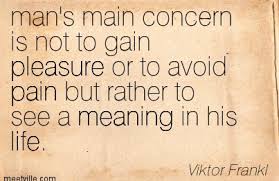
Viktor Frankl then floated once again into my consciousness. A friend who I have witnessed awakening these last two years, had told me he had started reading his book “Man’s Search for Meaning”, only a few days before. Another friend had recommended it to him a few months earlier. I did not, thank God, mention to the man that it was I who had initially recommended the book to our mutual friend. I did not need to as here was the love coming back and multiplying ten-fold. Here was further meaning growing on and on and on...

In “Man’s Search For Meaning” Frankl gives an account of his struggle to find meaning when held as a prisoner in the Nazi death camps of the “Second World War”. He lost most of his family and friends in the camps and yet he never lost hope in humanity.

Frankl was the founder of what has often been referred to as the “Third Viennese School of Psychotherapy” Freud founded the first which was based on the central role of the libido or pleasure principle in human psychology. Alfred Adler founded the second which emphasised the importance of the will to power and the significance of the superiority/inferiority complex in human behaviour. In contrast to these two schools Frankl’s psychology is based on the will to meaning which he saw as the primary motivating force in human life. He named it “Logotherapy” taken from the Greek term logos, which means “word”, “reason”, or “meaning”.

Think of the opening words from John’s Gospel, “In the beginning was the word, and the word was with God, and the word was God.” The word here of course is “Logos”. For Frankl meaning had a transcendent origin.

Frankl saw a spiritual dimension beyond the biological and psychological. He saw the suppression of this spiritual dimension as the root cause of our human malady. Therefore the task of “Logotherapy” was “to remind patients of their unconscious religiousness”; to uncover the spiritual dimensions of their lives; enable them to recover the capacity to choose those values which give our lives worth and meaning.

Now this meaning is of course different for everyone, he did not see one universal meaning. As Frankl said himself:

“For the meaning of life differs from man to man, from day to day and from hour to hour. What matters, therefore, is not the meaning of life in general but rather the specific meaning of a person’s life at a given moment.”

Frankl claimed that meaning is discovered through creative and worthwhile activities, by creating something beautiful or doing good. That meaning can be found through experiencing and sharing in the beauty of art or nature or through loving or ethical encounters with others. That even in the most horrific and terrifyingly hopeless situations we still have the capacity to choose our attitude towards whatever circumstances we are faced with. It is our response to life’s events that shapes our souls. Remember Frankl developed his theory during the utter despair and horror of the Nazi death camps.

As Frankl himself said “Everything can be taken from a man but one thing: the last of the human freedoms – to choose one’s attitude in any given set of circumstances.”

I attended many other wonderful workshops throughout the FUSE weekend and experienced many more beautiful moments of connection and conversation, too many to mention now. There was one that stood out though. It was during a session about listening in which we were asked to break into threes and listen to one another in non-responsive and non-judgemental ways. Now just as I broke into a three, there were originally five groups of three, just by chance another person came in late and wanted to join in. The facilitator of the group asked if one of the threes could become two two’s and the group I was in did so. So we were now two. This meant that the whole process did not work as it was meant to, but what actually followed was deeply meaningful and seemingly exactly what my partner in the exercise required right then. He began to speak about something I had shared publicly some time ago that had helped him immensely and lead him down a path. I couldn’t even remember saying it, but it did sound like something I would say. My partner then began to open up about some pain and struggle he had been going through. We spent the whole session sharing and listening uninterrupted and he seemingly came to a place of conclusion in the time together.

The session had not gone the way it had been planned to but something far more important had emerged instead, something deeply moving and meaningful. Now some could suggest that this was “meant to be”. Perhaps this is true, nobody knows. My preferred conclusion is that this was a moment of possibility for both of us. A moment we took and meaning emerged from it due to our response to the given situation and the many situations that followed it. I believe that it is a perfect example of meaningful interchange and how the Lure of Divine Love operates. It does not control life and nothing is pre-determined but it is their offering itself constantly and it is up to us to respond. It is certainly how meaning emerges in my life. My task and I believe all our tasks is to stay open to these moments, and that by staying open to every moment our own meaning emerges from them as they pass.

There are those that say that life has no meaning, that nothing matters in life. I was once one of these people. These days I see no truth in such statements. These days I see meaning in everything, even in the most painful moments in life. In fact I have discovered that it has been through coming through these most painful moments that the greatest meaning has emerged. Not immediately always but eventually, as I have been able to give back to others from the experience of the suffering I have experienced and or witnessed. This in no way justifies the suffering please do not get me wrong, I am in no way suggesting any such thing. No what I am saying is that through living openly meaning can emerge. Meaning can merge from living by the way of the Lure of Divine Love.


Saturday, 13 February 2016

The Highest Form Of Love

I love language and its many nuances. You can learn a lot about a culture and what it holds as most important by its language. Iceland has for example many words for snow. Some have suggested even a hundred, although a more accurate figure is probably about 40. The Icelandic language has many subtle variations for different types of snow and the time of day and year in which the snow has fallen. The English language has just one word, snow.

The English language also only has one word for Love, love. Love it is clear comes in many forms and yet we only have one word that seems to cover every single type of love going. The love I have for language is not the same love I had for my grandfather who died a couple of years ago or other forms of love I held and hold for other people. Dear friends I have known, family members who have loved me unconditionally, lovers I have known and brothers in arms. My love for Yorkshire cricket and all things Yorkshire or the music of New Model Army. My love for the congregations I serve and this work I have been given. All these loves come under the same umbrella of “Love”, but they are not the same kind of love, no not at all. That said “Love” is the only word I have to use, thanks to limits of the English language that I profess to love.

Now unlike the English language of the 21st century the ancient Greeks had at least six, perhaps even more, different words for love. The main six were “Eros”, which was primarily sexual or passionate desire. This may surprise some but the ancient Greeks did not always hold a positive view of Eros, It could be seen as fiery and irrational. It involved a loss of control that was feared. Just think of the story of Helen of Troy, “the face that sailed a thousand ships.” Plato saw it as “Divine” madness. The ancient Greeks understood what it meant to “fall madly in love”. I have been consumed by this kind of overpowering love many times in my life, I hope to goodness I will again. It is a part of our humanity, but not the only part.

The Greeks viewed “Philia” as a higher form of love than “Eros”. This is the type of love that develops through deep friendships. When they spoke of “Philia” they were often talking of the kind of love that was formed on the battlefield between comrades in arms, brotherly love. It’s the kind of love that compels a person to go to any lengths to protect the person or persons they love; it’s the kind of love that inspires self-sacrifice. In many ways it is similar to “Storge” which the ancient Greeks described as the love parents feel for their children. When I look at my life this is a love that has grown and developed in me in recent years. It’s the kind of love that is formed in 12 step fellowships and religious communities, you see it in sporting teams too and other communities where people bind together and look out for one another.

Another form of love that the Ancient Greeks spoke of was “Ludus”. This is a kind of playful or flirtatious love. It comes alive in friendly banter, around the people we feel comfortable with or when we dance and flirt with others. It’s the love that comes alive when I joke with members of the congregations I serve during worship. It’s the wink of the eye and the knowing smile.

Another form is Agape love. This is a love without prejudice, a selfless love, some call it religious love. In Christianity it is seen as the highest form of love. When translated into Latin it became Caritas from which comes the word charity. This is the love that is spoken of by the Epistle Paul’s in 1 Corinthians 13 “4Love is patient, love is kind. It does not envy, it does not boast, it is not proud. 5It is not rude, it is not self-seeking, it is not easily angered, it keeps no record of wrongs.6Love does not delight in evil but rejoices with the truth. 7It always protects, always trusts, always hopes, always perseveres.” Agape has parallels with the Buddhist concept of “metta” or “universal loving kindness”. The Buddha’s word’s on loving kindness, the Metta Sutta says. “So with a boundless heart; Should one cherish all living beings; Radiating kindness over the entire world:”

Another form was “Pragma” or longstanding love. This is a form of mature love that develops over long-term relationships say between married couples. Pragma was about making compromises and developing patience and tolerance so that relationships could mature over time. It was not so much about the madness of falling in love we find in “eros” and more about standing and holding in love. I suspect that this is the kind of love we see less and less of these days. People of my generation seem to be inspired by the need to be free and have their personal needs met, rather than this kind of love. It’s not something I’ve ever been any good at myself, I must admit.

The final form was “Philautia” or self-love. Now for the ancient Greeks this manifested in two ways. It had both a light and a shadow side. Its negative aspect was a form of narcissistic self-obsession, which was motivated by vanity and greed and self-absorption, to the total neglect of others. Think of the story “Echo and Narcissus”. Yet the other aspect of “Philautia” “self-love” was, perhaps the most important, and from which all forms of healthy human love grew. It is what today we would describe as positive self-regard, although actually I believe it runs much deeper than that. It is the kind of experience that is vital in order to deeply and appropriately love others and for that matter all life. Without this sense of love being at the core of who we are we are never going to offer “Agape” love to others, or not in a positive way. This is because we will love our neighbour as ourselves, in the sense that we will hate them as we hate ourselves, if we do not experience this form of love at the core of our being.

We need to love our reflection as we look at it in the glass, “warts and all and beauty spots too”, although we need to guard against becoming self-absorbed. Remember we are formed from the same stuff as everyone else and in everyone is a reflection of the divine. We are formed from the divine spark.

The ancient Greeks considered Philautia to be the highest form of “Love” and I believe that they were right.

Have you heard of Philautia before? Have you ever tried to practise it? For most folk true Philautia is the area where there is perhaps the greatest potential for growth and yet it is the one area that most of us feel least comfortable exploring. The ancient Greeks believed that when philautia was practiced appropriately (in a healthy, blanced and non-narcisisstic way) it provided the foundation upon which all other love could be built. You see the better your self-love-foundation is, the more brilliant loving life you could build.

If you do not experience and express the love within you, the love that you are formed from, you cannot offer real love to others. It is often said that before you can give to others you need to take care of yourself. If you give too much from your cup, your well will soon become dry and you will be unable to help others. It is said that you’ve got to look after yourself first, before you can help others. This to me is an expression of Philautia, real self-love. The aeroplane analogy is often used, which goes something like the following. If you are in an aeroplane and it gets into distress, so much so that the cabin becomes de-compressed, leading to the oxygen masks having to be deployed, before you can help anyone else you must first secure your own oxygen mask. This is not a selfish act, but it is an act of self-love, taking care of yourself so that you can then take care of others. We need to take care of ourselves if we are to be of use to anyone or anything. If we do not take care of our basic human needs, it means we end up depending on others to do so for us. This I believe leads to unhealthy and needy expressions of so called love.

This brings me back to thoughts around “The Golden Rule”, the core principle of all good religion and philosophy. It is for me the core of everything and the true expression of God manifesting in human life, for God is love. I believe that we all live by the golden rule, we do in fact love our neighbour as we love ourselves. The problem being that often we do not truly recognise the love we are created from. We can feel shame about loving ourselves. We somehow see this as being selfish or narcissistic, when that is the last thing that it is. In fact philautia, self-love, is essential to truly loving our neighbours as the very same children of love, children of God that we ourselves are. By failing to love ourselves we are actually separating ourselves from the rest of the creative life. We need to respect and celebrate our own beautiful uniqueness in order to recognise this in others.

We need to let go of the idea that loving ourselves truly as we, warts and all and beauty spots too is in any sense a selfish or narcissistic act. Please remember that a selfish person is interested only in himself wants everything for herself; can see nothing but her or himself. A selfish person does not love herself too much, but too little. You see the truth is that a truly selfish person is incapable of loving others because they are seemingly unable to love themselves.

To truly love yourself is to follow that greatest commandment, it is to acknowledge that love is at the root of all that we are. If we do not love ourselves, then we cannot love our neighbour.

Parker Palmer said that:

“Self-care is never a selfish act—it is simply good stewardship of the only gift I have, the gift I was put on earth to offer to others.”

Taking care of ourselves, emotionally, mentally, physically and spiritually is not a selfish act, it is the opposite it is loving act. In fact I would suggest to not do so is actually more like selfishness as we usually understand it. It is our responsibility in fact to take care of the life we have been given. Each life is unique and is there to be used for the purpose of all. To truly achieve this we need to take care of ourselves and to express our joy in life. You see to be joyful, to be happy, is to express all that you are; to be all that you can be is neither selfish or greedy, it is a true expression of love in all its forms.

It is what we are here for and it inspires others to love both themselves and each other too.

So my message to you on Valentines Day, on this festival of Love is simply this. Love all life, love all that you are, warts and all and beauty spots too…Fill your heart with the love that surrounds you and pour out this love on our love starved world, for it surely needs it…

I’m going to end this little "blogspot" with a blessing by Barbara Pescan, taken from “Morning Watch”

“Blessing” by Barbara Pescan from “Morning Watch”

We spend so much time running from ourselves
Fleeing from what we know
about the goodness in our hearts
we think we can escape
the intelligence of our loving.

Imagine you are standing before a bodhisattva—
Jesus, Buddha, the first mother
it does not matter what you call the holy one—
he has dust on his shoes
chaff clings to her
the smells of being alive—
Shining from their faces is the beam of
all their questions
the compassion of their living

Can you see yourself through those eyes?
Can we know each other like this?
(We, who no longer believe in messiahs
can hardly believe in each other.)

Can we
know ourselves seen
and know each other this same way
until our restless hearts
learn to abide
in this knowing and this love?
Can we live in this gaze of blessing?

Saturday, 6 February 2016

If Only

In “Love and Death: My Journey through the Valley of the Shadow”, a book written while he knew that he was dying, Forrest Church wrote,

“The only way to reconcile yourself, make peace with yourself, make peace with your neighbor, make peace with God, find salvation, is to break through and love — to forgive and to love. You don’t change the person you forgive. You change your own heart. So anything that you can do to reconcile also means that at the end of your life, when you’re given a few months to live, you can look back without regret.

The two saddest words in the English language are “if only,” and they ring with the most poignancy at a time that a person gets word that he or she has a terminal illness: “If only I had stopped drinking; if only I had dared to change careers when I could; if only I had reconciled with my father when I had a chance.”

I agree with Forrest. I believe that “If Only” are the saddest two words in the English language. I would add also that they are loneliest too. How many of us live with this sense of regret for the things we have done, or just as painfully failed to do? How many of us live in isolation from people we have known and loved in our lives because of our pride? How many of us have let past wrongs done, or perceived to have been done, stop us living the loving and connected lives we are capable of?

So why do we find it so hard to seek and give forgiveness? Why is reconciliation so challenging? Why does pride hold us in this sense of regret? Why are so many of us visited in the darkest night with the ghosts that whisper “If Only”

Well because it is not easy. It requires us to rise above and beyond our small selves to a larger way of being. As Sara Moores Campbell has claimed. “There is incredible power in forgiveness. But forgiveness is not rational. One can seldom find a reason to forgive or be forgiven. Forgiveness is often undeserved. It may require a dimension of justice (penance, in traditional terms), but not always, for what it holds sacred is not fairness, but self-respect and community. Forgiveness does not wipe away guilt, but invites reconciliation. And it is as important to be able to forgive as it is to be forgiven.”

No it is not easy, but it is vital. Not only for ourselves but for the greater good also. Forgiveness is about reconciliation it is about bringing wholeness and healing to all. This is why, in my experience, failing to offer forgiveness and failing to atone for our own wrongs and mistakes makes reconciliation impossible and I have come to believe that it is this that breeds a sense of isolation and loneliness, deep within us. It is not by chance that atonement can be broken down to at-one-ment. For it is such acts that bring about oneness in life.

I recently spent a few days away with a group of people exploring the subject of forgiveness. We were together in a beautiful and loving setting and it was an open environment in which we all talked about our struggles with forgiveness of others and of ourselves. I believe that we all gained a great deal from our time together and I hope it renewed us in our efforts to reconcile ourselves with our pasts and those we have shared our lives with, so as to live better lives in the future. One thing that came strongly out of the weekend was this sense that forgiveness is not about forgetting. Yes it is about healing and reconciliation, but not about simply abandoning the past and passively letting go. In fact if anything real forgiveness is a true act of remembrance. It is about growing from the past and becoming increasingly whole people.

Again as Sara Moores Campbell said, “No, we do not forgive and forget. But when we invite the power of forgiveness, we release ourselves from some of the destructive hold the past has on us. Our hatred, our anger, our need to feel wronged – those will destroy us, whether a relationship is reconciled or not.”

Our varied struggles with forgiveness showed how difficult it was to truly reconcile ourselves with our pasts, with ourselves and with those we have shared and share our lives with. Forgiveness is not easy. It is easy to say perhaps “I forgive you”, but those are just words, it is far from easy to truly mean them though. We cannot just simply will ourselves into it and it certainly isn’t an overnight matter. The key, as in all things, is to be open to it. Here lays its power and its love. Here lays the key to be freed from that aching loneliness of regret and the ghosts of “If Only”. Not only for ourselves but for the good of all. I have come to believe that all our lives depend upon it

Again to quote Sara Moores Campbell,

“…we cannot just will ourselves to enter into forgiveness, either as givers or receivers. We can know it is right and that we want to do it and still not be able to.

We can, however, be open and receptive to the power of forgiveness, which, like any gift of the spirit, isn’t of our own making. Its power is rooted in love. The Greek word for this kind of love is agape as “Love seeking to create community.” This kind of love is human, but is also the grace of transcendent power that lifts us out of ourselves. It transforms and heals; and even when we are separated by time or space or death, it reconciles us to ourselves and to Life. For its power abides not just between us but within us. If we invite the power of agape to heal our personal wounds and give us the gift of forgiveness, we would give our world a better chance of survival.”

At one point during the weekend we discussed the limits of forgiveness and whether there were any. A friend said that he didn’t know how he would react if someone did anything to his son and many people agreed with him and then I shared an example of this and the power forgiveness. I recounted my dear friend Claire’s reaction to witnessing her son being killed in front of her on a crossing. The driver did not stop at the crossing and took Ethan’s life. A power from within or beyond her compelled her to forgive him there and then. I know from watching her piece her life back together since that if she hadn’t have done so there and then she could not have survived herself or if she had she would have lived with an aching bitterness for the rest of her life. Not that the last nine years have been easy, she has been to hell and back many times, but that power, the power of love, has held her through it all and I believe that it was that same power that compelled her to forgive the driver of the car that day on the side of the road. A love that passeth all rational understanding, but one that can hold and sustain us through whatever happens in life, if we would let it have its way and bring it to life in our being.

Forgiveness is a true act of Love, in the purest Agapeic sense of the word. It is an act of the heart, it takes real courage, Remember that courage comes from the French word for heart “Coeur” In the Hindu sacred poem “The Bhagavad Gita” you hear this reflected “If you want to see the brave, look at those who can forgive, If you want to see the heroic, look at those who can love in return for hatred.” You see it reflected in the dying words of Jesus on the cross “Father forgive them, for they know not what they do.” This same loving courage was expressed in the way that both Martin Luther King and Gandhi led their movements of non-violent resistance. These were powerful loving soul forces that inspired healing and reconciliation taken up by the likes of Arch Bishop Desmond Tutu in South Africa and “The Truth and Reconciliation Hearings” that took place there following the end of Apartheid. It can be the same with our individuals lives and our individual hearts. At some level I think we all need to reconcile ourselves with someone or something, even if it is just our own pasts.

This is why I have come to believe that forgiving is not about forgetting at all. In fact what it is really about is remembering. Actually it is more than that, forgiveness is an act of remembrance. It is about bringing the memory alive and creating something from the past. Reconciliation is not just something that occurs between us, but also within us. In each of our hearts and minds and souls. If we can make something from our past hurts we can create meaning from even the hardest moments of our lives and bring a new wholeness and openness to our lives. In so doing we won’t live out our lives with that aching lonely feeling of regret and be visited by the ghosts of “If Only”. In so doing we will leave something to pass on to those who follow and our lives will have truly proved worth dying for, by the love we have left behind.

Below is the full version of Sara Moores Campbell's reflection on "Forgiveness" quoted above

“Forgiveness” by Sara Moores Campbell, from “Into the Wilderness”

There is incredible power in forgiveness. But forgiveness is not rational. One can seldom find a reason to forgive or be forgiven. Forgiveness is often undeserved. It may require a dimension of justice (penance, in traditional terms), but not always, for what it holds sacred is not fairness, but self-respect and community. Forgiveness does not wipe away guilt, but invites reconciliation. And it is as important to be able to forgive as it is to be forgiven.

No, we do not forgive and forget. But when we invite the power of forgiveness, we release ourselves from some of the destructive hold the past has on us. Our hatred, our anger, our need to feel wronged – those will destroy us, whether a relationship is reconciled or not.

But we cannot just will ourselves to enter into forgiveness, either as givers or receivers. We can know it is right and that we want to do it and still not be able to.

We can, however, be open and receptive to the power of forgiveness, which, like any gift of the spirit, isn’t of our own making. Its power is rooted in love. The Greek word for this kind of love is agape as “Love seeking to create community.” This kind of love is human, but is also the grace of transcendent power that lifts us out of ourselves. It transforms and heals; and even when we are separated by time or space or death, it reconciles us to ourselves and to Life. For its power abides not just between us but within us. If we invite the power of agape to heal our personal wounds and give us the gift of forgiveness, we would give our world a better chance of survival.