Showing posts with label meaning. Show all posts

Monday, 9 February 2026

Tell me your story and I will tell you mine: Good speech, Godsibb and Gossip

Last Monday 2nd February was “Groundhog Day”. Sorry, but it is bad news, “Punxsutawney Phil” saw his shadow. This means 6 more weeks of winter. Do not worry this is Pennsylvania, so it may not apply to we in the North West of England. We shall see.

Last Monday morning was a bit like Groundhog Day the movie as I went through many usual Monday activities. There was a slight twist as I met with a couple who are getting married at Dunham Road. We talked through the service, which is fairly traditional with one or two twists, just to make it personal. It was a wonderful conversation, getting to know these two wonderful people, there was much humour shared. I also went through one or two or my usual Monday rituals. After catching up with emails and posting my blog etc I took Molly out into Altrincham and through to the park. On the way Molly insisted on calling into CafĂ© Nero. She loves the place and obviously knows I need a coffee before walking round the park. I had a fascinating conversation with the manager their Keiran. He is a breeder of exotic fish, a growing business for him. He told me he has 1,000 fish tanks now. He also tried to play a trick on me telling me they were having a minutes silence. I know he is a joker so I didn’t fall for it. I told him that we do not have a minutes silence for “Groundhog Day”. We then talked about “Groundhog Day”. He expressed a hope that winter would soon be over.

We then headed to the park and saw the same people I often see when I go there. We nod and say hello and sometimes talk. I got into a conversation with a woman who is there every day and who I rarely get into a conversation with. Whenever we do it is as if we are speaking for the first time, symptomatic of something I am growing familiar with. She told me about her family, her son and grandchildren, all high achievers. We talked about her dog who is the same breed and as my sister’s dog Brian. She then started calling Molly Brian and then she wandered off after I had given her dog and Molly a treat. By the way we also talked about the weather and the desire for Spring. I told her it was “Groundhog Day” , at which point she looked at me like I was mad. As we continued to wander I got chatting to a man and his dog. We always talk when we meet one another. He has a grand dog named Ruby who is a labradoodle. We chatted about our dogs and the weather. I then said it is “Groundhog Day” and we will find out if winter is ending or whether we have six more weeks of it. I then said but it doesn’t really apply as we don’t live in Pennsylvania. He told me his parents used to live there and the winters were never too bad, except for a couple of weeks. They now live in Quebec he told me where the winters are far more extreme. He then showed me a conversation he had with his mother talking about the weather. He asked me if I was always there at this time and I said I come at varied times. I chuckled as I walked off and thought well maybe it isn’t Groundhog Day.

On the way home I bumped into a couple of friends. Both of whom told me about concerns for friends who are being treated for cancer. One seems hopeful the other not so much. I have had several such conversations all week long. Some of which sound like a long winter ahead and others showing signs of spring.

I have been thinking of conversations all week long. Conversations and how our lives are made up of the stories we tell. The stories we tell about ourselves and our lives. On Wednesday I conducted the funeral of Jim Hill. The Hill family have been a part of the Queens Road congregation for several generations. Afterwards I talked with folk who I have known for many years now. We shared our stories and our concerns I also saw several children whose Child blessing service I have conducted. I thought of their stories and their familys stories. I also remembered Alison, Jim’s sister telling the story, on a Zoom service during Covid, when we were joined by Rev Peter Godfrey who had been minister to the congregation in 1950’s and 60’s. I will never forget the delight in her voice and on her face as she saw Peter and reminded him that she was the first child he had Baptised. This is one of those stories I love to tell. The circle of life and of love.

Another friend told me of her ex-partner had being diagnosed with cancer this week. This brought me back to the formation story that led me into ministry. A story of sorrow that I have to tell when folk ask me why I became a minister. He and his family have been in my heart and prayers ever since.

The stories of live. Stories of love, of life and of death. The circle of life.

Our lives are made up of all kinds of stories, that tell us who we are. We connect with one another through the telling of these stories. We all have our stories and we love to hear stories. I was reminded this week of a character I created during “lockdown” Cap’N Dan. Everyday I told a classic tale and recorded it on camera. Many people watched the stories, both young and old. The stories helped people through a difficult time, both children and adults. A friend told me that the stories both entertained and fed both him and his children. His children would probably be embarrassed now, as they are 5 or 6 years older. That said these stories are a part of their life. They helped to both feed and connect them and others.

Our lives are made up of stories.

The author Phillip Pulman has said of stories “After nourishment, shelter and companionship, stories are the thing we need most in the world.” I would suggest that in some ways stories give us nourishment, shelter and companionship in a none material sense.

Anthony DeMello wrote...

The Master gave his teaching in parables and stories, which his disciples listened to with pleasure — and occasional frustration, for they longed for something deeper.

The Master was unmoved. To all their objections he would say, "You have yet to understand, my dears, that the shortest distance between a human being and Truth is a story."

We all have our stories and no doubt those that know us have stories to tell about us. It’s interesting that when a person tells a story about you their perception and memory will reveal something of how they see you and know you. It reveals as much about the storyteller as the person they are telling the story about.

I have been thinking of stories, the ones we share when we meet and speak with each other. Whether they be strangers, close friends and or folk you see from time to time. I wonder what stories they will tell of us.

It matters the stories we tell of one another. We all speak of one another we share our tales. It matters the tales that we tell. The words we share. The way we gossip about one another and life.

Gossip is one of those words that has changed in meaning over time. There can be good gossip and bad gossip. It not so much the way we speak about one another but it’s intent, it’s meaning. It matters how we speak about others and how we listen to what others say to us about people. Malicious gossip can be very destructive. That said sharing concern for others and singing their praises can add to the loving creation.

The word “gossip” is derived from words for God and sibling. It originally meant “akin to God”. “God-Sibb” describing a person you were connected to in spiritual kinship, either a sponsor or God parent. When we share stories of one another in such a spirit we are connecting together in shared love and concern. I have shared a week of being engaged mostly in “God-Sibb”, although not always I have occasionally spoken unskilfully, not from this spirit.

Like a lot of words sadly the word gossip only has negative connotations. In fact, it means the exact opposite to its original meaning. It seems more akin to separation than connection. Gossip as we understand it these days is often deeply destructive.

The way we speak with and of one another can connect us, but it can also separate us; words are incredibly powerful things. Words can begin to bring deep healing or can be deeply destructive. What matters is the intention behind them. What seems to matter is the condition of our heart and soul as we speak what we must speak. It is the meaning behind the words that seems to matter the most.

Words are powerful they can be either destructive or creative. Perhaps an example of “words” creative power comes at the beginning of John’s Gospel and the following lines:

'In the beginning was the Word, and the Word was with God and the Word was God.
The same was in the beginning with God.
All things were made by him; and without him was not anything made that was made.'

According to John the spoken word can literally create life, in fact all life. Now of course in the original Greek, which these opening words were written in, the word for “Word” was “Logos”, which roughly translated actually does not mean merely a “word,” but also “speech,” “principle,” “meaning” or “thought.” In Greek philosophy, it is also referred to as Divine Reason or the Mind of God. So, it could mean God speaking life into being, linking it to the first verses from Genesis when God is said to have breathed life into being, remembering always that he saw this creation as “Good”. So “word” here means, in my view at least, that life is the meaning coming into being and Jesus is the example of this in human form. An example we can all aspire to. For we can all incarnate Love, we can all be a part of the Divine creation. It begins in our words and how we say these words for they are an expression of our meaning. It also begins in how we listen to others. Our ability for each to share, an open loving invitation. This is Divine activity. This space between us is the Kin-dom of Love. Conversation can be a Divine activity; the sharing of stories can be Divine activity, if engaged in in a loving spirit.

When we speak we are not merely flapping our lips, vibrating air we are engaged in Divine activity we are creating or destroying life. It is the same with listening. If we listen with ears of heart we are creating sacred space, thus creating the Kin-dom of Love.

So, it is not just about what we say, the words we use, but the meaning behind them. This brings a whole deeper meaning to the phrase “The word (Logos, meaning the Meaning), became flesh and dwelt amongst us.” We embody our meaning through the words we use and how we use these words.

What we say and the meaning behind our language really matters. Our words are our meaning. It is not just about the words we use, but the meaning behind them. It can be deeply creative or destructive.

Ursula K Le Guin the great 20th century novelist wrote:

“Words are events, they do things, change things. They transform both speaker and hearer; they feed energy back and forth and amplify it. They feed understanding or emotion back and forth and amplify it,”

Words express our meaning and they amplify the meaning of our society and culture. This is why the meaning of words change over time. Remember Logos meant both word and meaning and yet in the English translation of the Bible it is always translated as word and not meaning.

It matters the words we use and the meaning behind them. It matters how we engage with one another. It matters the conversations that we have with each other and ourselves. It matters the stories we tell of one another and of life. It matters.

The way we speak with and of one another can connect us, but it can also separate us; words are incredibly powerful things. Words can begin to bring deep healing or can be deeply destructive. What matters is the intention behind them. What matters is the condition of our heart and soul as we speak what we must speak. It is the meaning behind the words that seems to matter the most. Do we speak as siblings that connect or enemies that separate.

It matters you know, it really does.

Below is a video devotion based on the material in this "Blogspot"


Monday, 13 January 2025

Super Ordinary Heroes: The Lives of Christopher Reeve and Victor Frankl

“When the first Superman movie came out I was frequently asked, "What is a hero?" My answer was that a hero is someone who commits a courageous action without considering the consequences...

...Now my definition is completely different. I think a hero is an ordinary individual who finds strength to persevere and endure in spite of overwhelming obstacles.”

Christopher Reeve

I recently watched “Super/Man: The Christopher Reeve Story”. It was a powerful and moving documentary film about not only his life, but his family’s life also. Like a lot of young people, of my generation, Superman was the ultimate hero, and Christopher the archetype. I went to see all of the first three films at the pictures. Just like young people do today as they marvel at such features. Christopher Reeve seemed to be the perfect image of the “Superman”. He was the all American hero and a great success. He seemed to be well loved too by his contemporaries. He had a life long friendship with Robin Williams. He had lived something of a hedonistic lifestyle, living the good life and achieving much. Then tragedy struck and he became paralysed from his neck down after being thrown from his horse.

His chances of survival were slim. In fact he only survived due to a new surgery. He fell into despair and said to his wife Dana “Maybe we should just let me go”. Dana persuaded him to give himself two years and told him “But you are still you. And I love you.” He was still him, but he could no longer physically touch life. Despite all he had lost he still had had the love of his family, he also had fame and saw that he could create something powerful and useful from this. So, he decided use all he had to create something good. He and Dana set up the “Christopher and Dana Reeve Foundation”.to help both other paraplegic people but also develop research to help people perhaps one day walk again, to heal spinal injuries.

Christopher Reeve realised that even though he could no longer use his body, he had a power that so many other people do not. He could use his fame. He could create something from this tragedy. He succeeded he created something incredible, as did his family. Sadly, he died suddenly in 2004 but his legacy lived on. A year later his wife Dana was diagnosed with stage four lung cancer, sadly she died only a year or so after Christopher. This left their son Will without either parent. He and his older siblings Matthew and Alexandra, from a previous relationship, carried on the work of the foundation.

There is a moment towards the end of the film where Will speaks of the death of both of his parents and the potential to slip into despair. He, spoke of a decision, of a choice that he and perhaps all of us have to make. That you can look at the universe and look at life and say it is simply meaningless; or you can search out a meaning and create something from this. It struck me powerfully, in fact it filled me with tears.

I know that Christopher Reeve became a Unitarian towards the end of his life. He went on an inner journey following his accident and the open and free community helped him to do so. He was interviewed by “Readers Digest” not long before he died and he was asked why. He said "It gives me a moral compass. I often refer to Abe Lincoln, who said, 'When I do good, I feel good. When I do bad, I feel bad. And that is my religion.' I think we all have a little voice inside us that will guide us. It may be God, I don't know. But I think that if we shut out all the noise and clutter from our lives and listen to that voice, it will tell us the right thing to do."

As I watched this deeply moving film it obviously brought to my mind the “Hero’s Journey” that Joseph Campbell Identified. Chrsitopher Reeve and his family are a classic example of this. That said it spoke more powerfully to me of the work of Viktor Frankl. I thought this throughout and I felt it deeply as his son Will spoke of the decision he took after both of his parents had died. The choice was his to turn to meaningless despair or find meaning, to create something from this suffering and thus transform it into something meaningful. This the whole family has done. So many have benefited from this decision.

I also thought of Christopher Reeve’s inner journey. He was an athlete and a physical being. He enjoyed fame and fortune and all the trappings that go with it. He enjoyed all the pleasures that life has to offer. In the end he lost all of this, it was a chasing in the wind, to quote Ecclesiastes. He lost all that and had to go on an inner journey, into the spiritual realm. Again it brought to my mind the work of Viktor Frankl and what he described as “Religio” or the search for the “Unconscious God” and to bring this alive through our lives and thus create a life rich in meaning. I think it is clear that in so doing that Christopher Reeve truly found the hero inside himself. To repeat that quote of his:

“When the first Superman movie came out I was frequently asked, "What is a hero?" My answer was that a hero is someone who commits a courageous action without considering the consequences...

...Now my definition is completely different. I think a hero is an ordinary individual who finds strength to persevere and endure in spite of overwhelming obstacles.”

Christopher Reeve reminded me of a quadriplegic man, from Texas, named Jerry Long, who Viktor Frankl often spoke of in his later interviews. Jerry Long had read “Man’s Search for Meaning”, whilst recuperating from an accident that had left him paralysed. It did not kill his spirit though. He wrote to Frankl and they formed a lifelong friendship. Frankl described Jerry as "a living testimony to logotherapy lived and the defiant power of the human spirit".

Jerry gained his doctorate in psychotherapy and became a renowned public speaker throughout the world. In 1998 he wrote a contribution to a journal issue commemorating the recently deceased Viktor Frankl. Here is a passage from it.:

"Once, after speaking to a large audience, I was asked if I ever felt sad because I could no longer walk. I replied, "Professor Frankl can hardly see, I cannot walk at all, and many of you can hardly cope with life. What is crucial to remember is this - We don't need just our eyes, just our legs, or just our minds. All we need are the wings of our souls and together we can fly." - Jerry L. Long

This is what Viktor Frankl was trying to show the world, through Logotherapy. He was trying to help us see this.

Now you may well ask Who is this Viktor Frankl and what is Logotherapy.

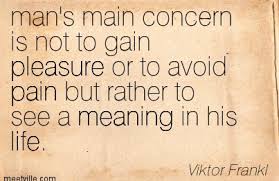
Viktor Frankl was the founder of what has often been referred to as the “Third Viennese School of Psychotherapy” Freud founded the first which was based on the central role of the libido or pleasure principle in human psychology. Alfred Adler founded the second which emphasised the importance of the will to power and the significance of the superiority/inferiority complex in human behaviour. In contrast to these two schools Frankl’s psychology is based on the will to meaning which he saw as the primary motivating force in human life. He named it “Logotherapy” taken from the Greek term logos, which means “word”, “reason”, or “meaning”. Think of the opening words from John’s Gospel, “In the beginning was the word, and the word was with God, and the word was God.” The word here of course is “Logos”. There is an implication here that meaning has a transcendent origin.

Frankl saw a spiritual dimension beyond the biological and psychological. He saw the suppression of this as the root cause of our human malady. Therefore, the task of “Logotherapy” was “to remind patients of their unconscious religiousness” and to uncover the spiritual dimensions of their lives and enable them to recover the capacity to choose those values which give our lives worth and meaning.

Now this meaning is of course different for everyone, as Frankl said himself:

“For the meaning of life differs from man to man, from day to day and from hour to hour. What matters, therefore, is not the meaning of life in general but rather the specific meaning of a person’s life at a given moment.”

Frankl claimed that meaning is discovered through creative and worthwhile activities, by creating something beautiful or doing good – I believe that one of the greatest sadness’s of our age is the fact that the phrase “do-gooder” has become a term of mockery, that it is somehow seen as wrong and suspicious to do good - Meaning can be found through experiencing and sharing in the beauty of art or nature or through loving or ethical encounters with others. Now is the example of Christopher Reeve and his family, the embodiment of this.

Even in the most horrific and terrifyingly hopeless situations we still have the capacity to choose our attitude towards whatever circumstances we are faced with. It is our response to life’s events that shapes our souls. Remember Frankl developed his theory during the utter despair and horror of the Nazi death camps. As Frankl himself said “Everything can be taken from a man but one thing: the last of the human freedoms – to choose one’s attitude in any given set of circumstances.”

There are those that say that life has no meaning, that nothing matters in life. I was once one of these people. These days I see no truth in such statements. These days I see meaning in everything, even in the most painful moments in life. In fact, it has usually been through coming through these most painful moments that the greatest meaning has emerged. Not immediately always but eventually as I have been able to give back to others from the experience of the suffering I have experienced and or witnessed. These last few months have proven this once again. By the way Frankl is in no way suggesting that this justifies suffering, please do not misunderstand. Frankl is not suggesting any such thing. To quote Dorothee Soelle, “no heaven can rectify an Auswitz”. Frankl was very clear that is suffering can be stopped then it must, and that can be done to stop the suffering must be applied. What I have discovered and Frankl taught was that despite the suffering that by living openly meaning can emerge. Meaning can emerge from living by the way of the Lure of Divine Love. Such love draws us out of ourselves and meaning emerges as we live from love and our most painful experiences are transfigured into meaning and purpose. The suffering is still as real, but meaning begins to emerge as we are saved from the hell of despair.

We can find our meaning, by uncovering whatever it is that makes us feel alive. I have witnessed it again in the lives of ordinary people recent weeks. I have experienced it too. Spiritually speaking, my heart has felt close to bursting at times recently. Not without pain, of course not, but even in that suffering meaning has emerged and I have experienced utter joy and bliss.

The key is to find our meaning, whatever makes our soul sing and bring it life through your very human being, bring to life that which is within you and all life. I am not here to tell you what the meaning of life is. I would be cautious of anyone who suggests that they have all the answers to such questions. What I can tell you though is that meaning can and will emerge from you, all you have to do is bring it to life. In so doing not only will your life be meaning filled but you will inspire others to do the same. Just as Viktor Frankl has been doing for generations and the story of Christopher Reeve and his family have too.

Below is a video devotion based on the material in this "blogspot"


Monday, 10 July 2023

The Essence of the Spiritual Life: Taking Care of Your 3 Millimetres

I will begin with a letter taken "Letters to Sam A Grandfather's Lessons on Love, Loss, and the Gifts of Life" By Daniel Gottlieb

In it I find the essentials to living the spiritual life, living spiritually alive. It teaches lessons that we can learn from pain and struggle as well as well as the suggestion that the essence of freedom is responsibility, or as Daniel discovered, taking care of your three millimetres. It is simple, but not so easy.

"Your Three Millimetres"

"Dear Sam,

"An author and sociologist named Frank Abbott has said, 'Death is no enemy of life. We would have no idea what life was about if it weren't for death.'

"About ten years before you were born, I went through a terrible time in my life. And I had a dream that was a revelation.

"This was several years after my accident, shortly after your grandmother Sandy had left the marriage. Debbie and Ali had just departed for college. I was home alone. And my beloved sister, who had become my closest confidante, had just been diagnosed with a terminal brain tumor. My heart was in turmoil.

"Then I developed a bedsore on my buttocks. This is not unusual for someone who sits in a wheelchair all day, but when it happens, it can be a nightmare. The only treatment for these sores is to stay out of the wheelchair, so what little independence the wheelchair provides gets taken away.

"With grief welling up on every side, I visited the doctor. He examined me and said, 'It's broken.' I said, 'I know.' He was referring to the skin, but I was talking about my heart. 'Too much pressure,' he said, meaning my buttocks. 'I know,' I said, meaning my life.

"Then the doctor saw that the wound was moist.
"That's an unhealthy sign. 'It's weeping,' he said, using a medical term.
" 'I know,' I said, But I still wasn't talking about the wound.
"Finally he said, 'You've got to go to bed for thirty days.'

"This was my greatest nightmare. Right after the accident, I imagined that everyone would leave me and I would be home alone, confined to bed, with a nurse who was there only because she was being paid. Then, upon the recommendation of this doctor, that's exactly what happened. Displaced from my wheelchair, immobilized, I knew I would not be able to do any of the usual things that sustained me. I couldn't see patients if I couldn't sit up or go into my office. I couldn't get to the radio station for my weekly show. I couldn't drive my van or get around the house by myself. I would have to lie prone, waiting for the wound to heal.

" 'How do you know it will take thirty days?' I asked.
"The doctor explained that skin wounds, if they are in a healthy environment, heal at a rate of one millimeter a day. I wondered about wounds to the heart. How could you measure that healing?

"He gave me a brown patch called Deuoderm to cover the wound. I told him I was surprised that the wound would be covered. I thought wounds needed oxygen to heal. Shouldn't the bedsore be exposed to the air?

"Yes, he said, wounds do need oxygen to heal. But the oxygen is in the blood, not in the air. 'Everything a wound needs to heal is already in your body,' he explained. 'We just have to get access to those nutrients and let them work.'

"Those words stayed with me. If that was the way the body healed, what about the human spirit? Remembering the old prophetic story that tells how infants are born with all the wisdom they need to live, I realized that everything we needed to heal our hearts' wounds might already be in us too.

"I went home and went to bed. But the wound didn't heal in thirty days or in forty or fifty. When it finally did close, after about two months, I was elated to get back in my wheelchair. (It made me think — how many people feel overjoyed because they can sit in a wheelchair?) But then it opened up again.

"I was devastated. Here came the nightmare all over again. I felt as though my spirit was crushed for good.

"Finally, the doctor and I decided that I should have surgery.

"One night in the hospital, a friend came to visit me. I told her I didn't think I could go on anymore. What I was feeling went beyond despair. It was a loss of hope — of everything I valued, trusted, and loved. The pain had become simply unbearable.

"My friend held my hand and said, 'Dan, what you are about is more important than who you are.'

"That night, I had a dream. I dreamed that God came to me. This was not the God I believe in, the one you read about in the Bible. It was some other God, and when He spoke, he said, 'I'm going to give you a piece of the universe. Your job is to take care of it. Not make it bigger or better — just take care of it. And when I'm ready, I'll take it back, and your life will be over.'

"I looked at the piece of the universe that God was showing me, and I saw that it was just three millimeters! Was that all? I could feel my ego begin to rail against this indignity. I'm a psychologist! I am an author! I have a radio show! Aren't these things important?

"Of course, no matter how much I protested, it wouldn't make any difference. My allotment was still — and would always be — just three millimeters of the entire universe. That was it!

"But in this dream I also saw that caring for three millimeters of the universe was an awesome responsibility. A God-given responsibility. Though I had felt I couldn't go on, finally I had to acknowledge that I would have to give back my three millimeters before I was ready. And because, at the time of the dream, I had a wound that was healing in millimeters, I knew that my job was to help heal my three millimeters of the universe.

"Sam, part of the reason I'm at peace with my life is that I take care of the part of the universe I'm responsible for. I haven't made it bigger or better. I haven't changed it. But I have cared for it. Writing these letters to you is just one of many ways of tending my three millimeters.

"What I wish for you, Sam, is what I wish for everybody — to get as clear a sense of what your life is about as I got in that dream. Your three millimeters is not much in terms of area. But I hope you will feel the gratitude and joy that I feel, having been given that much to tend.

"Love,
"Pop"

I came across this wonderful piece a couple of years ago when searching for resources for “The Colours of Grief”. It hit me hard at the time, had a powerful effect on my heart and soul. I have wanted to share it with you in worship, but never found the right time. It is long and not appropriate for a reading. It came back to me on Sunday as I sat enjoying the 200 hundreth anniversary at Norcliffe Chapel Styal as stories were shared of the congregation and its mission, particularly the concept of faith and works. It got me thinking about my spiritual beliefs and how I express them, which I would say are almost perfectly encapsulated in this letter by Daniel Gottlieb.

“letters to Sam” is a touching, personal and deeply inspiring collection of letters by Daniel Gottlieb to his grandson Sam. There is clearly a deep connection between two, they share a common bond, an unconditional love, that goes beyond blood. Both would be considered “different” from the so called “norm”. Daniel is a quadriplegic who has learnt so much from his disability. His grandson Sam was diagnosed with autism at just 14 months old.

Daniel wrote the book as way of offering help and advice to Sam, to ease his attempts at navigating a life, in which he would always be dependent on others. It is a celebration of the worth and dignity of all people, that they can: "help teach people, that no matter what happens to our bodies or minds, our souls remain whole." It is not sugar coated, pain and how to live with it is a constant theme, as are the fears that come with pain. An example being Daniel’s reaction to being diagnosed with the sores. He describes his fear of being abandoned, a real fear as his wife has left, his sister who he depends on has been diagnosed with terminal cancer and his children have left him and yet humour remains.

The letter and the whole book offers a way to live spiritually alive. The essence of which is responsibility. Daniel discloses in the letter that all of us have our own little patch of life that we are responsible for. It is not necessary to get a bigger patch or to make it better. The point is to take care of it with love and gratitude and joy. This is the key to living spiritually alive. It is a book about faith and doing what is ours to do. It brings to my mind those words from the Book of James “Faith without works is dead”.

I love how Daniel describes how all that he needed to heal was already there within him. That the key is to take care of that, to be responsible for his three millimeters. As he wrote:

"The doctor explained…Yes, he said, wounds do need oxygen to heal. But the oxygen is in the blood, not in the air. 'Everything a wound needs to heal is already in your body,' he explained. 'We just have to get access to those nutrients and let them work.'

"Those words stayed with me. If that was the way the body healed, what about the human spirit? Remembering the old prophetic story that tells how infants are born with all the wisdom they need to live, I realized that everything we needed to heal our hearts' wounds might already be in us too.”

Isn’t this so true, everything we need is already here, we just need to learn to take care of it and make best use of it.

Sometimes of course no matter what we do, things still continue to go wrong. Sometimes things seem to get better and then all seems lost again. As he wrote:

"I went home and went to bed. But the wound didn't heal in thirty days or in forty or fifty. When it finally did close, after about two months, I was elated to get back in my wheelchair. (It made me think — how many people feel overjoyed because they can sit in a wheelchair?) But then it opened up again.

"I was devastated. Here came the nightmare all over again. I felt as though my spirit was crushed for good.
"Finally, the doctor and I decided that I should have surgery.”

There is something here is the wisdom of faithful and acceptance.

Then finally we see the real lesson. His whole philosopher for him and his grandson Sam. This is a universal lesson, the key to me to the spiritual life. Something of faith and works of the spiritual of life making the most of what is yours, of being responsible for what is yours, this is your gift. I hear so powerfully the wisdom of Forrest Church here too and his mantra “Want what you have, do what you can, be who you are.” What came to him at his moment of utter despair, when he felt he could go on no longer, his dream. As Daniel wrote:

"One night in the hospital, a friend came to visit me. I told her I didn't think I could go on anymore. What I was feeling went beyond despair. It was a loss of hope — of everything I valued, trusted, and loved. The pain had become simply unbearable.

"My friend held my hand and said, 'Dan, what you are about is more important than who you are.'

"That night, I had a dream. I dreamed that God came to me. This was not the God I believe in, the one you read about in the Bible. It was some other God, and when He spoke, he said, 'I'm going to give you a piece of the universe. Your job is to take care of it. Not make it bigger or better — just take care of it. And when I'm ready, I'll take it back, and your life will be over.'

The key was to take care of his piece of the universe, his three millimeters, his responsibility. This was Daniel’s work and it came to him faithfully when he was in utter despair. Again as he wrote:

"But in this dream I also saw that caring for three millimeters of the universe was an awesome responsibility. A God-given responsibility. Though I had felt I couldn't go on, finally I had to acknowledge that I would have to give back my three millimeters before I was ready. And because, at the time of the dream, I had a wound that was healing in millimeters, I knew that my job was to help heal my three millimeters of the universe.

"Sam, part of the reason I'm at peace with my life is that I take care of the part of the universe I'm responsible for. I haven't made it bigger or better. I haven't changed it. But I have cared for it. Writing these letters to you is just one of many ways of tending my three millimeters.”

The key for all of us to find our own three millimeters and love and care for it and when our time is up to give back whatever life has lent to us.

Now whatever our three millimeters may be, it is for each of us to discover ourselves. It doesn’t have to be anything big and glorious. By taking care of what is close at hand sounds like the embodiment of faith and works to me. As Viktor Frankl stated it was the responsibility of each individual to find their own meaning in life, that this was in many ways the ultimate freedom and that it could not be prescribed for us. That said it was more than just our ultimate freedom, it was also our responsibility. In fact he taught that the ultimate freedom was to be responsible for what is yours. Daniel Gottlieb’s letters to Sam are also in alignment with Frankl’s central concept that the key to life is to find meaning despite our very real suffering and it was this that led to us transcending despair. That this is our ultimate responsibility and thus freedom.

The beginning of this is to accept the reality that we find ourselves, if it is beyond our power to change it. Of course if we can change it our ultimate responsibility is to do so, if it causes suffering. This brings to mind a favourite story, this version uses Nasrudin as the vehicle. It is titled “Dandelions”

Mulla Nasrudin decided to start a flower garden. He prepared the soil and planted the seeds of many beautiful flowers. But when they came up, his garden was filled not just with his chosen flowers but also overrun by dandelions.

He sought out advice from gardeners all over and tried every method known to get rid of them but to no avail. Finally he walked all the way to the capital to speak to the royal gardener at the sheikh's palace.

The wise old man had counseled many gardeners before and suggested a variety of remedies to expel the dandelions but Nasrudin had tried them all. They sat together in silence for some time and finally the gardener looked at Nasrudin and said, "Well, then I suggest you learn to love them."

So often in life we try to change our circumstances in our pursuit of what we believe will make us happy. We attempt to perfect our outer or even inner world thinking that this will rid us of the potential troubles that accompany life. We attempt to wish our troubles away, when maybe what we ought to be doing is learning to love what is there in its wholeness. Maybe we all spend too much time weeding the garden and not enough time learning to love what is already there. Maybe those dandelions are our three millimeters.

Again I am reminded of Forrest Church’s mantra: “Want what you have; do what you can; be who you are.”

It begins with accepting who we are and actually loving who we are, we are then better able to do what we can. This is exemplified in the following story.

There is a wonderful ancient Jewish story about Rabbi Gamaliel. He was asked by one of his students if he thought he had done enough with his life. He pondered the question for a moment before answering...

“When I die, God will not ask me, ‘Gamaliel, why were you not an Abraham or a Moses? God will ask me, ‘Were you Gamaliel?’”

To be who we are means that we must embrace our God-given natures and talents; it means that we accept who we are and make the most of it; it means that we do not try to be something or someone we are not. We take responsibility for what we have been gifted. Our job is to nurture and develop these gifts not merely for ourselves, but for the good of all.

As Gottlieb said it is about taking care of our 3 millimetres. Being responsible for our lives. This is the spiritual life in its entirety. It is purpose and it is what will give our lives true meaning. In so doing we may just begin to create the “Kin-dom” of love right here, right now.

Below is a video devotion based on the material in this "blogspot"


Monday, 18 July 2022

Turn towards the sun, sideways into the light, not away from life

A good friend Rob planted a load of beautiful flowers in gardens at Dunham Road. Gardening is a new love for him; a love born from the grief of the loss of his father, who was an early Covid death. He had nurtured the seedlings and had so many that he was giving them away as gifts. He wanted some to come to the chapel, as it means so much to him. It is where his soul came back to life. He also wanted to thank me for helping him along the way, not least when his father died. He planted the flowers on the second anniversary of his father’s death back in the Spring.

He planted many sunflowers and some are now blooming. I was admiring them early the other morning and thinking of how they always turn towards the sun. How it is a source of everything to the sunflower. They need to turn towards the sun not only to survive, but to thrive. I don’t think I am that different myself, are any of us?

When I think of my friend and his flowers, particularly those sunflowers I see a love born from pain and suffering. The way his father died and the way so many others did and still do, in such tragic isolated ways, without the ability to grieve this love as they would have normally done so. My friend has created something beautiful from that suffering, something meaningful that he can share with others. I see pure joy born from the pain and rich meaning too. Thus, there is no despair, no empty shell, no lingering destructive resentment. Thinking of this turns my heart towards the sun, just like those sunflowers he so lovingly planted do.

I was thinking of this the other morning as I walked down and round to Dunham Massey. I had much weighing heavily on my heart that day, things are would rather not face. Not least the news that my cousin has only a few days to live. I was travelling to see my auntie and uncle that day. Cheryl is now home, where she is being cared for as her life comes to an end.

It was a beautiful sunlit morning in Dunham. I bumped into another friend and his wife, they were out running. I had never actually met her before. We had once spoken on the phone, when he was in his darkest hour, a few years earlier. So, it was lovely to actually meet her, in the sunshine. Things are very different for them now, thank God. There lives have certainly turned around, they turned towards the light and back to life.

As I wandered in the morning sun I was reminded of Mary Oliver’s poem “The Sun”.

Here it is

“The Sun” Mary Oliver


Have you ever seen

Anything

in your life

more wonderful


than the way the sun,

every evening,

relaxed and easy,

floats toward the horizon


and into the clouds or the hills,

or the rumpled sea,

and is gone--

and how it slides again


out of the blackness,

every morning,

on the other side of the world,

like a red flower


streaming upward on its heavenly oils,

say, on a morning in early summer,

at its perfect imperial distance--

and have you ever felt for anything

such wild love--

do you think there is anywhere, in any language,

a word billowing enough

for the pleasure


that fills you,

as the sun

reaches out,

as it warms you


as you stand there,

empty-handed--

or have you too

turned from this world--


or have you too

gone crazy

for power,

for things?

Mary had such a beautiful pastoral way about her. Her poems were very real and earthy, there are no bromides and yet there is a deep sense of love and care, and devotion to life, they are spiritual in every sense of the word. There is a sense of the sacred in anything and everything she described. She reminds me how vital it is to sanctify life and let life sanctify me, by simply being alive. Like my friend and his sunflowers. I feel so carried and cared for by Mary’s words in “The Sun” and yet brought to a halt by the final lines which asks if we have turned away from  the world or gone crazy with power for things. Both will be destructive, it matters how we live in this world and how the world lives in us, it really does. It matters how we turn in life, is it in love, towards the sun, or do we turn away from life or perhaps even worse get so crazy with power we try to destroy everything in our way.

As I continued my walk round Dunham I was reminded of another poem of Mary’s, I thought of my friend and his flowers as I remembered a few lines from “Morning Poem”: “Every morning the world is created under the orange sticks of the sun the heaped ashes of the night turn into leaves again and fasten themselves to the high branches…”

How important it is whenever the pain gets too overwhelming, when, to quote another line from the poem, that “heavier than lead” feeling comes, that we keep on turning back to life. That we do not let our ego control the lives of others. That instead we turn to life and play our role in everything. Afterall this is what life needs and in so doing meaning always emerges right there in the ashes of suffering.

Walking in nature brings solace to me, it is not the answer to the troubles both close at hand and in the wider world but my heart and soul needs it in order to return to whatever is my responsibility. In so doing joy is born deep in the heart, even in the very real suffering. The suffering is not transcended, it is transformed into meaning and love. Gosh have I known love this week.

On Tuesday after talking through some very difficult and painful experiences with someone another favourite poet came to my heart, this time as I watched dogs frolicking in the park. This time it was David Whyte and his poem “Tobar Phadraic”, again it is a poem about turning, only this time sideways into the light. Here it is:

TOBAR PHADRAIC


Turn sideways into the light as they say
the old ones did and disappear
into the originality of it all.

Be impatient with easy explanations
and teach that part of the mind
that wants to know everything
not to begin questions it cannot answer.

Walk the green road above the bay
and the low glinting fields
toward the evening sun, let that Atlantic
gleam be ahead of you and the gray light
of the bay below you, until you catch,
down on your left, the break in the wall,
for just above in the shadows
you’ll find it hidden, a curved arm
of rock holding the water close to the mountain,
a just-lit surface smoothing a scattering of coins,
and in the niche above, notes to the dead
and supplications for those who still live
.
But for now, you are alone with the transfiguration
and ask no healing for your own
but look down as if looking through time,
as if through a rent veil from the other
side of the question you’ve refused to ask.

And you remember now, that clear stream
of generosity from which you drank,
how as a child your arms could rise and your palms
turn out to take the blessing of the world.

I love the line,
"Turn sideways into the light." It is just so beautiful . it comes from a Celtic myth about a tribe of people who went into battle knowing they would be defeated. They stood facing the enemy and as the enemy charged toward them, they turned sideways into the light and disappeared.

There is much more to the poem of course, but that is perhaps for another day.

“Turning sideways into the light” reminds of another way to face life and conflict; it reminds me that in war no one wins. Yes, one side may lose more, but no one wins. There is so much conflict in life and it grieves my heart. I was reminded of this last Monday and shared deeply about it on Tuesday. To “turn sideways into the light”, suggests another way, one that is relational, what Whyte would call conversational. You do not have to have the confrontational conversation that those who come towards you want. It is about turning down another path, not the one the antagonist wants you down. “Turning sideways into the light” is another way of saying Jesus’ teaching in Matthew ch3 v 38 “But I say to you, do not resist the evil doer…love your enemies and pray for those who persecute you.” “Turning sideways into the light” is like turning the other cheek. In so doing the hatred and aggression is transformed and disarmed. This takes courage and deep integrity. It is a shift of consciousness akin to Gandhi on the “Salt Marches.” In so doing suffering is transformed into meaning and love. It is a better way that recognises how sacred everything is, not least ourselves. It brings healing too.

So it matters which way we turn in life, it also matters how we turn. It matters what we do and how we do it. It matters whether we turn towards the world or sideways into the light, rather than grasping for power and creating conflict. It matters how and which way we turn. I prefer to be a sunflower always turning towards the light, the warmth of the sun. Rather than someone who charges towards life and others, head down causing destruction. In so doing it enables me to turn to life in a loving way.

It is a curious phrase to turn, or to turn again or even to return. Did you know that to turn or to re-turn was the original meaning of the religious word “conversion”. Conversion is rooted in the Latin word “convertere”, which meant to turn around to transform. Today I choose to turn towards the light and not away from life and in so doing whatever suffering is there begins to be transformed into love and meaning emerges, thus there is no despair. I have felt this powerfully all week, right down in the core of my being, it is why I have known such joy.

This brings back to my mind Victor Frankl and that wonderful and simple equation D=S-M

Despair equals suffering minus meaning...Despair is suffering without meaning.

In “Man’s Search For Meaning” Frankl wrote “Man is not destroyed by suffering; he is destroyed by suffering without meaning.” He discovered that if we have a “why” to live for we can endure anything. More than that actually it is this that allows us to thrive, to be all that we are born to be. To not only improve our lives, but to serve our world. In so doing, despite living with real suffering we can know joy, in even the tiniest of things, our hearts will seek it out, that is what hearts are for.

The question this raises though is how do we uncover meaning? Where do we find meaning in our lives? What about those who tell us that life is essentially meaningless? Is there one meaning? Is there one truth?

Now Frankl would suggest that it is for each of us to discover our own meaning in any given situation. That this is our task; that this meaning may not be in the given moment but in some place in the future; that it is to be found in some purpose or meaning yet to come.

What are the things that hold us and sustains when life seems too much?

Remember Frankl’s equation D = S-M. Despair is suffering without meaning. How do we find and develop meaning in our lives, in spite of the inevitable suffering that will always be present?

Well, that is up to each of us. I know my friend found it in those flowers he has been nurturing ever since his father died, sharing that love and beauty with others. I find it in simply being in life, but also in accompanying others in their grief and suffering, as well as refusing to play the game of destruction. I would much rather live authentically from love and turn sideways into the light.

So many ask why, when suffering occurs. I cannot answer that, at least not fully. All I can do is encourage folk to keep and turning towards the sun, or sideways into the light and walk side by side, to accompany each other. Maybe that is the answer, to not turn away from life, even when it really hurts and to keep on turning towards light and love and truth and in so doing meaning will emerge and the suffering will be transformed into love.

Please find a video devotion based on

the material found in this "blogspot"


Monday, 7 March 2022

“Resting in the Grace of the world: Bearing witness to the horror and finding the courage to do what you can”

“The Peace of Wild Things” by Wendell berry

When despair for the world grows in me
and I wake in the night at the least sound
in fear of what my life and my children’s lives may be,
I go and lie down where the wood drake
rests in his beauty on the water, and the great heron feeds.
I come into the peace of wild things
who do not tax their lives with forethought
of grief. I come into the presence of still water.
And I feel above me the day-blind stars
waiting with their light. For a time
I rest in the grace of the world, and am free.

This short piece constantly sings in my heart. It nudges me, it comes often when despair begins to grow in me again. Such feelings grow inside every single one of us at times, there is nothing more human, well unless you have become utterly detached from your heart. This poem is often shared back to me by others and whenever it does how it lifts my heart. Sue recently contacted me to tell me that a family had asked for it to be shared at a funeral service she was creating and leading. How it lifted my heart, just as I was feeling the pain of the loss of someone.

I have recently found my own place, where I find a similar peace to Wendell Berry. I often wander down to Stamford Park in Altrincham. I like to walk around but really I like to go and see my favourite duck. The mystery has been solved as to what type it is. It is a Rouen Duck. The only one of its kind in the pond. It is a lonely displaced one, perhaps a refugee. Now while I don’t lie down where he lies down, I do rest in the grace of the world whenever I go there and I feel free.

There is so much grief, suffering and anxiety around at this time. I was talking with a friend the other day who had spent hours staring at the news, at the horror in Ukraine, fixated on the suffering, feeling utterly powerless. I had awoken slowly myself last Sunday, caught up the suffering, both close at hand and in the wider world, despairing at inhumanity. I worked myself into the day slowly and did my job, I always do, trying to carry three groups of people through worship, whilst constantly being contacted about the suffering of many folk, particularly two dear friends. Two more souls died last week.

In the midst of the suffering, I found myself surrounded by so many folk, doing all they can, coming together in love, living by that spirit and resting in the grace of this world whilst finding freedom too. Not turning from life. They were bearing witness to the horror and fear and then finding the courage to do what they could. No, we cannot change the world, but we can do something, we do not have to sink into the utter despair and suffering. The key is the find what that something is; our duty is to find out what that is and to do it.

Last Sunday several folk seemed to go out of their way to tell me how much they appreciated the worship I had created and shared with them. They too had awoken with a sense of despair, they felt lost and confused and were suffering deeply despairing at the world, concerned for their loved ones and due to the horrors they had seen on their tv screens, a horror that has continued. I thanked them and I thanked God for this work. It certainly lifted me out of myself, gave me meaning in the very real suffering, there was no despair. I had an extra service on Sunday, in Dukinfield, I go there several times a year, I have been doing so for years and I love the folk. The last time I was there I had heard of a lovely woman who had given up on life, she had stopped eating. Well this time I learnt that she had died, as a member said, a victim of Covid, but who had not died from the virus. There have been many more and there will continue to be many more. I was talking to her lovely partner, they had both been widowed and had been together these last 15 years. It was beautiful to listen to him, although distressing, I felt deeply his pain and I understood it. I have felt this pain so many times, this deep grief, the loss of love, the sense of being unable to do something for someone you love so deeply, except bare witness as their life slipped away.

Monday, I felt even more tired than I normally do. I awoke and slowly moved into the day, I had begun it in my usual manner. On returning from the gym I noticed a couple of missed calls and a message on my phone. The number read private, and the message was from an obviously distressed woman, who I do not know, asking me to call her back. Sadly, I was unable to do so as her number was withheld. I wonder who this poor lost soul is. It was one of those days when I felt somewhat hopeless against the suffering in this world, both close at hand and in other lands too. There is so much suffering in this our shared world. The horrors in the Ukraine being just one terrible example.

I know that the answer is not to stare at the rolling news all day long, that will help no one. The answer is in find a way to rest in whatever grace we can find in the world, where we can find our solace and then to turn back to life and do what we can. I have been doing that all week; I have been doing that for many years. I have turned and I have kept on turning toward the world again and again. As I find that peace, that love, that strength to do what I can, with what I have.

No one can take away the suffering that is a part of life, but we do not have to fall into utter despair. We cannot do everything, but we can do something, it is our task, our duty, our purpose, our meaning, to do so.

I hope you can find yours and I hope that you can share it with others. I hope you can offer them some of the grace of this world, something that that they too can rest in and share it with the world.

We have entered the season of Lent. I hope you all enjoyed your pancakes on Tuesday. On what some still call Shrove Tuesday, or as many prefer to call it “Pancake Day”, or as I prefer to call it “Flat Yorkshire Pudding Day. How do you eat yours?

The following day “Ash Wednesday”, for Christians, marks the beginning of 40 days of fasting, reflection, penitence and self-sacrifice that lead up to Easter, the day of re-birth re-newal and new beginnings.

Lent is a time of reflection, a time of temptation, a time to observe and find answers. It’s a time of preparation. These forty days or so are meant to be a barren time, where we strip ourselves down of luxuries and distractions to give birth to new treasures that can be symbolically born again at Easter time. Not an easy time and a time to experience a sense of loneliness as we enter our inner wilderness time.

Lent is not just about giving up luxuries. It is also a time of reflection a time to go inward and search out answers to the troubles we face as individuals, but also as families, communities, nations and the world. It is a time for repentance and for re-building relationships with those we share this world with.

Lent shares this focus on repentance with many other religions. Such as Yom Kippur, the Jewish New Year. where prayer and fasting accompany acts of atonement. There are parallels with Ramadan in the Islamic tradition, a time for fasting and spiritual engagement as well as charitable works and act acts of atonement. Both have a key focus on putting right relationships with God and the people around us. You see similar rituals in both Hinduism and Buddhism too, where fasting atonement, forgiveness and reconciliation are key components.

You can see clearly two key components in all these traditions that is at the core of Lent. These being fasting, denying oneself of life’s luxuries and therefore connecting with those less fortunate and the other healing relationships with one another and with whatever we believe is at the core of all life. It is a time to go in, but with the intention of going out and bringing healing to our shared world.

Our world is suffering, both close at home and in other lands too. We have all continued to witness the horrors in the Ukraine. It is easy to just despair and to give up, or to become utterly fixated by the suffering that all we can do is stare at our screens, paralysed by the horror. This is of no use. We need to find our way to seek solace in this world, to go and find our own “peace of wild things” and then turn back to the world and do whatever it is that we can. We do not need to wait for Easter, or some hope to be born in the future to do this. We can begin now, we can find our meaning here and now, we can give birth to that love right here and now, no special date in the calendar is needed. We are responsible for our lives and our world. It is up to us. The time is now.

Lent is about attempting to practise love in life. It’s not about giving up luxuries, not really, it’s about giving of ourselves to life each and every day in whatever way we can. It’s about preparing for the new love that can be born again in our hearts and lives and for this we are all responsible. The time is now. And because I cannot do everything

Like Wendell Berry we all feel despair at the world at times. We all fear for our own lives, our loved ones and the lives of others. We all seek to come into the peace of something. We can find that peace. I know this to be true and when the peace comes, provided we do not close down or close in, hope can once again come to life and we can begin to bring healing not only in our lives, but in the lives of those around us stretching out to the wider reaches of this our shared world. We cannot avoid suffering, but we can give birth to meaning in that suffering in the way that we live our lives. We need not despair, we can live in hope, we can live in love.

We can live in love. We can do so in all that we feel, all that we think, all that we say and all that we do.

I’m going to end with following I saw posted on facebook the other day. It is by John Roedel

I can’t make the
world be peaceful
I can’t stall tanks
from roaring down roads
I can’t prevent children
from having to hide in bunkers
I can’t convince the news to
stop turning war into a video game
I can’t silence the sound of bombs
tearing neighborhoods apart
I can’t turn a guided missile
into a bouquet of flowers
I can’t make a warmonger
have an ounce of empathy
I can’t convince ambassadors
to quit playing truth or dare
I can’t deflect a sniper’s bullet
from turning a wife into a widow
I can’t stave off a country being
reduced to ash and rubble
I can’t do any of that
the only thing I can do
is love the next person I encounter
without any conditions or strings
to love my neighbor
so fearlessly that
it starts a ripple
that stretches from
one horizon to the next
I can’t force peace
on the world
but I can become a force
of peace in the world
because
sometimes all it takes
is a single lit candle
in the darkness
to start a movement
“Lord, make me a candle
of comfort in this world
let me burn with peace”

Below is a devotion based on
the material in this "blogspot"


Saturday, 27 February 2016

Ikigai: As Meaning Emerges

I recently, unintentionally, attended a workshop led by a young woman who worked for Citizen’s UK. She talked about the organisation its purpose and what it can offer individuals and groups in an attempt to empower them so that they can bring about change in their own communities.

One aspect of their method was to encourage individuals to examine and talk about their stories. In this way individuals and groups can find common ground and then hopefully find ways in which they can work together.

At one point we were asked to explore the things that make us angry, that get our passion flowing. She asked where our pain came from? Explaining that this is where inspiration to act comes from. She talked of the etymology of the word anger, which as always pricks my ears up. Anger comes from the old Norse word “angr” meaning “distress, grief, sorrow, affliction” She then talked about the positives that can then grow from this pain, explaining that there are two forms of anger “cold anger” and “hot anger”. She suggested that “hot anger” consumes and controls a person, leading to irrational and ill thought out actions that can make things worse than they were originally. Whereas “cold anger” is more thoughtful and reacts to the individual rather than the other way round. She suggested that this type of anger can be harnessed positively and can lead to change.

We were then shown several methods, employed by Citizens UK, that help people to explore their own lives, to examine their own stories and to find out what really matters the most to them. We tried several of these exercises and as we did so I thought of the things in my own life that had hurt deeply and caused lingering anger. Anger and hurt that had at periods in my life been destructive and paralysing. I then thought of how these hurts and angers had in time turned into something positive and how meaning had eventually emerged from them, in the person I am today and the life I am now living. Meaning and deep love had emerged from the deepest most painful experiences of my life.

As I sat there reflecting I remembered the anger of Jesus towards the money changes from the Gospel accounts, along with images of his compassionate loving eyes and gaze. I remembered how his life was motivated by love, but not immune from anger when people moved beyond the pale. I thought of the passage of the rich young man who could not give up his love of money in order to follow what his heart truly desired. His worship of money was too great it seemed for him to give it up and lead him to follow his true bliss. I then thought of one of my favourite verses from the classic hymn “Dear Lord and Father of Mankind” the verse

“Oh Sabbath rest by galilee! O calm of hills above! Where Jesus knelt to share with thee the silence of eternity interpreted by love!” “Interpreted by love!” The repeated line “Interpreted by love!” just stayed with me and dwelt in that place deep in the soul of me. I thought to myself, everything of true meaning must be interpreted by love. That this is where the true meaning in life comes. This is what must motivate all life and this is the thing of highest worth and value and meaning in life and that if you put anything in front of it that you will be consumed by it. Interestingly, as if by chance, in another workshop the following day we explored this very hymn in a more prayerful way.

Now all this awakened my “homiletic consciousness”. My mind slipped back to a word I had come across while flicking through facebook on the train journey to Worthing and the FUSE (Festival of Unitarians in the South East) earlier that day - The Citizen’s UK workshop had proceeded FUSE and I only attended it because I had arrived early - The word was “Ikigai”. “Ikigai” is a Japanese word that simply means the thing that makes your life worth living, the things that gives your life meaning, the thing that makes your life worth dying for.

I wonder what it is that gives each of our lives meaning?


Now there are of course many who will tell us that life has no real meaning, that it is essentially meaningless. I was once one of those people. When the old pleasures were gone there was no meaning left, just a life meaning no-thing, nothing. Thank God this is no longer the case.

Viktor Frankl then floated once again into my consciousness. A friend who I have witnessed awakening these last two years, had told me he had started reading his book “Man’s Search for Meaning”, only a few days before. Another friend had recommended it to him a few months earlier. I did not, thank God, mention to the man that it was I who had initially recommended the book to our mutual friend. I did not need to as here was the love coming back and multiplying ten-fold. Here was further meaning growing on and on and on...

In “Man’s Search For Meaning” Frankl gives an account of his struggle to find meaning when held as a prisoner in the Nazi death camps of the “Second World War”. He lost most of his family and friends in the camps and yet he never lost hope in humanity.

Frankl was the founder of what has often been referred to as the “Third Viennese School of Psychotherapy” Freud founded the first which was based on the central role of the libido or pleasure principle in human psychology. Alfred Adler founded the second which emphasised the importance of the will to power and the significance of the superiority/inferiority complex in human behaviour. In contrast to these two schools Frankl’s psychology is based on the will to meaning which he saw as the primary motivating force in human life. He named it “Logotherapy” taken from the Greek term logos, which means “word”, “reason”, or “meaning”.

Think of the opening words from John’s Gospel, “In the beginning was the word, and the word was with God, and the word was God.” The word here of course is “Logos”. For Frankl meaning had a transcendent origin.

Frankl saw a spiritual dimension beyond the biological and psychological. He saw the suppression of this spiritual dimension as the root cause of our human malady. Therefore the task of “Logotherapy” was “to remind patients of their unconscious religiousness”; to uncover the spiritual dimensions of their lives; enable them to recover the capacity to choose those values which give our lives worth and meaning.

Now this meaning is of course different for everyone, he did not see one universal meaning. As Frankl said himself:

“For the meaning of life differs from man to man, from day to day and from hour to hour. What matters, therefore, is not the meaning of life in general but rather the specific meaning of a person’s life at a given moment.”

Frankl claimed that meaning is discovered through creative and worthwhile activities, by creating something beautiful or doing good. That meaning can be found through experiencing and sharing in the beauty of art or nature or through loving or ethical encounters with others. That even in the most horrific and terrifyingly hopeless situations we still have the capacity to choose our attitude towards whatever circumstances we are faced with. It is our response to life’s events that shapes our souls. Remember Frankl developed his theory during the utter despair and horror of the Nazi death camps.

As Frankl himself said “Everything can be taken from a man but one thing: the last of the human freedoms – to choose one’s attitude in any given set of circumstances.”

I attended many other wonderful workshops throughout the FUSE weekend and experienced many more beautiful moments of connection and conversation, too many to mention now. There was one that stood out though. It was during a session about listening in which we were asked to break into threes and listen to one another in non-responsive and non-judgemental ways. Now just as I broke into a three, there were originally five groups of three, just by chance another person came in late and wanted to join in. The facilitator of the group asked if one of the threes could become two two’s and the group I was in did so. So we were now two. This meant that the whole process did not work as it was meant to, but what actually followed was deeply meaningful and seemingly exactly what my partner in the exercise required right then. He began to speak about something I had shared publicly some time ago that had helped him immensely and lead him down a path. I couldn’t even remember saying it, but it did sound like something I would say. My partner then began to open up about some pain and struggle he had been going through. We spent the whole session sharing and listening uninterrupted and he seemingly came to a place of conclusion in the time together.

The session had not gone the way it had been planned to but something far more important had emerged instead, something deeply moving and meaningful. Now some could suggest that this was “meant to be”. Perhaps this is true, nobody knows. My preferred conclusion is that this was a moment of possibility for both of us. A moment we took and meaning emerged from it due to our response to the given situation and the many situations that followed it. I believe that it is a perfect example of meaningful interchange and how the Lure of Divine Love operates. It does not control life and nothing is pre-determined but it is their offering itself constantly and it is up to us to respond. It is certainly how meaning emerges in my life. My task and I believe all our tasks is to stay open to these moments, and that by staying open to every moment our own meaning emerges from them as they pass.

There are those that say that life has no meaning, that nothing matters in life. I was once one of these people. These days I see no truth in such statements. These days I see meaning in everything, even in the most painful moments in life. In fact I have discovered that it has been through coming through these most painful moments that the greatest meaning has emerged. Not immediately always but eventually, as I have been able to give back to others from the experience of the suffering I have experienced and or witnessed. This in no way justifies the suffering please do not get me wrong, I am in no way suggesting any such thing. No what I am saying is that through living openly meaning can emerge. Meaning can merge from living by the way of the Lure of Divine Love.