Saturday, 27 February 2016

Ikigai: As Meaning Emerges

I recently, unintentionally, attended a workshop led by a young woman who worked for Citizen’s UK. She talked about the organisation its purpose and what it can offer individuals and groups in an attempt to empower them so that they can bring about change in their own communities.

One aspect of their method was to encourage individuals to examine and talk about their stories. In this way individuals and groups can find common ground and then hopefully find ways in which they can work together.

At one point we were asked to explore the things that make us angry, that get our passion flowing. She asked where our pain came from? Explaining that this is where inspiration to act comes from. She talked of the etymology of the word anger, which as always pricks my ears up. Anger comes from the old Norse word “angr” meaning “distress, grief, sorrow, affliction” She then talked about the positives that can then grow from this pain, explaining that there are two forms of anger “cold anger” and “hot anger”. She suggested that “hot anger” consumes and controls a person, leading to irrational and ill thought out actions that can make things worse than they were originally. Whereas “cold anger” is more thoughtful and reacts to the individual rather than the other way round. She suggested that this type of anger can be harnessed positively and can lead to change.

We were then shown several methods, employed by Citizens UK, that help people to explore their own lives, to examine their own stories and to find out what really matters the most to them. We tried several of these exercises and as we did so I thought of the things in my own life that had hurt deeply and caused lingering anger. Anger and hurt that had at periods in my life been destructive and paralysing. I then thought of how these hurts and angers had in time turned into something positive and how meaning had eventually emerged from them, in the person I am today and the life I am now living. Meaning and deep love had emerged from the deepest most painful experiences of my life.

As I sat there reflecting I remembered the anger of Jesus towards the money changes from the Gospel accounts, along with images of his compassionate loving eyes and gaze. I remembered how his life was motivated by love, but not immune from anger when people moved beyond the pale. I thought of the passage of the rich young man who could not give up his love of money in order to follow what his heart truly desired. His worship of money was too great it seemed for him to give it up and lead him to follow his true bliss. I then thought of one of my favourite verses from the classic hymn “Dear Lord and Father of Mankind” the verse

“Oh Sabbath rest by galilee! O calm of hills above! Where Jesus knelt to share with thee the silence of eternity interpreted by love!” “Interpreted by love!” The repeated line “Interpreted by love!” just stayed with me and dwelt in that place deep in the soul of me. I thought to myself, everything of true meaning must be interpreted by love. That this is where the true meaning in life comes. This is what must motivate all life and this is the thing of highest worth and value and meaning in life and that if you put anything in front of it that you will be consumed by it. Interestingly, as if by chance, in another workshop the following day we explored this very hymn in a more prayerful way.

Now all this awakened my “homiletic consciousness”. My mind slipped back to a word I had come across while flicking through facebook on the train journey to Worthing and the FUSE (Festival of Unitarians in the South East) earlier that day - The Citizen’s UK workshop had proceeded FUSE and I only attended it because I had arrived early - The word was “Ikigai”. “Ikigai” is a Japanese word that simply means the thing that makes your life worth living, the things that gives your life meaning, the thing that makes your life worth dying for.

I wonder what it is that gives each of our lives meaning?


Now there are of course many who will tell us that life has no real meaning, that it is essentially meaningless. I was once one of those people. When the old pleasures were gone there was no meaning left, just a life meaning no-thing, nothing. Thank God this is no longer the case.

Viktor Frankl then floated once again into my consciousness. A friend who I have witnessed awakening these last two years, had told me he had started reading his book “Man’s Search for Meaning”, only a few days before. Another friend had recommended it to him a few months earlier. I did not, thank God, mention to the man that it was I who had initially recommended the book to our mutual friend. I did not need to as here was the love coming back and multiplying ten-fold. Here was further meaning growing on and on and on...

In “Man’s Search For Meaning” Frankl gives an account of his struggle to find meaning when held as a prisoner in the Nazi death camps of the “Second World War”. He lost most of his family and friends in the camps and yet he never lost hope in humanity.

Frankl was the founder of what has often been referred to as the “Third Viennese School of Psychotherapy” Freud founded the first which was based on the central role of the libido or pleasure principle in human psychology. Alfred Adler founded the second which emphasised the importance of the will to power and the significance of the superiority/inferiority complex in human behaviour. In contrast to these two schools Frankl’s psychology is based on the will to meaning which he saw as the primary motivating force in human life. He named it “Logotherapy” taken from the Greek term logos, which means “word”, “reason”, or “meaning”.

Think of the opening words from John’s Gospel, “In the beginning was the word, and the word was with God, and the word was God.” The word here of course is “Logos”. For Frankl meaning had a transcendent origin.

Frankl saw a spiritual dimension beyond the biological and psychological. He saw the suppression of this spiritual dimension as the root cause of our human malady. Therefore the task of “Logotherapy” was “to remind patients of their unconscious religiousness”; to uncover the spiritual dimensions of their lives; enable them to recover the capacity to choose those values which give our lives worth and meaning.
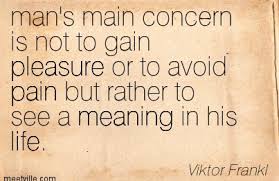
Now this meaning is of course different for everyone, he did not see one universal meaning. As Frankl said himself:

“For the meaning of life differs from man to man, from day to day and from hour to hour. What matters, therefore, is not the meaning of life in general but rather the specific meaning of a person’s life at a given moment.”

Frankl claimed that meaning is discovered through creative and worthwhile activities, by creating something beautiful or doing good. That meaning can be found through experiencing and sharing in the beauty of art or nature or through loving or ethical encounters with others. That even in the most horrific and terrifyingly hopeless situations we still have the capacity to choose our attitude towards whatever circumstances we are faced with. It is our response to life’s events that shapes our souls. Remember Frankl developed his theory during the utter despair and horror of the Nazi death camps.

As Frankl himself said “Everything can be taken from a man but one thing: the last of the human freedoms – to choose one’s attitude in any given set of circumstances.”

I attended many other wonderful workshops throughout the FUSE weekend and experienced many more beautiful moments of connection and conversation, too many to mention now. There was one that stood out though. It was during a session about listening in which we were asked to break into threes and listen to one another in non-responsive and non-judgemental ways. Now just as I broke into a three, there were originally five groups of three, just by chance another person came in late and wanted to join in. The facilitator of the group asked if one of the threes could become two two’s and the group I was in did so. So we were now two. This meant that the whole process did not work as it was meant to, but what actually followed was deeply meaningful and seemingly exactly what my partner in the exercise required right then. He began to speak about something I had shared publicly some time ago that had helped him immensely and lead him down a path. I couldn’t even remember saying it, but it did sound like something I would say. My partner then began to open up about some pain and struggle he had been going through. We spent the whole session sharing and listening uninterrupted and he seemingly came to a place of conclusion in the time together.

The session had not gone the way it had been planned to but something far more important had emerged instead, something deeply moving and meaningful. Now some could suggest that this was “meant to be”. Perhaps this is true, nobody knows. My preferred conclusion is that this was a moment of possibility for both of us. A moment we took and meaning emerged from it due to our response to the given situation and the many situations that followed it. I believe that it is a perfect example of meaningful interchange and how the Lure of Divine Love operates. It does not control life and nothing is pre-determined but it is their offering itself constantly and it is up to us to respond. It is certainly how meaning emerges in my life. My task and I believe all our tasks is to stay open to these moments, and that by staying open to every moment our own meaning emerges from them as they pass.

There are those that say that life has no meaning, that nothing matters in life. I was once one of these people. These days I see no truth in such statements. These days I see meaning in everything, even in the most painful moments in life. In fact I have discovered that it has been through coming through these most painful moments that the greatest meaning has emerged. Not immediately always but eventually, as I have been able to give back to others from the experience of the suffering I have experienced and or witnessed. This in no way justifies the suffering please do not get me wrong, I am in no way suggesting any such thing. No what I am saying is that through living openly meaning can emerge. Meaning can merge from living by the way of the Lure of Divine Love.


Saturday, 13 February 2016

The Highest Form Of Love

I love language and its many nuances. You can learn a lot about a culture and what it holds as most important by its language. Iceland has for example many words for snow. Some have suggested even a hundred, although a more accurate figure is probably about 40. The Icelandic language has many subtle variations for different types of snow and the time of day and year in which the snow has fallen. The English language has just one word, snow.

The English language also only has one word for Love, love. Love it is clear comes in many forms and yet we only have one word that seems to cover every single type of love going. The love I have for language is not the same love I had for my grandfather who died a couple of years ago or other forms of love I held and hold for other people. Dear friends I have known, family members who have loved me unconditionally, lovers I have known and brothers in arms. My love for Yorkshire cricket and all things Yorkshire or the music of New Model Army. My love for the congregations I serve and this work I have been given. All these loves come under the same umbrella of “Love”, but they are not the same kind of love, no not at all. That said “Love” is the only word I have to use, thanks to limits of the English language that I profess to love.

Now unlike the English language of the 21st century the ancient Greeks had at least six, perhaps even more, different words for love. The main six were “Eros”, which was primarily sexual or passionate desire. This may surprise some but the ancient Greeks did not always hold a positive view of Eros, It could be seen as fiery and irrational. It involved a loss of control that was feared. Just think of the story of Helen of Troy, “the face that sailed a thousand ships.” Plato saw it as “Divine” madness. The ancient Greeks understood what it meant to “fall madly in love”. I have been consumed by this kind of overpowering love many times in my life, I hope to goodness I will again. It is a part of our humanity, but not the only part.

The Greeks viewed “Philia” as a higher form of love than “Eros”. This is the type of love that develops through deep friendships. When they spoke of “Philia” they were often talking of the kind of love that was formed on the battlefield between comrades in arms, brotherly love. It’s the kind of love that compels a person to go to any lengths to protect the person or persons they love; it’s the kind of love that inspires self-sacrifice. In many ways it is similar to “Storge” which the ancient Greeks described as the love parents feel for their children. When I look at my life this is a love that has grown and developed in me in recent years. It’s the kind of love that is formed in 12 step fellowships and religious communities, you see it in sporting teams too and other communities where people bind together and look out for one another.

Another form of love that the Ancient Greeks spoke of was “Ludus”. This is a kind of playful or flirtatious love. It comes alive in friendly banter, around the people we feel comfortable with or when we dance and flirt with others. It’s the love that comes alive when I joke with members of the congregations I serve during worship. It’s the wink of the eye and the knowing smile.

Another form is Agape love. This is a love without prejudice, a selfless love, some call it religious love. In Christianity it is seen as the highest form of love. When translated into Latin it became Caritas from which comes the word charity. This is the love that is spoken of by the Epistle Paul’s in 1 Corinthians 13 “4Love is patient, love is kind. It does not envy, it does not boast, it is not proud. 5It is not rude, it is not self-seeking, it is not easily angered, it keeps no record of wrongs.6Love does not delight in evil but rejoices with the truth. 7It always protects, always trusts, always hopes, always perseveres.” Agape has parallels with the Buddhist concept of “metta” or “universal loving kindness”. The Buddha’s word’s on loving kindness, the Metta Sutta says. “So with a boundless heart; Should one cherish all living beings; Radiating kindness over the entire world:”

Another form was “Pragma” or longstanding love. This is a form of mature love that develops over long-term relationships say between married couples. Pragma was about making compromises and developing patience and tolerance so that relationships could mature over time. It was not so much about the madness of falling in love we find in “eros” and more about standing and holding in love. I suspect that this is the kind of love we see less and less of these days. People of my generation seem to be inspired by the need to be free and have their personal needs met, rather than this kind of love. It’s not something I’ve ever been any good at myself, I must admit.

The final form was “Philautia” or self-love. Now for the ancient Greeks this manifested in two ways. It had both a light and a shadow side. Its negative aspect was a form of narcissistic self-obsession, which was motivated by vanity and greed and self-absorption, to the total neglect of others. Think of the story “Echo and Narcissus”. Yet the other aspect of “Philautia” “self-love” was, perhaps the most important, and from which all forms of healthy human love grew. It is what today we would describe as positive self-regard, although actually I believe it runs much deeper than that. It is the kind of experience that is vital in order to deeply and appropriately love others and for that matter all life. Without this sense of love being at the core of who we are we are never going to offer “Agape” love to others, or not in a positive way. This is because we will love our neighbour as ourselves, in the sense that we will hate them as we hate ourselves, if we do not experience this form of love at the core of our being.

We need to love our reflection as we look at it in the glass, “warts and all and beauty spots too”, although we need to guard against becoming self-absorbed. Remember we are formed from the same stuff as everyone else and in everyone is a reflection of the divine. We are formed from the divine spark.

The ancient Greeks considered Philautia to be the highest form of “Love” and I believe that they were right.

Have you heard of Philautia before? Have you ever tried to practise it? For most folk true Philautia is the area where there is perhaps the greatest potential for growth and yet it is the one area that most of us feel least comfortable exploring. The ancient Greeks believed that when philautia was practiced appropriately (in a healthy, blanced and non-narcisisstic way) it provided the foundation upon which all other love could be built. You see the better your self-love-foundation is, the more brilliant loving life you could build.

If you do not experience and express the love within you, the love that you are formed from, you cannot offer real love to others. It is often said that before you can give to others you need to take care of yourself. If you give too much from your cup, your well will soon become dry and you will be unable to help others. It is said that you’ve got to look after yourself first, before you can help others. This to me is an expression of Philautia, real self-love. The aeroplane analogy is often used, which goes something like the following. If you are in an aeroplane and it gets into distress, so much so that the cabin becomes de-compressed, leading to the oxygen masks having to be deployed, before you can help anyone else you must first secure your own oxygen mask. This is not a selfish act, but it is an act of self-love, taking care of yourself so that you can then take care of others. We need to take care of ourselves if we are to be of use to anyone or anything. If we do not take care of our basic human needs, it means we end up depending on others to do so for us. This I believe leads to unhealthy and needy expressions of so called love.

This brings me back to thoughts around “The Golden Rule”, the core principle of all good religion and philosophy. It is for me the core of everything and the true expression of God manifesting in human life, for God is love. I believe that we all live by the golden rule, we do in fact love our neighbour as we love ourselves. The problem being that often we do not truly recognise the love we are created from. We can feel shame about loving ourselves. We somehow see this as being selfish or narcissistic, when that is the last thing that it is. In fact philautia, self-love, is essential to truly loving our neighbours as the very same children of love, children of God that we ourselves are. By failing to love ourselves we are actually separating ourselves from the rest of the creative life. We need to respect and celebrate our own beautiful uniqueness in order to recognise this in others.

We need to let go of the idea that loving ourselves truly as we, warts and all and beauty spots too is in any sense a selfish or narcissistic act. Please remember that a selfish person is interested only in himself wants everything for herself; can see nothing but her or himself. A selfish person does not love herself too much, but too little. You see the truth is that a truly selfish person is incapable of loving others because they are seemingly unable to love themselves.

To truly love yourself is to follow that greatest commandment, it is to acknowledge that love is at the root of all that we are. If we do not love ourselves, then we cannot love our neighbour.

Parker Palmer said that:

“Self-care is never a selfish act—it is simply good stewardship of the only gift I have, the gift I was put on earth to offer to others.”

Taking care of ourselves, emotionally, mentally, physically and spiritually is not a selfish act, it is the opposite it is loving act. In fact I would suggest to not do so is actually more like selfishness as we usually understand it. It is our responsibility in fact to take care of the life we have been given. Each life is unique and is there to be used for the purpose of all. To truly achieve this we need to take care of ourselves and to express our joy in life. You see to be joyful, to be happy, is to express all that you are; to be all that you can be is neither selfish or greedy, it is a true expression of love in all its forms.

It is what we are here for and it inspires others to love both themselves and each other too.

So my message to you on Valentines Day, on this festival of Love is simply this. Love all life, love all that you are, warts and all and beauty spots too…Fill your heart with the love that surrounds you and pour out this love on our love starved world, for it surely needs it…

I’m going to end this little "blogspot" with a blessing by Barbara Pescan, taken from “Morning Watch”

“Blessing” by Barbara Pescan from “Morning Watch”

We spend so much time running from ourselves
Fleeing from what we know
about the goodness in our hearts
we think we can escape
the intelligence of our loving.

Imagine you are standing before a bodhisattva—
Jesus, Buddha, the first mother
it does not matter what you call the holy one—
he has dust on his shoes
chaff clings to her
the smells of being alive—
Shining from their faces is the beam of
all their questions
the compassion of their living

Can you see yourself through those eyes?
Can we know each other like this?
(We, who no longer believe in messiahs
can hardly believe in each other.)

Can we
know ourselves seen
and know each other this same way
until our restless hearts
learn to abide
in this knowing and this love?
Can we live in this gaze of blessing?

Saturday, 6 February 2016

If Only

In “Love and Death: My Journey through the Valley of the Shadow”, a book written while he knew that he was dying, Forrest Church wrote,

“The only way to reconcile yourself, make peace with yourself, make peace with your neighbor, make peace with God, find salvation, is to break through and love — to forgive and to love. You don’t change the person you forgive. You change your own heart. So anything that you can do to reconcile also means that at the end of your life, when you’re given a few months to live, you can look back without regret.

The two saddest words in the English language are “if only,” and they ring with the most poignancy at a time that a person gets word that he or she has a terminal illness: “If only I had stopped drinking; if only I had dared to change careers when I could; if only I had reconciled with my father when I had a chance.”

I agree with Forrest. I believe that “If Only” are the saddest two words in the English language. I would add also that they are loneliest too. How many of us live with this sense of regret for the things we have done, or just as painfully failed to do? How many of us live in isolation from people we have known and loved in our lives because of our pride? How many of us have let past wrongs done, or perceived to have been done, stop us living the loving and connected lives we are capable of?

So why do we find it so hard to seek and give forgiveness? Why is reconciliation so challenging? Why does pride hold us in this sense of regret? Why are so many of us visited in the darkest night with the ghosts that whisper “If Only”

Well because it is not easy. It requires us to rise above and beyond our small selves to a larger way of being. As Sara Moores Campbell has claimed. “There is incredible power in forgiveness. But forgiveness is not rational. One can seldom find a reason to forgive or be forgiven. Forgiveness is often undeserved. It may require a dimension of justice (penance, in traditional terms), but not always, for what it holds sacred is not fairness, but self-respect and community. Forgiveness does not wipe away guilt, but invites reconciliation. And it is as important to be able to forgive as it is to be forgiven.”

No it is not easy, but it is vital. Not only for ourselves but for the greater good also. Forgiveness is about reconciliation it is about bringing wholeness and healing to all. This is why, in my experience, failing to offer forgiveness and failing to atone for our own wrongs and mistakes makes reconciliation impossible and I have come to believe that it is this that breeds a sense of isolation and loneliness, deep within us. It is not by chance that atonement can be broken down to at-one-ment. For it is such acts that bring about oneness in life.

I recently spent a few days away with a group of people exploring the subject of forgiveness. We were together in a beautiful and loving setting and it was an open environment in which we all talked about our struggles with forgiveness of others and of ourselves. I believe that we all gained a great deal from our time together and I hope it renewed us in our efforts to reconcile ourselves with our pasts and those we have shared our lives with, so as to live better lives in the future. One thing that came strongly out of the weekend was this sense that forgiveness is not about forgetting. Yes it is about healing and reconciliation, but not about simply abandoning the past and passively letting go. In fact if anything real forgiveness is a true act of remembrance. It is about growing from the past and becoming increasingly whole people.

Again as Sara Moores Campbell said, “No, we do not forgive and forget. But when we invite the power of forgiveness, we release ourselves from some of the destructive hold the past has on us. Our hatred, our anger, our need to feel wronged – those will destroy us, whether a relationship is reconciled or not.”

Our varied struggles with forgiveness showed how difficult it was to truly reconcile ourselves with our pasts, with ourselves and with those we have shared and share our lives with. Forgiveness is not easy. It is easy to say perhaps “I forgive you”, but those are just words, it is far from easy to truly mean them though. We cannot just simply will ourselves into it and it certainly isn’t an overnight matter. The key, as in all things, is to be open to it. Here lays its power and its love. Here lays the key to be freed from that aching loneliness of regret and the ghosts of “If Only”. Not only for ourselves but for the good of all. I have come to believe that all our lives depend upon it

Again to quote Sara Moores Campbell,

“…we cannot just will ourselves to enter into forgiveness, either as givers or receivers. We can know it is right and that we want to do it and still not be able to.

We can, however, be open and receptive to the power of forgiveness, which, like any gift of the spirit, isn’t of our own making. Its power is rooted in love. The Greek word for this kind of love is agape as “Love seeking to create community.” This kind of love is human, but is also the grace of transcendent power that lifts us out of ourselves. It transforms and heals; and even when we are separated by time or space or death, it reconciles us to ourselves and to Life. For its power abides not just between us but within us. If we invite the power of agape to heal our personal wounds and give us the gift of forgiveness, we would give our world a better chance of survival.”

At one point during the weekend we discussed the limits of forgiveness and whether there were any. A friend said that he didn’t know how he would react if someone did anything to his son and many people agreed with him and then I shared an example of this and the power forgiveness. I recounted my dear friend Claire’s reaction to witnessing her son being killed in front of her on a crossing. The driver did not stop at the crossing and took Ethan’s life. A power from within or beyond her compelled her to forgive him there and then. I know from watching her piece her life back together since that if she hadn’t have done so there and then she could not have survived herself or if she had she would have lived with an aching bitterness for the rest of her life. Not that the last nine years have been easy, she has been to hell and back many times, but that power, the power of love, has held her through it all and I believe that it was that same power that compelled her to forgive the driver of the car that day on the side of the road. A love that passeth all rational understanding, but one that can hold and sustain us through whatever happens in life, if we would let it have its way and bring it to life in our being.

Forgiveness is a true act of Love, in the purest Agapeic sense of the word. It is an act of the heart, it takes real courage, Remember that courage comes from the French word for heart “Coeur” In the Hindu sacred poem “The Bhagavad Gita” you hear this reflected “If you want to see the brave, look at those who can forgive, If you want to see the heroic, look at those who can love in return for hatred.” You see it reflected in the dying words of Jesus on the cross “Father forgive them, for they know not what they do.” This same loving courage was expressed in the way that both Martin Luther King and Gandhi led their movements of non-violent resistance. These were powerful loving soul forces that inspired healing and reconciliation taken up by the likes of Arch Bishop Desmond Tutu in South Africa and “The Truth and Reconciliation Hearings” that took place there following the end of Apartheid. It can be the same with our individuals lives and our individual hearts. At some level I think we all need to reconcile ourselves with someone or something, even if it is just our own pasts.

This is why I have come to believe that forgiving is not about forgetting at all. In fact what it is really about is remembering. Actually it is more than that, forgiveness is an act of remembrance. It is about bringing the memory alive and creating something from the past. Reconciliation is not just something that occurs between us, but also within us. In each of our hearts and minds and souls. If we can make something from our past hurts we can create meaning from even the hardest moments of our lives and bring a new wholeness and openness to our lives. In so doing we won’t live out our lives with that aching lonely feeling of regret and be visited by the ghosts of “If Only”. In so doing we will leave something to pass on to those who follow and our lives will have truly proved worth dying for, by the love we have left behind.

Below is the full version of Sara Moores Campbell's reflection on "Forgiveness" quoted above

“Forgiveness” by Sara Moores Campbell, from “Into the Wilderness”

There is incredible power in forgiveness. But forgiveness is not rational. One can seldom find a reason to forgive or be forgiven. Forgiveness is often undeserved. It may require a dimension of justice (penance, in traditional terms), but not always, for what it holds sacred is not fairness, but self-respect and community. Forgiveness does not wipe away guilt, but invites reconciliation. And it is as important to be able to forgive as it is to be forgiven.

No, we do not forgive and forget. But when we invite the power of forgiveness, we release ourselves from some of the destructive hold the past has on us. Our hatred, our anger, our need to feel wronged – those will destroy us, whether a relationship is reconciled or not.

But we cannot just will ourselves to enter into forgiveness, either as givers or receivers. We can know it is right and that we want to do it and still not be able to.

We can, however, be open and receptive to the power of forgiveness, which, like any gift of the spirit, isn’t of our own making. Its power is rooted in love. The Greek word for this kind of love is agape as “Love seeking to create community.” This kind of love is human, but is also the grace of transcendent power that lifts us out of ourselves. It transforms and heals; and even when we are separated by time or space or death, it reconciles us to ourselves and to Life. For its power abides not just between us but within us. If we invite the power of agape to heal our personal wounds and give us the gift of forgiveness, we would give our world a better chance of survival.


Saturday, 30 January 2016

Wake Now My Senses To Hear Life's Call

“i thank You God for most this amazing day” by ee cummings

i thank You God for most this amazing day:
for the leaping greenly spirits of trees and a blue true dream of sky;
and for everything which is natural which is infinite which is yes

(i who have died am alive again today, and this is the sun's birthday;
this is the birth day of life and love and wings:
and of the gay great happening illimitably earth)

how should tasting touching hearing seeing breathing any
--lifted from the no of all nothing—
human merely being doubt unimaginable You?

(now the ears of my ears awake
And now the eyes of my eyes are opened)

I was out walking the other day, when I once again experienced what is voiced so beautifully in the words above by e e cummings; once again the ears of my ears had awoken and the eyes of my eyes had opened to something new. In fact it felt as though all my senses had opened like they had never opened before.

Now one of the reasons for this was that I had just had my ears cleared. I had for weeks been suffering quite badly with my hearing and at last the treatment had worked and I could hear clearly once again. I had also in recent times had trouble with my voice, I felt like I had lost my voice somewhat. Thankfully this seems to have been resolved. I have, as I have many times, re-found my voice. The changes in my voice had been due to the weight loss over the last few months. So many of the physical aspects of my being have changed and this has taken some re-adjustment in my living and being. I feel I can hear in a new way and I can speak once again. I have also noticed other changes in all my senses, including what they call the sixth sense…My senses have been awakened as I have heard life’s call.

Now as I was walking I noticed I could hear many new bird songs and just as I looked up and noticed birds, I had not paid attention to before, a smell filled my nostrils that reawakened a childhood memory. My mind turned to a time, during my childhood, when I would have been about 11. The smell reminded me of working in my dad’s butchers shop and of making sausages and beef burgers, a job I used to delight in doing. I smiled as I waked and as I did lots of other memories came flooding back into my current consciousness. Memories that only brought joy and happiness at this moment, but ones that have in past brought tears and pain to my experiences. Memory, or at least the way I remember has changed so much over time.

They say that you cannot re-write history and that you cannot change the past. I am not convinced by this. I have noticed that as time has gone by so much of my life, or at least how I remember my life has changed. Now don’t get me wrong it’s not that the events have changed, just how I remember them. The darkness and the pain is still there, only now it is the correct proportion. Today the difficult memories are surrounded and filled by the joy and the love that was always there too.

Memory is a fascinating thing and I do believe it is connected to way we experience life currently. I suspect that it is connected to our senses and how awake they are to our current experiences. Just as the way that we feel about our past influences, impacts on, our current lives. Therefore it was no surprise that the opening of my senses brought a new experience of my past.

Now the sense of smell has long been connected to memory. Neuro-science suggests that upon detecting a smell the olfactory neurones in the upper part of the nose generate an impulse which is passed to the brain along the olfactory nerve. The part of the brain this arrives at first is called the olfactory bulb, which processes the signal and then passes information about the smell to other areas closely connected to it, collectively known as the limbic system.

The limbic system comprises a set of structures within the brain that are regarded  as playing a major role in controlling mood, memory, behaviour and emotion. This affects areas of what is often referred to as “the old brain”, so called as they were present within the brains of the very first mammals. It is suggested that those with full olfactory function may be able to think of smells that evoke particular memories and that this can happen spontaneously. This is exactly what happened to me while out walking the other day, as I felt my senses had reawakened, once again, as long forgotten memories came alive in my current consciousness. 

Wake now my senses, let me hear life’s call.

Just as how I experience the present moment effects how I remember the past, I also believe it is important to understand that how I remember impacts on how I experience the present moment and also how I experience the future. As I look at times in my own spiritual journey I regret my attempts to reject my past. I now know that to truly bring the moment alive, rather than to just passively live in the moment, I must bring the experience of my whole life into my experience of my living and being right here and right now. That includes those memories that cause pain and distress. Attempting to fully let go of them is neither healthy nor possible.

I love the way that John O’Donohue expressed the importance of memory and remembering in living a fully present live. In “Eternal Echoes” he wrote
“Memory is the place where our vanished days secretly gather. Memory rescues experience from total disappearance. The kingdom of memory is full of the ruins of presence. It is astonishing how faithful experience actually is; how it never vanishes completely. Experience leaves deep traces in us. It is surprising that years after something has happened to you the needle of thought can hit some groove in the mind, and music of a long vanished event can rise in your soul as fresh and vital as the evening it happened. Memory provides such shelter and continuity of identity. Memory is also fascinating because it is an indirect and latent presence in one's mind. The past seems to be gone and absent. Yet the grooves in the mind hold the traces and vestiga of everything that has ever happened to us. Nothing is ever lost or forgotten. In a culture addicted to the instant, there is a great amnesia. Yet it is only through the act of remembrance, literally re-membering, that we can come to poise, integrity, and courage. Amnesia clogs the inner compass and makes the mind homeless. Amnesia makes the sense of absence intense and haunted. We need to retrieve the activity of remembering, for it is here that we are rooted and gathered.”

Sometimes memory can become blocked up in our bodies too. I noticed the other day, while experiencing a deep tissue massage, memories come out of my being as I entered a place of deep meditation and transcendence. It brought to mind the following, taken from “A Walk Between Heaven and Earth” by Burghild Nina Holzer


"From time to time a friend comes to my house to give me a massage. I have decided that “massage” is a very inappropriate word for it. I decided this should be called “listening to the flesh.” She touches my body, and in each place she touches, the body has stored pain and joy, memories, knowledge of many kinds. And I begin to listen – to my arm, my shoulder, my belly, the soles of my feet, my tongue, my uterus.

I begin to walk in the landscape of my body, the landscape of my flesh. And I begin to write the autobiography of my flesh.

Perhaps my toe wants to tell me a story about my childhood, of the slimy places it touched, the sharp-edged stones, of the times when it still reached my mouth, toe or thumb being equally good.

Perhaps my womb wants to cry the story of the child I lost, of what wanted to be formed and what slipped out into darkness before it could be held securely by the arms near the heart.

Maybe my throat wants to tell me of all the songs held back. Held back in fear, or in doubt, or in anger, all the songs that the heart already knows but that I have not voiced. Perhaps I need to walk in that place, down my throat to my vocal cords."

All this brought to mind a favourite Bible passage from Mark’s Gospel (Ch7 vv 31-37) of Jesus healing a deaf mute man. I once heard Rev Bill Darlison preach on this. He believed that the passage and this particular section of Mark’s Gospel is attempting to teach us of the need to live more open and connected lives. He pointed out that the author is trying to make us listen by using a clever linguistic aid. In the account he states that Jesus says the Arameaic word Ephphatha as he heals the man. This is perhaps not so strange on the surface as this is certainly the language that Jesus would have spoken. What is strange though is that this is inconsistent with the rest of the Gospel which was originally written in Greek. Bill says that this is a deliberate ploy to make we who are listening to the account pay attention, because something really important is being taught here. In a published version of the address Bill states that:

“The word Ephphatha means ‘Open up!’ What Jesus is saying to this deaf man is the Gospel’s message to you and me. This man was suffering from a physical deafness; we are suffering from spiritual deafness. Our ears are closed to the entreaties of those who live in foreign countries, whose skin colour is different from our own, whose way of life does not correspond with ours. We are deaf to the words even of those who live in close proximity to us, but whose traditions are different from ours. We don’t hear what they are saying, and so our opinions about them and their customs are garbled and worthless...It’s a shocking reminder of our own refusal to listen attentively to the unfamiliar voices. It is only when we are prepared to open up that our prejudices can be eroded; and only then that the impediment in our speech will be removed and our opinions will be worth listening to. We have to break the shell of our own tribalism and exclusiveness.”

(now the ears of my ears awake And now the eyes of my eyes are opened)

I have come to believe that in order to live fully awake, mentally, physically and spiritually requires one to be awake to all that is, all that has been and all that has ever been. It is of no use just merely living in the present, in a passive sense, to merely be the observer. The spiritual life is one of engagement. Of being fully alive and I believe to be fully engaged and alive to what is occurring right here we also need to be awake to all that has been too and to therefore give ourselves fully to what is yet to come.

This requires us to have all our sense fully awake and fully engaged, to use all our senses, including the sixth sense. In so doing we will be able to live fully engaged and meaningful lives.

We need to awaken all our senses and thus not only hear life’s call,  but to also respond to it…

Amen


Saturday, 16 January 2016

Go placidly, not passively, amidst the storm


“A man seeks employment on a farm. He hands his letter of recommendation to his new employer. It reads simply, `He sleeps in a storm.’

The owner is desperate for help, so he hires the man.

Several week pass, and suddenly, in the middle of the night, a powerful storm rips through the valley.

Awakened by the swirling rain and howling wind, the owner leaps out of bed. He calls for his new hired hand, but the man is sleeping soundly.

So he dashes off to the barn. He sees, to his amazement, that the animals are secure with plenty of feed. He runs out to the field. He sees the bales of wheat have been bound and are wrapped in tarpaulins. He races to the silo. The doors are latched, and the grain is dry.

And then he understands.

`He sleeps in a storm.’

My friends, if we tend to the things that are important in life, if we are right with those we love and behave in line with our [beliefs], our lives will not be cursed with the aching throb of unfulfilled business. Our words will always be sincere, our embraces will be tight. We will never wallow in the agony of `I could have, I should have.’ We can sleep in a storm.

And when it’s time, our good-byes will be complete.”

I love this extract taken from Have a Little Faith” by Mitch Albom. A book set over an 8 year period exploring the lives of two extraordinary men. One is the authors childhood Rabbi Albert Lewis and the other is a former drug addict criminal Henry Covington who spends his time serving a community of homeless people and addicts in a run down former town church. “He sleeps in a storm” is an extract from a sermon delivered by the Rabbi

Now generally I am much like the man in the story. I sleep well and deeply. This hasn’t always been the case I used to suffer terribly from insomnia. I suspect that this is because so much of my mind was chaotic and certainly I didn’t tend to the things I needed to in my inner or outer life. Like so many of my generation, I lived a meaningless and unfulfilled life. Deep down inside I knew this, my mind never rested and as a result, I did not sleep.

Thankfully this is no longer the case. I tend to what needs to be tended to and as a result I am able to rest when it is time to rest and give myself fully to what life asks of me when I am awake. I am able to do my work calmly, without becoming overwhelmed by it. As a result, despite the many challenges, my life is rich with meaning and fully of life. As I often I like to say I live a wonderfulfilling life.

That said over the last couple of weeks I have suffered once again from insomnia. This has been due to an ear problem which has now thankfully been resolved. It did remind me though of those old days. This brought both gratitude and empathy to my heart and mind. Gratitude that I know peace, even in the storms of life as well as empathy for those who suffer from restlessness at night. For as I know it can feel like a living hell.

It is so easy to be overwhelmed by life’s troubles and become paralysed by the fear of what might be. This can lead to the opposite extreme of indifference to life and a rejection of it all. This is no way to live. We can live in the world, recognising all that is life, without being utterly consumed by all that is wrong. We are not powerless, in the face of the storms present in life, but then again neither can we control it all. We cannot do everything, but we can play our part in the drama of life. We can live our lives in the storm of it all, without getting destroyed by the whirlwind as it blows and we can rest when it is time to do so.

This brings to mind some wisdom I discovered while reading Forrest Church’s masterpiece “Love and Death: My Journey Through the Valley of the Shadow”, written while he was dying of oesophageal cancer. He asked knowing that we will die, what should we do? To which he answered we should live, we should laugh, and we should love. He then recalled a lesson he learnt from his children, about living. One day, when they were young, he was walking them to school, on a busy New York street. Suddenly a car swerved round a corner and almost killed them all. Forrest was incensed by this, but he remembers, "my kids just laughed, romping blithely down the sidewalk, jumping from tree to tree as they always did, trying to touch the leaves." The kids were celebrating, nay singing the joy of living, and they "had the right idea. Why didn't I think to jump and touch the leaves?"

Forrest believed that it was living, loving and laughing that took real courage, they required heart, while dying didn’t really take much courage at all, in his eyes that just came naturally.

Now to really live Forrest suggested a simple little mantra:" Want what you have. Do what you can. Be who you are." He didn’t suggest that this would be easy but it is the only way to live and in so doing we will live in such a way that our lives will prove worth dying for by the love we leave behind.

“Be Who You Are” means to live authentically, to live by your own truth, to follow your heart’s desire, this takes real courage.

“Do What You Can” means doing what you are able to do in the world you find yourself. To play your role in life, remembering there are no small parts only small players. Don’t try and be the director and control everything and everyone else, you can’t control the wind, but you can play your part and do the best you can.

“Want What You Have” is really about wanting all that is your life right here right now, not fleeing from anything or wishing your life away. It’s about not dwelling and counting the many blessings that are present right here, right now. It’s about thoughtful wishing not wishful thinking.

Now this all brings me to the following beautiful piece of wisdom "The Desiderata". Simple spiritual and practical design for living...


“Desiderata” by Max Ehrmann

Go placidly amid the noise and haste, and remember what peace there may be in silence.
As far as possible without surrender be on good terms with all persons.
Speak your truth quietly and clearly; and listen to others, even the dull and ignorant; they too have their story.
Avoid loud and aggressive persons, they are vexations to the spirit.
If you compare yourself with others, you may become vain and bitter;
for always there will be greater and lesser persons than yourself.
Enjoy your achievements as well as your plans.
Keep interested in your career, however humble; it is a real possession in the changing fortunes of time.
Exercise caution in your business affairs; for the world is full of trickery.
But let this not blind you to what virtue there is; many persons strive for high ideals;
and everywhere life is full of heroism.
Be yourself.
Especially, do not feign affection.
Neither be critical about love; for in the face of all aridity and disenchantment it is as perennial as the grass.
Take kindly the counsel of the years, gracefully surrendering the things of youth.
Nurture strength of spirit to shield you in sudden misfortune. But do not distress yourself with imaginings.
Many fears are born of fatigue and loneliness. Beyond a wholesome discipline, be gentle with yourself.
You are a child of the universe, no less than the trees and the stars;
you have a right to be here.
And whether or not it is clear to you, no doubt the universe is unfolding as it should.
Therefore be at peace with God, whatever you conceive Him to be,
and whatever your labors and aspirations, in the noisy confusion of life keep peace with your soul.
With all its sham, drudgery and broken dreams, it is still a beautiful world. Be careful. Strive to be happy.

© Max Ehrmann 1927


“The Desiderata”, begins with these beautiful words “Go placidly amongst the noise and haste” please note it says placidly not passively…In my experience there is nothing passive about living spiritually. The spiritual life is an active life. We are not merely observers here, we are active participants and life demands that we play our roles, while not becoming the director and attempting to control the roles that others are here to play. It is wanting what you have, doing what you can and being who you are in verse form.

The Desiderata has been around for a hundred years now. It first came into my consciousness about 20 years ago and it has been beautifully haunting me ever since. It kept on reappearing, even in my darkest and most secular days. Even when I thought such things were nonsense it has kept on knocking on the window of my soul. I was given a framed copy of it recently by someone I had been doing what I can to help, as a token of their appreciation. It now sits proudly on the desk in my vestry.

The “Desiderata” was written a hundred years ago by Max Ehrmann. It was copyrighted in 1927 but was first penned several years previous to this. It has spoken to several generations since then. It has developed its own life it would seem, including a myth that attempts to make it timeless, it does appear to have that quality about it. The myth began following a reproduction of it by Rev Frederick Kates for a collection of inspirational works for his congregation in 1959 on church notepaper, headed: 'The Old St Paul's Church, Baltimore, AD 1692' (the year the church was founded). Copies of it were circulated and the myth began to grow. It really took off when a copy was found at the bedside of deceased Democratic politician Aidlai Stevenson in 1965.

I like the myth, it does lend a timeless and universal quality that makes the myth into a true mythos. “Desiderata” is a beautiful and practical poem and a wonderful design for spiritual living in my eyes. One that I try to follow, despite the storms of life. It enables me to do what I can. To truly live faithfully and to rest and allow life to be what it can be, while I play my role, the best I can.

We can all go placidly amongst the noise and haste, we can live and we can rest when the storms of life really blow. We can give ourselves fully to the life we have been given. We can want we have, do what we can and be who we are. We can all live in such a way that our lives will prove worth dying for by the love we leave behind and when our time comes we can once more step into the great mystery and the final eternal sleep.


Saturday, 9 January 2016

We come together in Love

O come together in truth;
O come together in peace;
O come together in joy and sharing,
Come together in joy and sharing,
Come together in knowing and caring;
Come together,
O come together,
O come together in love.

Beautiful words by Dorothy Grover, from a much loved hymn.

They describe why I became a part of spiritual community. They are not the reason why I went from a secular singular person to one who sought out spiritual community, but they are why I stayed. I came to try and understand, to make sense of the sudden and profound changes that had occurred in my life some 11 years ago, changes that have continued on and on and on. I have not found the answers I was seeking by the way, in fact if anything there are many more questions today than there was then. What community has given me, amongst so many others is a space to explore those and many other questions with like hearted people. In such an environment I have learnt to not only ask and listen to the questions, but to truly live them. I came seeking answers, but it is not why I stayed. I stayed because I found something far more than I was consciously looking for. I stayed because I found community, I found true belonging. I found love. I found my heart's desire.

We come together in search
Of new beginnings for all,
Where understanding and trust surround us –
Gone the hate and fear that bound us;
Come together,
O come together,
O come together in love.

Loving community is something that I believe everyone needs, in order to truly thrive and grow and become all that they can be.

Starhawk catches this need near perfectly when she writes:

“Community. Somewhere, there are people to whom we can speak with passion without having the words catch in our throats. Somewhere a circle of hands will open to receive us, eyes will light up as we enter, voices will celebrate with us whenever we come into our own power. Community means strength that joins our strength to do the work that needs to be done. Arms to hold us when we falter. A circle of healing. A circle of friends. Someplace where we can be free.”

John O’Donohue describes beautifully what it means to come together in love. He wrote ““When we come together in compassion and generosity, the hidden belonging begins to come alive between us…”

Describing community as a constellation. And inspired, no doubt, by the spirit of Paul’s letter to Romans, he further stated “Each one of us is a different light in the emerging collective brightness. A constellation of light, of course, has greater power of illumination than any single light would have on its own. We need to come together. When people come together because they care and are motivated by the ideals of compassion and creativity, true belonging emerges, communities cease to be inward looking and enrich our world.”

Madeleine L’Engle in her piece from “Walking on Water”, was also no doubt inspired by the same spirit when she wrote the following.

“We all feed the lake. That is what is important. It is a corporate act. During my time in the theatre I knew what it was to be part of such an enlarging of the human potential, and though I was never more than a bit part player or an understudy, I knew the truth of Stanislavsky’s words: “There are no small roles. There are only small players.” And I had the joy of being an instrument in the great orchestra of a play, learning from the play (how much Chechov taught me during the run of Cherry Orchard), from the older actors and actresses. I was part of the Body. That’s what it’s all about.”

This is spiritual community, this is what it means to come together in love. Something which many observers say is going the way of the Dodo!

Many decry the state that we are in. they say that people are becoming increasingly isolated and selfish and that there is no community concern, no togetherness. Yet in recent weeks I have seen beautiful examples of people coming together in love and helping one another in difficult times. The devastating floods that have hit the north of England, parts of Wales and Scotland in and around the Christmas and New Year period has caused untold damage to individual lives and communities. And what has been the response, well I have witnessed so many people coming together in caring and sharing. Helping one another out in times of need.

One of my sisters lives on a Narrow Boat at Horbury Bridge in West Yorkshire, just off the River Calder. Over Christmas the water levels hit the highest point ever recorded and they and several other boats were in peril of rising above the canal bank and finding themselves on the tow path. Many of the people who they were moored with were away over the Christmas period. Those left behind were in peril but came together to support one another and keep all the boats safe. It was a scary time, but they came through it. I have seen and heard of many other similar examples up and down the land.

I had another personal example too, last week. My car broke down in stationary traffic on the motorway. It had overheated and I had to pull over on to the hard shoulder as there was steam coming out of the bonnet. I opened the bonnet and saw the water coolent tank looking like it was about to explode. I reacted foolishly, thinking I ought to loosen it and steam burst out and burnt my hand and face. I called to be rescued and the help came. As I stood there waiting in pain so many people called out pulled over and offered me water to help sooth my wounds. Just another example of people coming together in love, sharing and caring.

It is easy to get cynical about human nature and the selfishness that can grip us and yet there is a love there when it is allowed to flower and burst out on us all.

Having said all that our modern way of living does not encourage community as it once did. Last Sunday I was without a car. I could not get it into the garage to be repaired due to closures etc during the Christmas and New Year period. This meant that I had to travel by taxi between the congregations I serve. I got into a fascinating conversation with the taxi driver who began to tell me that he believed that his business would not be around for many more years.This was because Artificial Intelligence was taking over and that already in San Francisco there were taxi’s without drivers and that people would be increasingly turning to them. He also suggested that it would be the same in fast food outlets etc and all sorts of other industry. He suggested that increasingly there will be less and less human contact as all kinds of impersonal interaction would take over. He talked about the isolated lives that we live and lead these days and that young people don’t need to go out today and can live artificial as well as self-created and self-sustaining lives.

The image he painted was bleak. I did think to myself there was something of the Luddite in his fears, but he did make an interesting point. I pointed out to him, as I was paying for the ride, that one thing that would be lost would the fascinating human interactions that we had just shared in if things turned out that way.

The conversation awakened my homiletic consciousness and fed into some of the other thoughts I’ve already discussed in this blog. I thanked him for helping me write my sermon for this week. At which point we both laughed and smiled and got on with our business

I find it hard to believe that we humans will become what the taxi driver expressed. What I have witnessed in recent weeks has shown me that this spirit of coming together in love is powerful within us. Community may not be as obvious as it once was, but people will always come together in love, that spirit cannot die. There will always be community. As Howard Thurman once said “The moving finger of God in human history points ever in the same direction. There must be community.” There will always be community, the spirit will never let it die.

This is why, despite current trends, I believe that there will always be spiritual community. Privatised spirituality is not enough, for it does not truly bring the spirit alive. It loses power on its own it cannot thrive and grow. There is a need to come together in love; there is a need for community; there is a need for spiritual community.

Now I didn’t know this when I began searching for answers all those years ago. It’s not why I walked through the doors of Cross Street Chapel almost exactly 11 years ago to the day. I didn’t find what I was looking for, far from it. No, I found far more than I could have even begun to dream of. I found a place where I could come together in love…I hope and pray that it is something that everyone finds on their spiritual journeying.

Let’s continue to come together in truth; let’s continue to come together in peace; let’s continue to come together in joy and sharing; let’s continue to come together in knowing and caring; let’s continue to come together, o come together, o come together in love…

Saturday, 2 January 2016

I am not done with my changes

So here we are at the dawning of a New Year. It is hard to believe that it is 2016. Where do the years go? I wonder as I stand looking forward to the days ahead what this year will bring? What changes will occur and what will stay the same? As I look back at the year that has ended I also think about what has changed and what has stayed the same? Much is as it was then, but there has been changes. Nothing ever stays quite the same. Everything is always changing in some way or other, even if it isn’t always obvious. Or at least it appears that way.

Sometimes the changes are big and obvious. Sometimes things happen that change everything for ever. Some of those are close and personal and others are on a more global scale. There are moments in life that change everything for ever. Or so it seems.

Now last year was one of great change for me on a physical level. During the Watch Night service I led, I wrote on my piece of paper, that I burnt in the ceremony with others, that one thing I wanted to let go of was my excess weight. I had over the last few years grown heavier and heavier and I knew that something needed to be done about it. It had begun on trip to Alton Towers with some friends. I had become embarrassed during the day as every time I went on a ride I couldn’t fit into the safety harness and had to be put in the special seat for the very large. I left that day full of shame, but said nothing about it at the time. For months I made small attempts to change but could not bring it about myself. I also suffered a bout of bad health at the beginning of the year. I became quite ill, twice and became increasingly concerned about my physical well-being. I also noticed how this was impacting on my mental, emotional and spiritual health. Other people were noticing too and making comments. Well this all came to head last summer, particularly over the weekend of my nephew Joe’s wedding, when my car broke down in Devon and I experienced a kind of emotional and spiritual rock bottom. During this moment of surrender something changed within me. This opened me up to the possibility of seeking help and on returning home I began my weight loss journey, through Slimming World. I surrendered absolutely to the way of life they offered and over the next five months I reached my target weight and lost over 7 stones.

My life has changed immeasurable since. I have never felt better physically, mentally, emotionally and above all else spiritually.

Now this isn’t the first time I have had such experiences. I have known many rock bottoms in my life that have changed me. They have opened me up to new experiences, new awakenings, new beginnings. The changes never seem to come to an end. I have heard it said that the only thing permanent in life is change.

This brings to mind a favourite poem of mine, “The Layers” by Stanley Kunitz.


“The Layers” by Stanley Kunitz


I have walked through many lives,
some of them my own,
and I am not who I was,
though some principle of being
abides, from which I struggle
not to stray.
When I look behind,
as I am compelled to look
before I can gather strength
to proceed on my journey,
I see the milestones dwindling
toward the horizon
and the slow fires trailing
from the abandoned camp-sites,
over which scavenger angels
wheel on heavy wings.
Oh, I have made myself a tribe
out of my true affections,
and my tribe is scattered!
How shall the heart be reconciled
to its feast of losses?
In a rising wind
the manic dust of my friends,
those who fell along the way,
bitterly stings my face.
Yet I turn, I turn,
exulting somewhat,
with my will intact to go
wherever I need to go,
and every stone on the road
precious to me.
In my darkest night,
when the moon was covered
and I roamed through wreckage,
a nimbus-clouded voice
directed me:
“Live in the layers,
not on the litter.”
Though I lack the art
to decipher it,
no doubt the next chapter
in my book of transformations
is already written.
I am not done with my changes.


I am not done with my changes either, are any of us?

Yes it does seem true that the only thing permanent in life is change. Life itself is impermanent.

There is a gorgeous Buddhist saying that captures the beauty of the impermanence of life. It beautifully captures the turning nature of life, it is a call to us to live our lives fully.

“Thus shall you think of all this fleeting world: a star at dawn, a bubble in a stream, a flash of lightning in a summer cloud, a flickering flame, an illusion, a dream...”

Impermanence is the beauty and the energy of life. Life is forever changing and transforming and turning into something new.

Jesus captured this idea in a gorgeous way too when he described wheat as a metaphor for the resurrected life. He taught that all must die before new life can rise again. In the same way that seeds must die and cease being seeds in order to become life giving food, so must we in order to be transformed into something new. This can happen at many stages of our lives if we allow the natural cycle to just be and don’t get in the way.

Nothing ever stays exactly the same and nothing is ever repeated in exactly the same way again. This was wonderfully expressed by the ancient Greek philosopher Heraclitus some 2,500 years ago. Who said, among many other things, “Everything flows, nothing stands still.” “No one ever steps into the same river twice.” And “Nothing endures but change.” He was saying that the only constant in life was and is change, that life was constantly in flux and that everything is impermanent. In more contemporary times The Buddhist Pema Chodron has said “Impermanence is the goodness of reality…it’s the essence of everything.”

Also in more recent times the now deceased Unitarian Universalist minister Elizabeth Tarbox said

“Dukkha, all is impermanence, nothing lasts. I thought of that yesterday while watching leaves come down in a shower and inhaling the smell of rotting leaves returning to the earth. Leaf to humus and back to earth to nourish the roots of the mother tree, The crows crying as the leaves fall and their nests are exposed – dukkha, all is impermanence.

Life goes by and people who were with us last year at this time have died. All souls pass on, all is dukkha, nothing lasts.”

I have for some time been fascinated by the Buddhist concept of “Dukkha”.

Now "Dukkha is one of those words that is hard to explain. It is often translated as suffering, that "all life is suffering". This though is not an entirely accurate translation, in the sense that suffering is understood in the west. I believe it is trying to teach that suffering is a part of life that nothing ever lasts for ever. That nothing stays exactly as it in its current state. Impermanence is central to the Buddhist path; the path to enlightenment is to accept that nothing ever lasts forever.

So often in life we try to cling to things, to hold on to things to maintain things exactly as they are. This seems to be going against life and the nature of things. Nothing stays exactly as it is in its current nature, everything changes from moment to moment and to resist this is to resist life. Yes everything changes but life goes on.

As I look back at my life I can bear witness to many changes. Far too many to recount now. As I look back at last year I can recount how much has changed in me and yet so much is just as it was before. As I look back at my life in some ways I am the very same man I have always been. As I look back at my life what I see is not so much a man who has kept on changing as a man who keeps on awakening. I suspect it’s the same for all of us and all life itself. In many ways this is the true essence of spiritual living. It’s not so much that we keep on changing, on and on and on. It’s more that we awaken to something new. That new layers are revealed and we continue to open up more and more. To me this is the whole point and meaning of living faithfully, because in so doing we keep on awakening to something new and suddenly everything seems to have changed again and yet everything is still the same.

What I’ve really learnt is that it’s not so much that I’m not done with my changes as I am not done with my awakenings. I suspect that it’s the same for all of us, for everyone and for all created life. So let’s keep on journeying to new awakenings…for everything changes and yet everything somehow stays the same.